Pakistani Judges Have Accused Military “Intelligence Operatives” of “Coercion or Blackmail”
Six judges alleged that the Pakistan Army attempted to influence their verdicts, with now-imprisoned former prime minister Imran Khan at the center of the controversy.
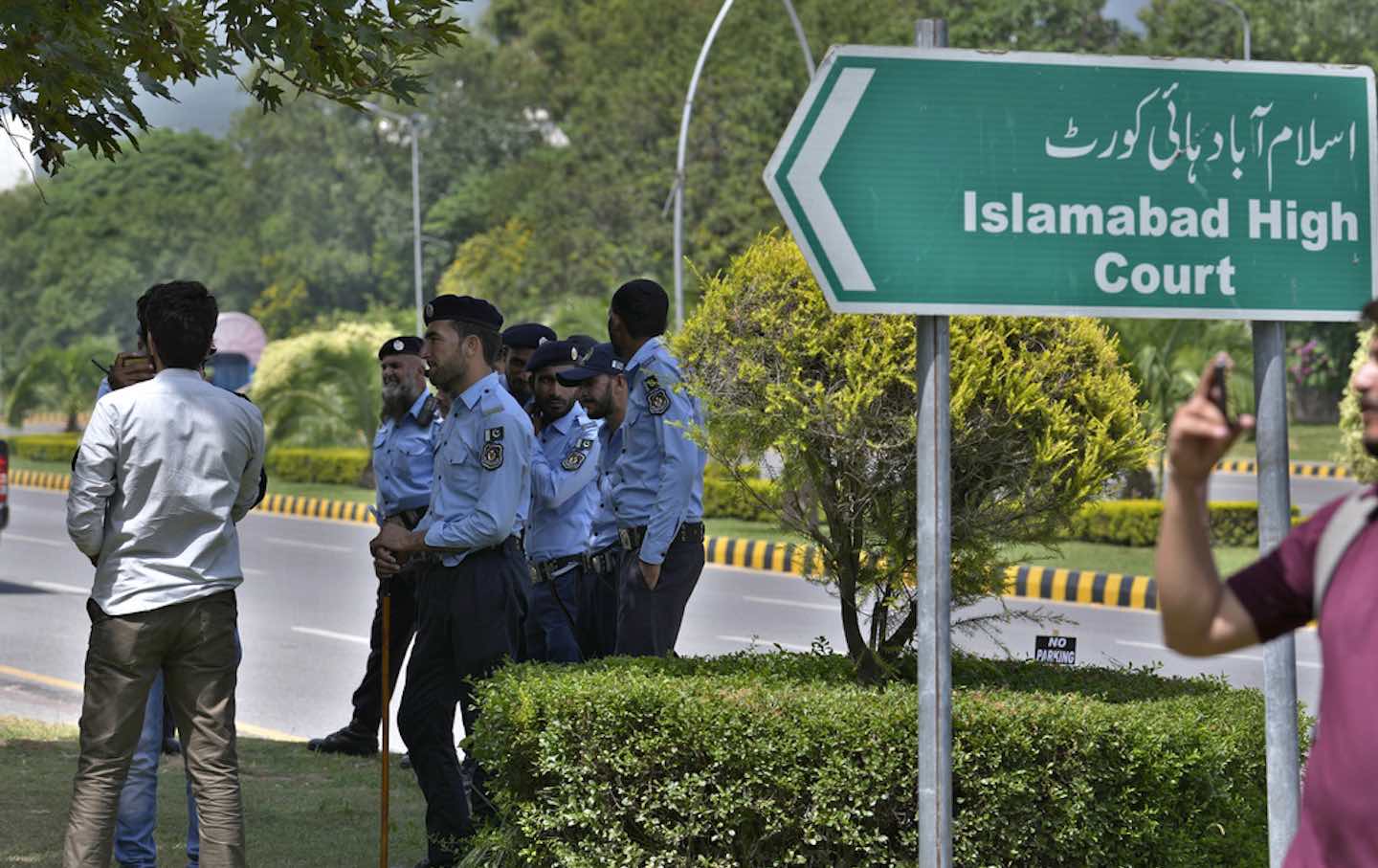
Months after Pakistan’s controversial general election, in which results were allegedly manipulated at the behest of the Pakistan Army to deny supporters of jailed former prime minister Imran Khan a majority in parliament, the country has become engulfed in yet another crisis. Last month, six judges of the Islamabad High Court (IHC) wrote an explosive letter to the Supreme Judicial Council in which they alleged that the country’s military-controlled intelligence agencies, including the notorious Inter-Services Intelligence (ISI), were coercing senior judges to influence their verdicts. “We believe it is imperative to inquire into and determine whether there exists a continuing policy on part of the executive branch of the state, implemented by intelligence operatives…to intimidate judges, under threat of coercion or blackmail, to engineer judicial outcomes in politically consequential matters,” the letter said.
At the center of the storm is the now infamous Tyrian White case, which seeks to disqualify Khan from holding public office on the grounds that he concealed the existence of White, a daughter he allegedly fathered out of wedlock, in his election documents. The justices claim that when members of the bench hearing the case questioned whether it met the standards necessary for adjudication, “Considerable pressure was brought to bear on the judges…by operatives of the ISI through friends and relatives of these judges.”
The letter also alleged that surveillance equipment had been found in the private lodgings of one of the justices and that a relative of another was abducted and tortured. In the days following the publication of the letter, a number of senior judges including the entire strength of the Islamabad High Court received threatening letters laced with a toxic powder. Forensic analysis of the substance showed that it contained a nonlethal concentration of arsenic.
The allegations, coupled with the threatening missives, have ensured that the spotlight remains fixed on Pakistan’s powerful military establishment, which many in the country blame for altering the result of the February 8 general election to ensure that candidates affiliated with Imran Khan’s political party, the Pakistan Tehreek-e-Insaaf (PTI), would not be in a position to form the new government.
The Pakistan Army, which has directly ruled Pakistan for half of the country’s history and spent the other half controlling its politics from the shadows, has historically relied on the courts to rubber-stamp its interference in the political domain. In the past, this has meant legitimizing military takeovers, toppling the governments of politicians that the military had fallen out with, and in the most egregious case, convicting former prime minister Zulfiqar Ali Bhutto of murder and sentencing him to death in 1979. Imran Khan, who fell out with the military in 2021, had previously enjoyed its support for more than a decade.
The Supreme Court of Pakistan, which has taken up the issue of the judges’ letter, resumed hearing the case on Tuesday more than a week after Khan wrote a letter from jail to Chief Justice Qazi Faez Isa in which he argued that inaction from the apex court would plunge the country into the abyss. “As, what I believe to be the majority of our populace, faces the wrath of the State,” Khan wrote, “now is the time for you to prove whether your declared belief in the principles and values espoused by Pakistan’s founding fathers, and your proclamation of the supremacy of the Constitution, are for real or were mere hollow rhetoric.”
Experts have noted, however, that the military and its associated intelligence agencies were also meddling in the judicial process when Khan was prime minister, as well as in support of his candidacy in the run-up to the 2018 election. In October 2018, during Khan’s tenure, Islamabad High Court judge Shaukat Aziz Siddiqui was dismissed for a speech in which he claimed that the judiciary was being controlled by “those with guns” and that intelligence officials had approached the Islamabad High Court to ensure that former prime minister Nawaz Sharif and his daughter Maryam would remain imprisoned during the 2018 poll. The Supreme Court set aside Justice Siddiqui’s dismissal last month.
But with the electorate having demonstrated its support for Imran Khan, the military now requires a compliant judiciary to ensure that the former cricketer turned politician remains behind bars. Last month, a Pakistani court suspended Khan’s 14-year sentence for illegally selling state gifts, though the former prime minister remains in jail on other charges. His release, which would almost certainly be accompanied by a campaign of public agitation, would be disastrous not just for the top brass of the army but also for the incumbent civilian administration led by Prime Minister Shehbaz Sharif.
The country of 241 million has been racked by instability ever since Khan’s government was toppled in a vote of no confidence in April 2022. Khan, who blamed the high command of the Pakistan Army for colluding with the State Department to remove him from office, has successfully positioned himself as the voice for democratic change. Now he is banking on the judiciary to create a path for his return to power.