Finding and Losing Flaco, the Owl That Got Free
There may never be another Flaco, but there will be other birds in the city to love. May we take better care of them.
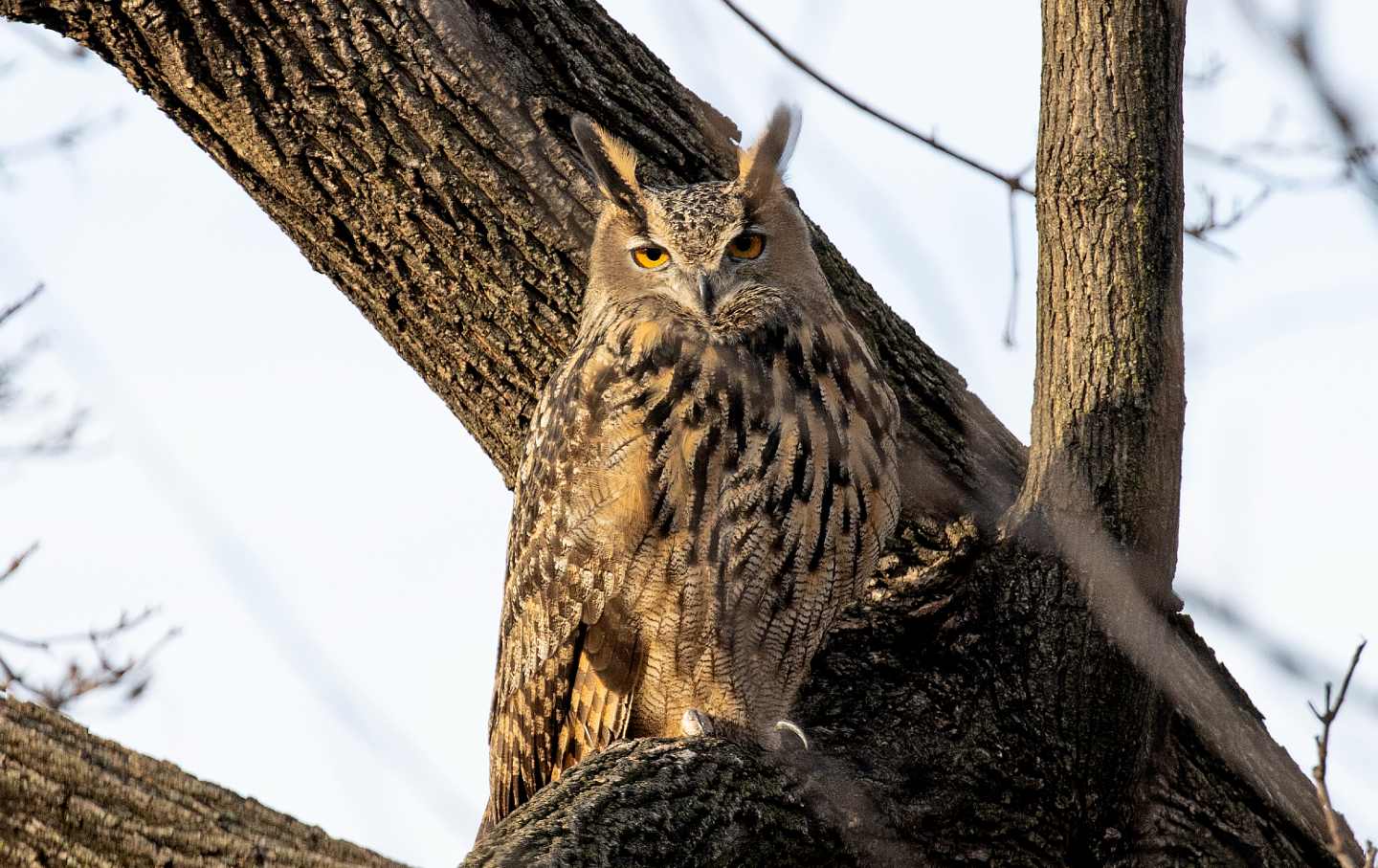
Flaco, a Eurasian eagle-owl that escaped from the Central Park Zoo, on February 15, 2023.
(Andrew Lichtenstein / Corbis via Getty Images)In February of last year, a Eurasian eagle-owl named Flaco escaped from a (ridiculously small) enclosure in Central Park. The owl, it seems, walked out through a hole in the fence. He wasn’t good at flying then. He made his way to the sidewalk outside Bergdorf Goodman on Fifth Avenue, where New York police protected him. He flew away, though not far.
Flaco’s captors were waiting to take him back. By captors, I mean employees of the Central Park Zoo, who had cared for Flaco since he was a baby owl.
I rooted against them. I wanted Flaco free.
Multiple smart essays were written about why Flaco would live longer in his cage. They did not resonate with me—or anybody else cheered by his freedom. Nor, apparently, with Flaco, who just kept flying. And flying farther.
On the night of February 23, Flaco flew into a window of a building on the Upper West Side. The Wild Bird Fund, a beloved neighborhood institution, tried to save him and could not. Windows are windows, folks. They are notorious bird killers.
I still remember the first day my sister and I stumbled upon Flaco. It wasn’t that hard. You just walked north along the Central Park Loch—when you saw a bunch of people with cameras, you were there. I figured out that if we crossed to the other side of the Loch, we’d have Flaco to ourselves and see him more clearly. I’ve never felt so useful as when I helped people who wandered by to spot him. After my sister showed him to me, I couldn’t not see him. The people I showed him to were thrilled.
Seeing Flaco, at least back then, produced an instant hit of dopamine. It energized you and chased away your blues.
I took a lot of other people to find him, including my daughter and son-in-law. It could be hard. In one of his most elusive periods, we had nearly lost hope of ever seeing him again. So I turned to Flaco Twitter—a community of Twitter users that posted Flaco sightings regularly—and, with their help, found him. At East Drive and 104th.
That’s the last place I saw him.
In fact, that’s where Flaco’s memorial will be Saturday. And that’s where you’ll find me.
It’s hard to write about Flaco because I know we anthropomorphized him. The zoo and its supporters are still saying they could have kept him alive for another 20 years if someone hadn’t let him out.
Popular
“swipe left below to view more authors”Swipe →I don’t know that person’s intent. I can’t say for certain that it was out of an impulse to free him, to see him live for 20 more years on the outside. But I have no reason to believe it was negative. We got what we got: a year of Flaco in the wild, among the chasms and channels of the Upper West Side’s urban landscape. And, in the end, our windows.
As he alighted on everything from apartment building rooftops to water towers to fire escapes, I just kept wanting him to return to Central Park. I considered it safer for him—probably because I feel safe there. Projection! It’s not the worst human trait.
Since the pandemic, an astonishing number of people have become bird watchers and migration experts, haunting the park with fancy binoculars and expensive cameras. Though I don’t blame the person whose window Flaco flew into, it’s clear that we need to make bird-safe glass an essential part of New York architecture. May we all become advocates for tailoring our buildings and our windows to these birds that give us so much joy.
There may never be another Flaco, but there will be other amazing birds we love. May we take better care of them.