
The Missing News About Gaza
To understand Palestine and Israel, we need more coverage of the everyday structural violence of occupation.
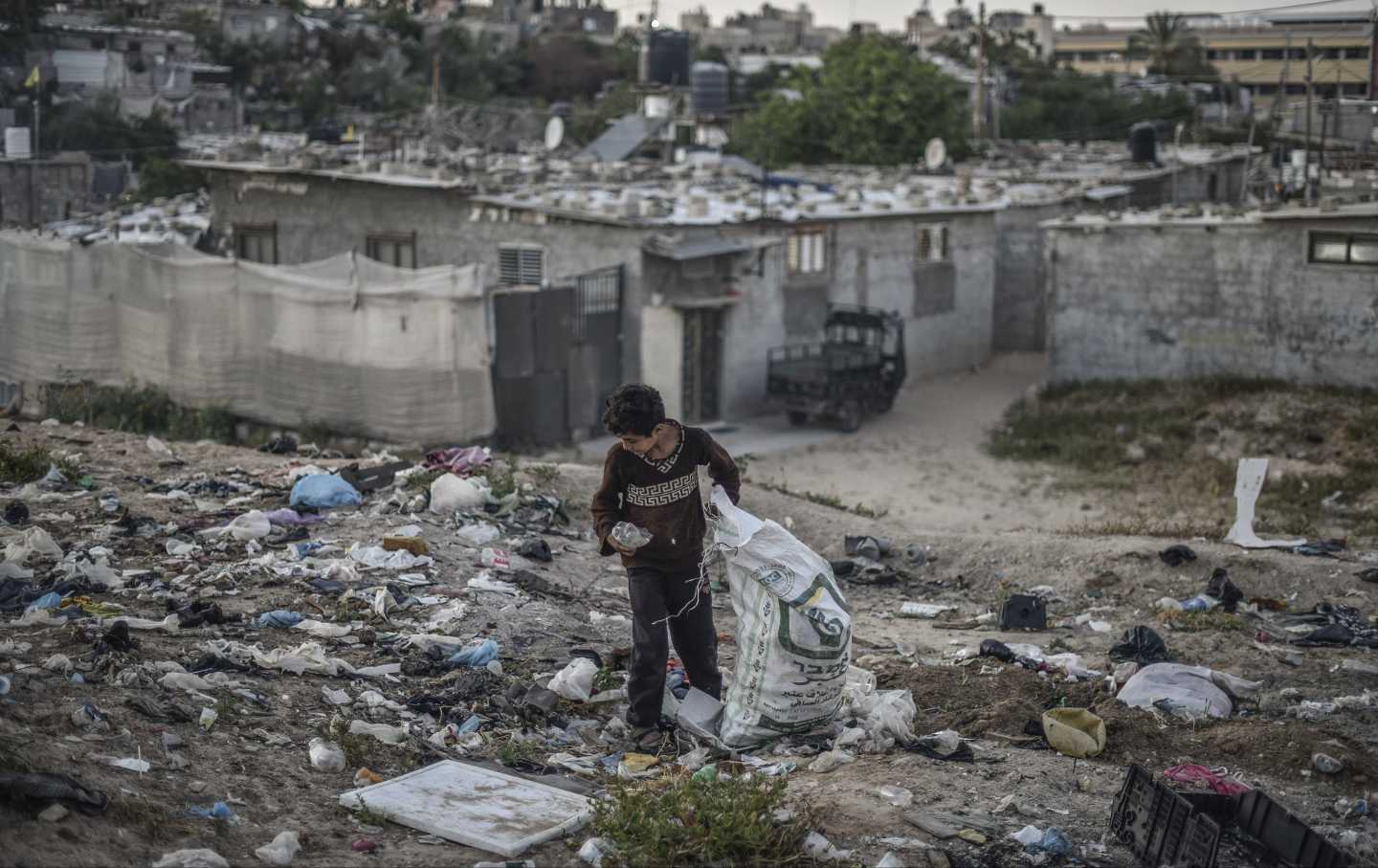
The violence unfolding across Palestine and Israel over the past four months has been accompanied by a near-real-time deluge of information. Some of this information has been false, and fact-checkers have had their hands full. But beyond the issue of disinformation (trafficking falsehoods),
I worry as a media researcher and a longtime scholar of the Palestinian struggle that decontextualization (selectively presenting truths) is the more ubiquitous and elusive threat to our collective understanding.
Disinformation involves lying by commission. Decontextualization, on the other hand, is about lying by omission. While much has been made of the differential coverage of Palestinian versus Israeli suffering over the past several months, by far the greater asymmetry is to be found when comparing coverage of the weeks of kinetic violence after October 7 with that of the decades of structural violence before. The reason for this asymmetry runs far deeper than political agendas.
News networks cover bombings, shootings, and other forms of kinetic violence because they are loud, finite events that seize our attention. By contrast, the everyday structural violence of Israel’s occupation and apartheid is comparatively uneventful. Instead of loss, it inflicts absence. Instead of killing, it simply aborts. Its first casualties are dreams and destinies. Even its victims cannot offer a full accounting, because how can you miss that of which you were always deprived? Yet the two are inextricably linked. Decades of structural violence give rise to weeks and months of kinetic violence. To cover the latter while neglecting the former is, in a word, to decontextualize: to show audiences the symptoms while depriving them of the underlying causes.
All of the narratives spun by the Israeli government to justify its murderous bombardment of the Gaza Strip draw centrally on the facts of October 7. And while there have been some embellishments that have rightly drawn scrutiny, those core facts are not in dispute, and they are awful enough in their own right as to offer prima facie credibility to Israel’s war narratives.
The deficiency is not so much to be found in the information they present, but rather in the information that is left absent. Using Media Cloud, a database that has tracked news worldwide for around a decade, I found all the news articles published by American, Canadian, or British news outlets during 2023 that mentioned either “Gaza” or the “West Bank,” and generated this chart:
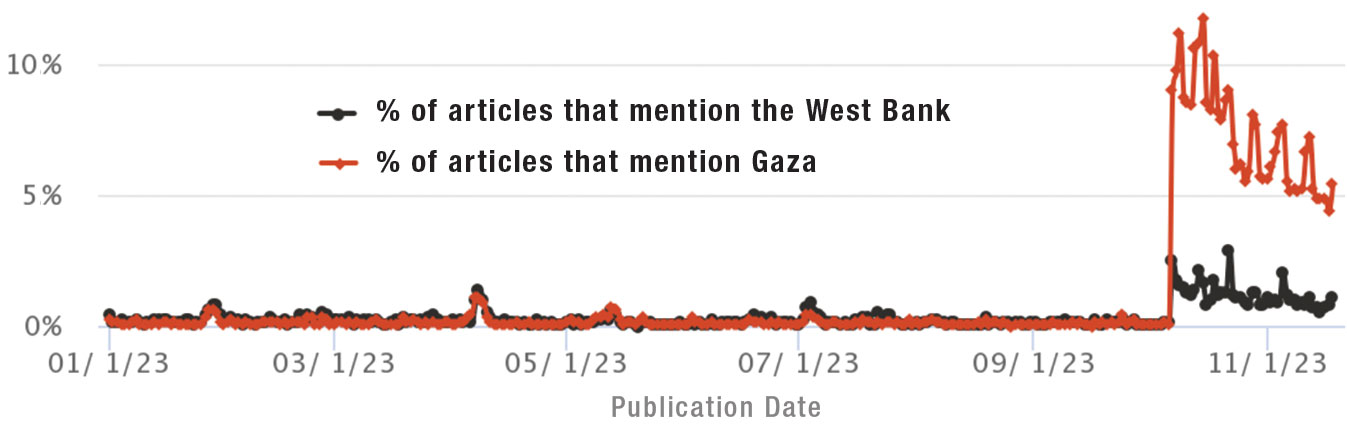
The coverage of both Gaza and the West Bank after October 7 dwarfs everything published in the comparatively stable nine months preceding it. The coverage of Gaza after October 7, meanwhile, consistently exceeds that of the West Bank, where kinetic violence was also happening but at orders of magnitude below its sister territory.
I say “kinetic violence” for the sake of distinguishing it from its complementary concept of structural violence. Whereas bombings or shootings are examples of kinetic violence, structural violence is exemplified by walls, barbed-wire fences, or systems of discriminatory laws. When a bomb goes off, it is a discrete event that can be reported or remarked upon. Structures of violence, by contrast, are continuous features that rend reality in two.
To get a glimpse of what it means for Palestinians to be the victims of structural violence, we can turn to the great Palestinian writer Ghassan Kanafani, who once wrote that “our lives are as a straight line that marches in shame and silence beside the line of our destiny; but the two lie parallel, and shall never meet.” In Kanafani’s telling, the life that Palestinians were meant to live haunts their every footstep. It runs parallel to their actual life, and in full view of their imagination, a daily reminder and humiliation next to which they trudge in silence and shame. As the Palestinian national poet Mahmoud Darwish alternatively phrased it, to live in the shadow of a wall, or on the wrong side of a fence, or on the receiving end of a discriminatory system, is to live “in the presence of absence,” to be haunted by the ghost of one’s potential self—the person you would have become were it not for this wall, this fence, this law, this structure.
This is the agony of the structural violence with which Palestinians were living throughout 2023, and for the long years and decades before that. Blockades and military occupations lead to declines in GDP or employment, which seem boring and statistical and simply lack the visceral horror of a suicide bomb or an airstrike. But behind those percentages are real people whose dreams have been crushed and who may succumb to depression, substance abuse, and death many years before their natural time. But all of that is deemed so indirect, obscured, and probabilistic that it just does not resonate with audiences as strongly.
The asymmetry with which kinetic violence is covered relative to structural violence has implications for how international audiences perceive Palestine-Israel and other civil conflicts. Eventually, after many years of daily indignities and frustration, a breaking point is reached and a rebellion forms. The rebels are much weaker than the state, however, and cannot wield structural violence. Instead, their primary tool is kinetic violence. And because kinetic violence is newsworthy, the first time many outside observers really pay attention to the conflict is when they see masked rebel gunmen killing and terrorizing people. Indeed, if you analyze the coverage of rocket fire and airstrikes over the Gaza Strip in the late 2000s and early 2010s, you will find over and over again that it is usually Palestinian militants who appear to have broken the “calm.” And yet, if you look closer, you will find that nearly every rocket attack was preceded by Israeli provocations—bulldozed orchards and structures, restrictions on freedom of movement, and so on—that blended into the day-to-day humdrum of structural violence.
The kinetic violence of October 7 cannot be understood without the structural violence of October 6 and all the days before. If you recklessly burn fossil fuels for decades, you risk hurricanes and wildfires. And if you indefinitely postpone the political process of relieving structural violence, you risk outbreaks of kinetic violence. For all of these reasons, decontextualization is an enormous challenge to our understanding. To undo it will require more than fact-checking. We will need compassion and patience, and to reflect upon our own biases and blind spots. We will need all of these instruments to see absence.
Become a Sustaining Donor This September
Between the reemergence of right-wing red-baiting and Donald Trump’s use of the chilling National Security Presidential Memorandum–7 to criminalize left political organizing, we’re seeing McCarthyism reborn before our eyes.
This assault on democracy cannot be ignored or wished away. Resisting it requires bravery in the face of threats and repression, a steadfast commitment to the truth, and the unwavering belief that we can—and will—overcome this darkness.
We must have an independent media that sets the record straight, unearths corruption and abuses of power, and advances a politics of justice and dignity for all if we’re to win this fight.
That’s why I’m writing to you today. This September, The Nation needs to add 100 monthly donors to sustain our progressive journalism. Your contribution makes the next investigative report, the next truth-speaking column, and the next pathbreaking essay all possible.
I hope you’ll support our work with a recurring donation today. If you donate $10 or more a month, we’ll send you a brand new “Hands Off the Free Press!” sticker to recognise your commitment to our cause. Please, donate today.
Onward,
Katrina vanden Heuvel
Editor and Publisher, The Nation
More from The Nation
Israel’s Election Can’t Fix What Netanyahu Broke Israel’s Election Can’t Fix What Netanyahu Broke
The fundamental problem is not the name of the prime minister, but rather the actions of the Israeli government and the urgent issues that need to be addressed.
The AfD’s Rise Isn’t Just About East Germany The AfD’s Rise Isn’t Just About East Germany
The Alternative für Deutschland has a stable national poll lead, including in the former West Germany. Its rise owes to much more than Eastern grievances.
Chinese Development Is the Betrayal Washington Cannot Forgive Chinese Development Is the Betrayal Washington Cannot Forgive
The prospects for Xi Jinping’s visit are dim because American leaders are blaming China for the failures of globalization.

Pinochet: The Verdict of History in the Letelier-Moffitt Case Pinochet: The Verdict of History in the Letelier-Moffitt Case
An act of international terrorism on the streets of Washington, DC, still reverberates 50 years later.
How to Arrest Benjamin Netanyahu How to Arrest Benjamin Netanyahu
Make no mistake: The United States can seize Netanyahu for crimes under US law and prosecute him in US courts when he is in New York City this week.
In the Age of AI, Nuclear Weapons Abolition Is a Renewed Imperative In the Age of AI, Nuclear Weapons Abolition Is a Renewed Imperative
As long as we have nuclear weapons, the job of ending humanity will continue to be as easy as the push of a button—or an AI agent hacking into a nuclear command-and-control system...

