Arab Citizens Are Livid Over Gaza. The US Ignores Them at Its Peril.
Ordinary people across the Middle East are being crystal clear about the depth of their opposition to the White House’s Israel policy—and that of their own governments.
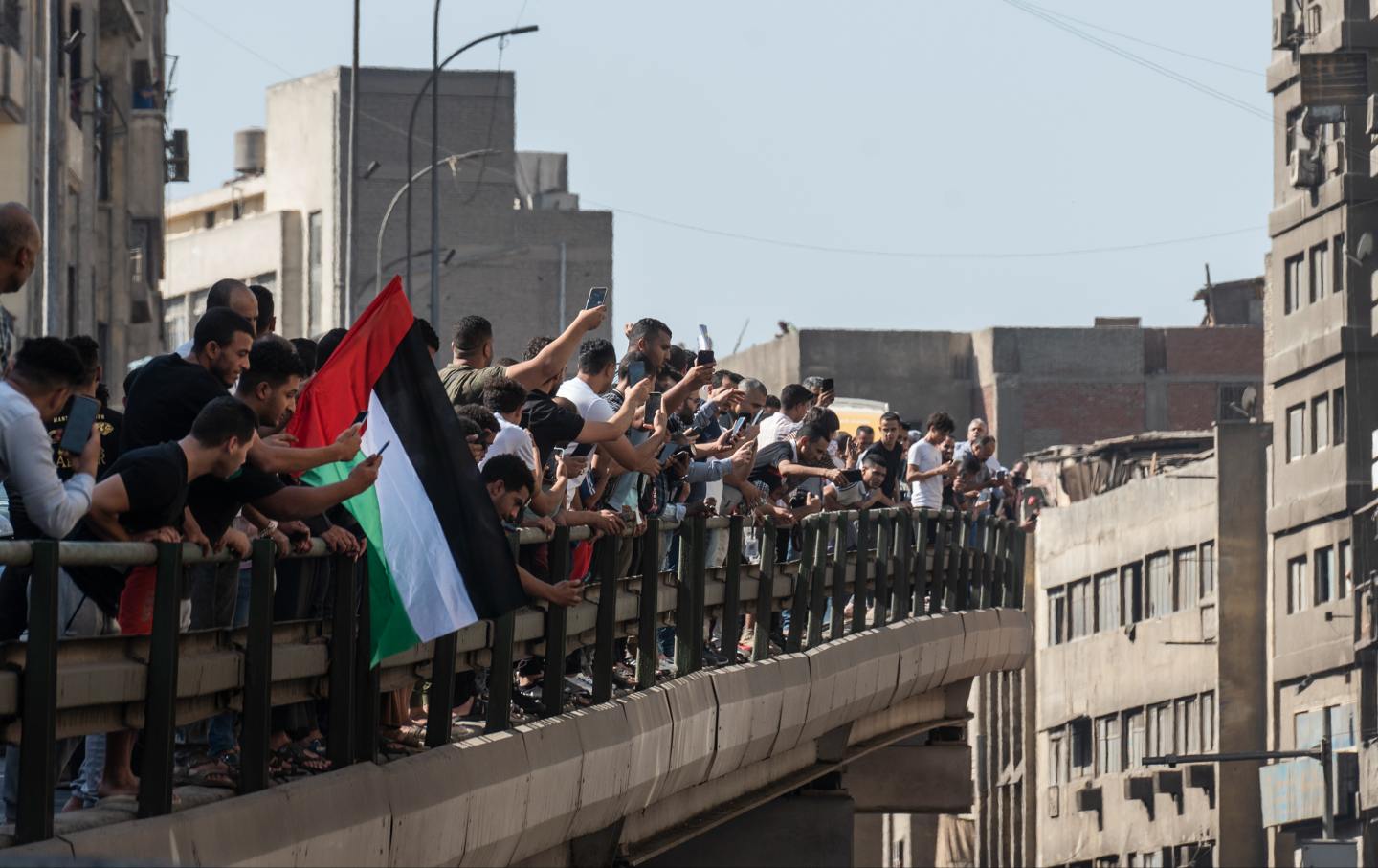
Pro-Palestinian demonstrators in Cairo on October 20, 2023.
(Mohamed Hossam / Getty Images)Nearly four months have passed since Hamas attacked Israel and Israel launched its bombardment of the Gaza Strip. The scale of the tragedy in Gaza is impossible to comprehend: over 26,000 killed, 70 percent of homes destroyed, 90 percent of the people of Gaza displaced. Famine in Gaza has begun, with a projected half a million people facing “catastrophic” conditions. Despite images of tortured Palestinians, the demolition of universities, and American citizens shot down in the occupied territories, the Biden administration continues to merely express “concern” while maintaining its material support of the current status quo.
On top of that, discussions about the “day after” the war continue unabated, seeming increasingly disconnected from reality. While the Israeli government insists that it will not allow any other military to operate in the Gaza Strip and that no Palestinian state will ever come to fruition, Biden administration officials continue to talk about a two-state solution and a possibly “revamped” Palestinian Authority overseeing Gaza. Alarmingly, and despite the events of the past few months, the Biden administration is also still pursuing of a Saudi-Israeli normalization deal, promising that Palestinians would get “a practical pathway” to a state with such an arrangement.
As I have written previously, Arab-Israeli normalization has little to do with the resolution of the Israeli-Palestinian conflict. In fact, evidence suggests such normalization worsens conditions for Palestinians in the occupied territories and Arab citizens in normalizing countries alike.
The notion that Arab-Israeli normalization facilitates Israeli-Palestinian peace seems instead a fig leaf, covering up the fact that successive Israeli governments—especially under Prime Minister Netanyahu—have never considered the possibility of a Palestinian state to begin with. Such deals are nothing more than an illiberal peace, designed to perpetuate a violent status quo.
The fact that the Biden team continues to throw its weight behind Arab-Israeli normalization nevertheless indicates that this administration has not absorbed any lessons from the past decade of US foreign policy, or the past 100 days of war. It also shows that they continue to presume that such a decisive policy can be imposed on the Arab world.
This is a dangerous assumption to make, and it has played very poorly with Arab citizens across the Middle East. Recent polling from the Arab Opinion Index—which included 8,000 respondents from 16 countries throughout the region—shows that anger over Israel’s war on Gaza, and the American response, is at an all-time high.
When respondents were asked why Israel continues its war on Gaza, the top reason given was continued US military support. Ninety-four percent of respondents evaluated the US response to Israel’s war as bad or very bad, and 81 percent said Washington is not serious about establishing a Palestinian state. In comparison, 37 percent and 42 percent of respondents evaluated the Iranian and Russian responses negatively, respectively.
Importantly, the second top reason given by respondents for why the war continues unabated is the inaction of Arab governments. When asked what measures Arab governments should take to stop the war, suspending relations or attempts at normalization with Israel was the most prevalent answer.
This is not surprising to anyone who follows the politics of the Arab world. The Palestinian cause has long been a source of mobilization and a gateway to dissent across the region. Historically, images from Palestine have facilitated political engagement and cycles of protest. Indeed, for many activists, the fact that their governments pursue normalization despite Palestinian suffering is connected to the way those same governments suppress citizens at home. Activists consider both foreign and domestic policy as manifestations of undemocratic, repressive rule. This connection is further strengthened when Arab governments utilize their ties with Israel to expand their states’ ability to oppress their citizens. Thus, the extreme levels of disapproval that these polls reveal are, to any honest observer, predictable.
Furthermore, rage at the ongoing war, Arab governments, and American involvement has manifested in protests across the region. Demonstrations have occurred in countries that have recently signed normalization deals with Israel, such as Bahrain, as well as countries with highly repressive leaders such as Egypt. Despite heavy government suppression, Egyptian protesters broke through police barricades and entered Tahrir Square—the site of the January 25 revolution that ousted former President Hosni Mubarak—for the first time since the coup that brought the current regime to power, over 10 years ago. Palestine is once again facilitating the political engagement of a new generation, and activists are decisively breaking the fear barrier. Protesters in Cairo recently went so far as to chant: “As long as Arab blood is cheap, down with any president!”
While it is true that protests over the war have not led to large changes in policy, and they are certainly far from the scope of the protests seen during the Arab Spring uprisings, what this polling reflects is the very real possibility of mass upheaval. This latest polling shows not only high levels of disapproval for both American and Arab policy but also a high level of reported personal and psychological stress as a result of the war. Alongside growing domestic grievances over economic stagnation, corruption, and repression, this becomes fertile ground for even more mass unrest.
Research has shown that anger is an emboldening emotion, helping to overcome fear. All it takes to activate these emotions and turn them into mass mobilization is a moral shock—“a visceral reaction against a reprehensible reality”—alongside the idea that protests might be meaningful.
The American government has paid scant attention to the anger of ordinary Arab citizens since October 7. Instead, it has largely focused on the role and impact of militia groups such as Hezbollah and the Houthis, and their Iranian backers. Undoubtedly, those actors have already significantly disrupted American interests and will continue to pose a threat as they win the narrative war in the region.
But the White House has failed to recognize that unrest could easily stem from the grassroots as well. The United States is already deeply implicated in what has transpired in Gaza. If the only path forward, from the American perspective, involves pushing a deeply unpopular policy of normalization on the Arab people, more rage and unrest is practically guaranteed. It goes without saying that this would not be helpful for long-term American interests, as the events of the last 100 days should have made clear. But, even more worryingly, such a course of action will mean dimming the possibility of sustainable peace in the region for many years to come.
Time is running out to have your gift matched
In this time of unrelenting, often unprecedented cruelty and lawlessness, I’m grateful for Nation readers like you.
So many of you have taken to the streets, organized in your neighborhood and with your union, and showed up at the ballot box to vote for progressive candidates. You’re proving that it is possible—to paraphrase the legendary Patti Smith—to redeem the work of the fools running our government.
And as we head into 2026, I promise that The Nation will fight like never before for justice, humanity, and dignity in these United States.
At a time when most news organizations are either cutting budgets or cozying up to Trump by bringing in right-wing propagandists, The Nation’s writers, editors, copy editors, fact-checkers, and illustrators confront head-on the administration’s deadly abuses of power, blatant corruption, and deconstruction of both government and civil society.
We couldn’t do this crucial work without you.
Through the end of the year, a generous donor is matching all donations to The Nation’s independent journalism up to $75,000. But the end of the year is now only days away.
Time is running out to have your gift doubled. Don’t wait—donate now to ensure that our newsroom has the full $150,000 to start the new year.
Another world really is possible. Together, we can and will win it!
Love and Solidarity,
John Nichols
Executive Editor, The Nation
More from The Nation
Brace Yourselves for Trump’s New Monroe Doctrine Brace Yourselves for Trump’s New Monroe Doctrine
Trump's latest exploits in Latin America are just the latest expression of a bloody ideological project to entrench US power and protect the profits of Western multinationals.
Chile at the Crossroads Chile at the Crossroads
A dramatic shift to the extreme right threatens the future—and past—for human rights and accountability.
The New Europeans, Trump-Style The New Europeans, Trump-Style
Donald Trump is sowing division in the European Union, even as he calls on it to spend more on defense.

The United States’ Hidden History of Regime Change—Revisited The United States’ Hidden History of Regime Change—Revisited
The truculent trio—Trump, Hegseth, and Rubio—do Venezuela.
Mahmood Mamdani’s Uganda Mahmood Mamdani’s Uganda
In his new book Slow Poison, the accomplished anthropologist revisits the Idi Amin and Yoweri Museveni years.

The US Is Looking More Like Putin’s Russia Every Day The US Is Looking More Like Putin’s Russia Every Day
We may already be on a superhighway to the sort of class- and race-stratified autocracy that it took Russia so many years to become after the Soviet Union collapsed.

