
How Should We Support School Shooting Survivors?
Rather than attempting to get back to normal, experts say more attention needs to be paid to students exposed to gun violence.
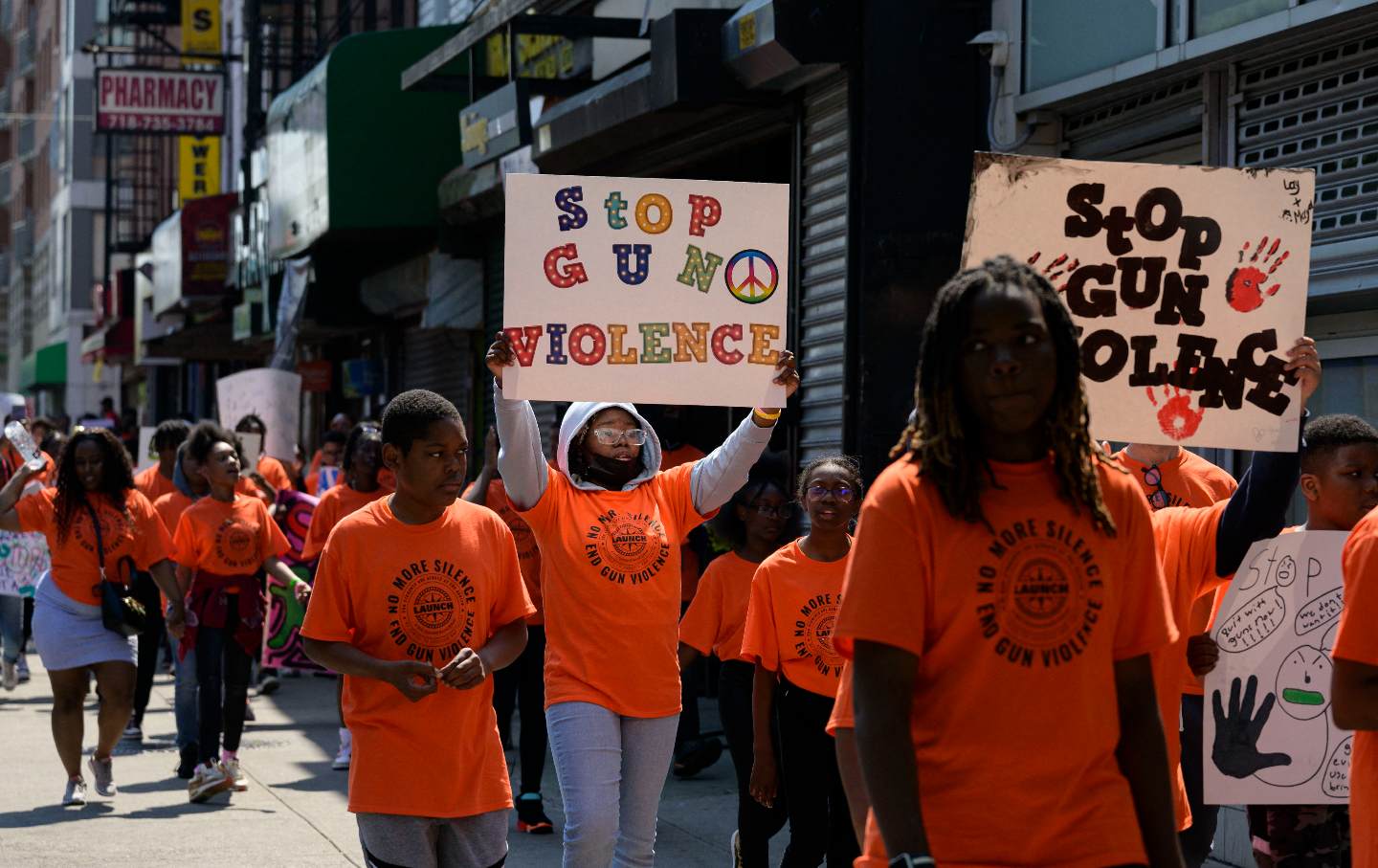
Students participate in a walkout on National Gun Violence Awareness Day in New York.
(Angela Weiss / Getty)For this series, five young journalists responded to our calls for articles detailing critical issues that impacted young people this year. The group of high school and young college writers pitched and reported on urgent topics like lack of access to mental health support for homeschooled students, student voices being silenced in schools, book bans, attacks on LGBTQ+ students, and school shootings. Of course, these are just a fraction of the issues that shape the lives, conditions, and experiences of young people—not to mention how these issues intersect with each other. We received more important pitches than we could publish this round. As we close out the year, this package centers the work of young journalists reporting on what affected their schools, communities, and peers in 2023.
—Rainesford Stauffer
There have been more than 300 school shootings so far in 2023—an increase from last year, which itself saw a record high. Students are now expected to be prepared for the possibility of a shooting at any moment, often scanning for exits in each room they enter.
Karly Scholz worked in gun violence activism for six years before she experienced a school shooting at the University of Virginia in November, 2022. “It was still just a shock to me,” says Scholz, currently in her third year at UVA and a member of Project Unloaded’s Youth Council. “No amount of work, no amount of talking to victims, no amount of anything, really, I think, could prepare me and prepare anyone else for what had happened.” Zoe Touray, a survivor of the Oxford High School Shooting in Michigan in November 2021, explained that the full gravity of what happened did not hit her immediately. In the aftermath, she said “it felt like it was one of the most important things to try to get back to normal.” Touray eventually realized that “after a shooting, things aren’t necessarily gonna go back to normal, if there ever even was a normal.” That realization typically marks the long process of grappling with the effects, both short- and long-term, of witnessing gun violence. Since then, Touray has become an activist, working with March for Our Lives and starting her own organization, SEE, Survivors Embracing Each Other.
It’s unsurprising that school shootings are shown to negatively affect students’ mental health and long-term educational and economic outcomes. “Exposure to gun violence during childhood is an adverse childhood experience,” says Dr. Sonali Rajan, an associate professor of Health Education at Teachers College at Columbia University. “It completely disrupts their sense of safety and stability.”
Rajan’s work focuses on how to prevent and respond to school violence. Rather than attempting to get back to normal as quickly as possible, some experts say more time and attention needs to be paid to students exposed to gun violence. “What our results show is that we might need to be paying attention for longer and devoting additional resources and support to these kids,” says Dr. Maya Rossin-Slater, an associate professor in the Department of Health Policy at Stanford University.
Dr. Rossin-Slater said that, to her knowledge, there are no coordinated programs in the US providing that sort of support after a shooting. As a result, the burden of providing resources often falls to the school districts, leading to inequity as “poor school districts, understaffed school districts are just gonna have fewer resources to be able to offer to their students.” According to Dr. Rajan, implementing the comprehensive infrastructure necessary to reach the nearly 51 million children that public schools serve—in around 90,000 public schools—will require substantial investment from the federal government.
And there’s still no clear playbook for how individual schools should respond. After the shooting in November 2022, UVA allowed students to leave early for Thanksgiving break and implemented a special policy allowing students to choose whether to have their classes marked as credit/no credit rather than graded. But T.J. White, a fourth-year student at the University of North Carolina (UNC) and the president of the UNC Young Democrats, said that he is unaware of any accommodations the administration has put into place since the shooting at UNC in August 2023.
The difference in reactions illustrates the lack of clear guidance of how best to respond after a shooting. Gun violence, of course, does not impact communities equally, as it “disproportionately and overwhelmingly hurts communities of color,” according to the Center for American Progress.
Touray experienced gun violence in both high school and college, a phenomenon that appears to be more common. She goes to North Carolina A&T, a historically black university, where a shooting occurred during an “altercation” on campus in August 2023.
“A lot of the students that are here at my HBCU weren’t as nervous as I was,” Touray says of the shooting. “People were kind of telling me that I was overreacting after hearing gunshots and running and that I shouldn’t be crying,” she said. “It’s become normal, which is a sad truth.”
“We experienced something that none of us should ever have experienced,” says White of the shooting at UNC.
Many have funneled this frustration into activism. Students at UNC, according to White, have since focused on pushing the North Carolina General Assembly for gun control measures and pushing UNC itself to divest from the firearms industry. For Touray, meeting other survivors through her activism helped start her healing process, as she saw that others “understand what [she was] going through completely.”
While many gun control measures have not yet been passed, Scholz, White, and Touray all said that they are still hopeful that change will come. “There’s so many amazing things that young people have done so far,” says Touray. “I am very hopeful for the future, because I’ve seen it being done already.”
More from The Nation
An Effective Movement for Palestine Needs Allies Like Zohran Mamdani An Effective Movement for Palestine Needs Allies Like Zohran Mamdani
In order to build a broad-based coalition, we need to work together—not practice purity politics.
The First Amendment Applies to Concert Stages Too The First Amendment Applies to Concert Stages Too
Protests like that of Macklemore on Palestine should never be silenced by billionaire owners.
France’s Students Won’t Back Down France’s Students Won’t Back Down
Without full-time teachers, temperature-regulated classrooms, or school nurses, French students are turning their grievances into a national movement.
Inside Cornell’s Week of Protest Inside Cornell’s Week of Protest
“We won’t be silenced anymore. Our university needs to start protecting us, like they should’ve with Jane Doe and all other survivors on campus.”
Netanyahu Came to New York. New Yorkers Were Ready for Him. Netanyahu Came to New York. New Yorkers Were Ready for Him.
Scenes from the defiant protest against the genocidal leader’s UN speech.
A Message From Prairieland Prisoner Autumn Hill: “Don’t Be Afraid” A Message From Prairieland Prisoner Autumn Hill: “Don’t Be Afraid”
I talked to the political prisoner about the politics of love, her case, surviving as a trans woman in a men’s prison, and how she makes it through the day.

