
Why Fewer International Students Are Coming to the US
More and more students from around the world are opting against studying in the United States.
Mir Sultan dreamed of studying in the United States. As a student in India, he was ecstatic when he had the chance to attend the University of Richmond in Virginia. But five years later, the dream came to an abrupt end when he was forced to leave the country. “After my visa expired, I didn’t get the opportunity to stay in the States,” said Sultan. “I ended up having to go back to India.”
International students in the US have few opportunities to remain in the country after graduation. Most are allowed one year to work in their field—STEM majors are allowed three—then, it becomes increasingly difficult to stay.
Work visas are incredibly difficult to come by, and many have to apply for the H1B lottery, with only an 18 percent chance of being selected. The lottery happens once a year, and all noncitizens interested in working in the United States enter. International students are not offered any other pathway to a visa; they must enter the lottery competing with every person attempting to get a work visa in the US.
So when Sultan started considering graduate schools, he decided to study in Canada. “I could have gotten accepted to grad school in the United States, but because of that experience I had navigating the immigration process for international students in the US, it kind of left a sour taste in my mouth,” said Sultan. “I realized if I ended up going to grad school in Canada, there’s a much easier pathway to immigration.”
More students from around the world have opted against studying in the United States, according to Cecilia Esterline, an immigration research analyst at the Niskanen Center. The popularity of the US among international students has been steadily declining since 2018, and the number of international students today remains well below pre-pandemic levels.
“For us to prepare the workforce for the needs of our innovation and interests of the future, the United States needs to continue to recruit international students,” said Esterline.
In the United Kingdom, once a student’s graduate visa has expired, they can apply for a skilled worker visa, allowing them to remain in the country. “There are lots of other countries that are creating competitive programs and are interested in attracting this same kind of talent that would usually be coming to our universities,” said Esterline. “As other countries continue to offer more attractive programs, we’re going to continue to be at risk of losing these international students because we don’t have an immigration system that is set up to retain them afterwards.”
Along with the lack of opportunities for international students to remain in the US following graduation, the cost of US schools and the lack of an inclusive environment are also cited as factors in the decline. According to data from the National Center for Education Statistics, tuition for college in the US increased 69 percent between 2000 and 2021.
“America’s colleges and universities have the highest tuition in the world,” said Arturo Castellanos Canales, policy and advocacy manager at the National Immigration Forum. “Many American students work while in their college to pay for their tuition. However, international students are only eligible for on-campus employment for 20 hours per week, which severely limits their ability to cover the cost of their studies.”
The National Immigration Forum has advocated increasing the number of international students allowed to stay in the country after graduating. “The scarcity of immigration options and the complicated bureaucracy required for international students to stay in the U.S., have pushed some future CEOs, inventors, and researchers to study in countries with more welcoming migration laws, such as the United Kingdom, Canada, and Australia,” wrote Canales for a Senate Judiciary Committee hearing on “Strengthening our Workforce and Economy through Higher Education and Immigration” in June 2022.
“Congress should enact immigration reforms to expand the legal avenues for international students to come and stay in the United States and for Dreamers to have permanent status in the United States,” Canales continued. “These reforms can help solidify the U.S.’s status as the world’s leading recipient of international students while also addressing persisting labor shortages, filling job openings in key sectors dependent on immigrant labor, and strengthening the U.S. economy.” Canales also suggests expanding the employment and residency alternatives for international students after graduation, expanding the extracurricular employment alternatives for international students during their studies, eliminating the interpretation of immigrant intent when considering student visa applications, maintaining inclusive and welcoming policies for Chinese students, and learning good practices from other countries to make the United States a more attractive destination for international students.
In 2022, international students contributed almost $37 billion to the economy, according to Canales. “It is an economic imperative to reform the American immigration system to attract and retain international students.”
Republican lawmakers are making it increasingly difficult to take steps toward accomplishing these solutions. In the Senate and the House, there is real support for a bill proposing to end the program allowing international students to work on an F-1 visa after graduation for even three years—essentially halting the OPT program.
Meanwhile, President Biden has attempted to address the declining popularity of the United States among international students by increasing the OPT for STEM students. He added 22 more fields of study to be included in the STEM category, allowing more students to participate in the three-year OPT following graduation.
While this helps, according to Canales, it is still not nearly enough. The National Immigration Forum is advocating for ideas like the “Let Immigrants Kickstart Employment Act” proposed by Representative Zoe Lofgren, which would establish a new class of nonimmigrant visas for international entrepreneurs.
“I just wish there was a better path to immigration,” Sultan said. “There should be clear paths for students to be able to stay there, build a life there and advance in their careers.”
More from The Nation

Jalen Hurts Deserved Better. We All Do. Jalen Hurts Deserved Better. We All Do.
In a country that treats workers as expendable parts, Hurts’s playing through a blood clot is just the highest-profile example of the price workers pay in an oligarchy.
The Terrifying Future of States’ Criminalizing Pregnant People Is Already Here The Terrifying Future of States’ Criminalizing Pregnant People Is Already Here
The idea of charging people who have abortions with murder is gaining traction on the right. But a report finds that people are already being prosecuted for their pregnancy outcom...
The Supreme Court Is Coming for Affirmative Action—Again The Supreme Court Is Coming for Affirmative Action—Again
The high court has just accepted a case that takes aim at efforts to increase diversity at high-performing public schools.

My Family’s Dark, Hidden History With Institutionalization My Family’s Dark, Hidden History With Institutionalization
My great-great-grandfather was the namesake of an infamous institution for the disabled. From long-neglected records of the property, the lives of forgotten people were uncovered....
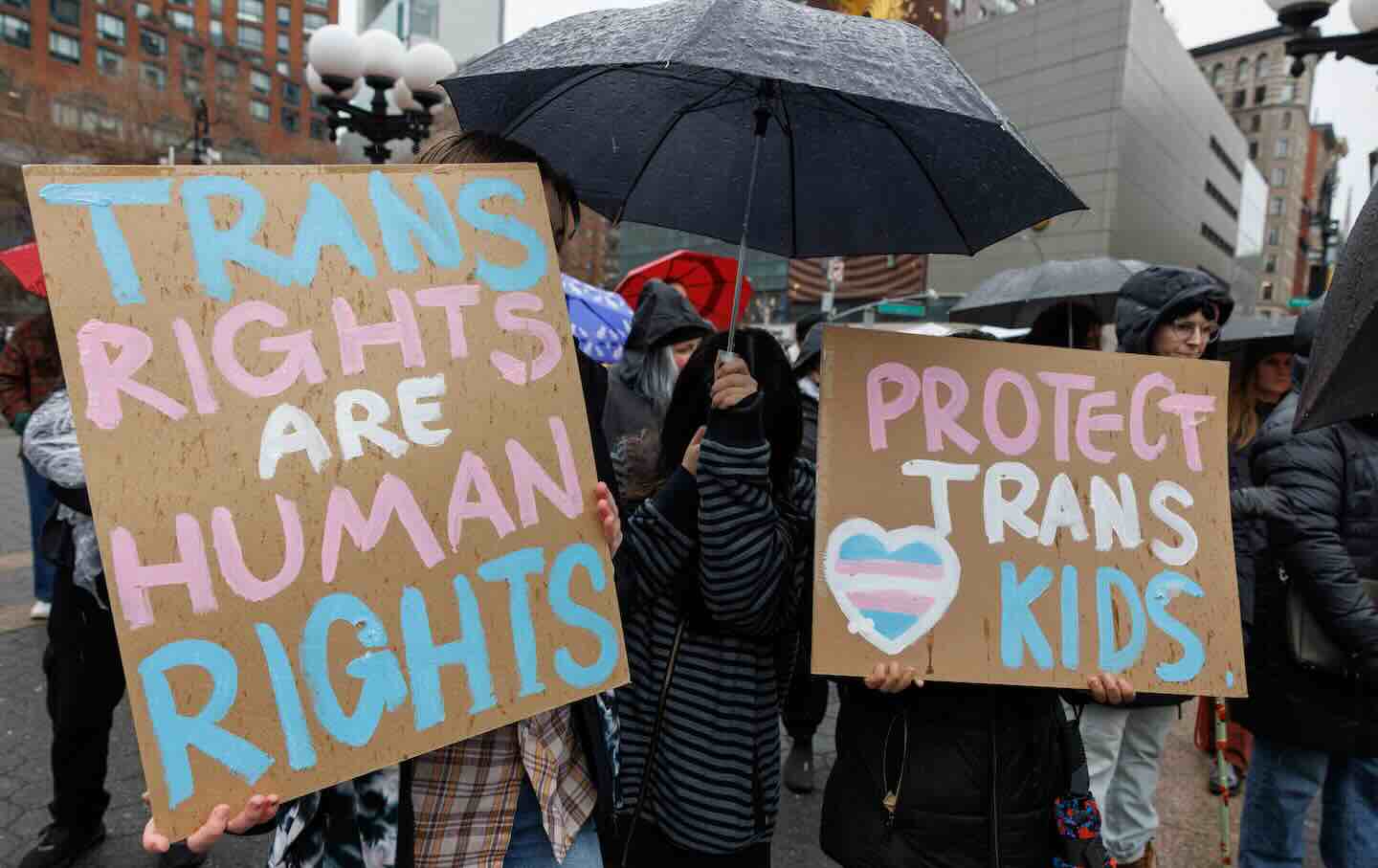
Smoke and Mirrors: The Right's Latest Attacks Against Trans People Smoke and Mirrors: The Right's Latest Attacks Against Trans People
The MAGA movement is redoubling its attacks on trans healthcare in an attempt to win votes this November.

Is Blockbuster Video the Answer to Our Digital Privacy Woes? Is Blockbuster Video the Answer to Our Digital Privacy Woes?
The Supreme Court is weighing whether a 1988 video-store law can be used to protect our digital privacy.

