It’s Time to Confront Israel’s Version of “From the River to the Sea”
Far from being a mere slogan, the phrase captures both the longtime ambitions of the Israeli right and the reality Israel has imposed on Palestine since 1967.
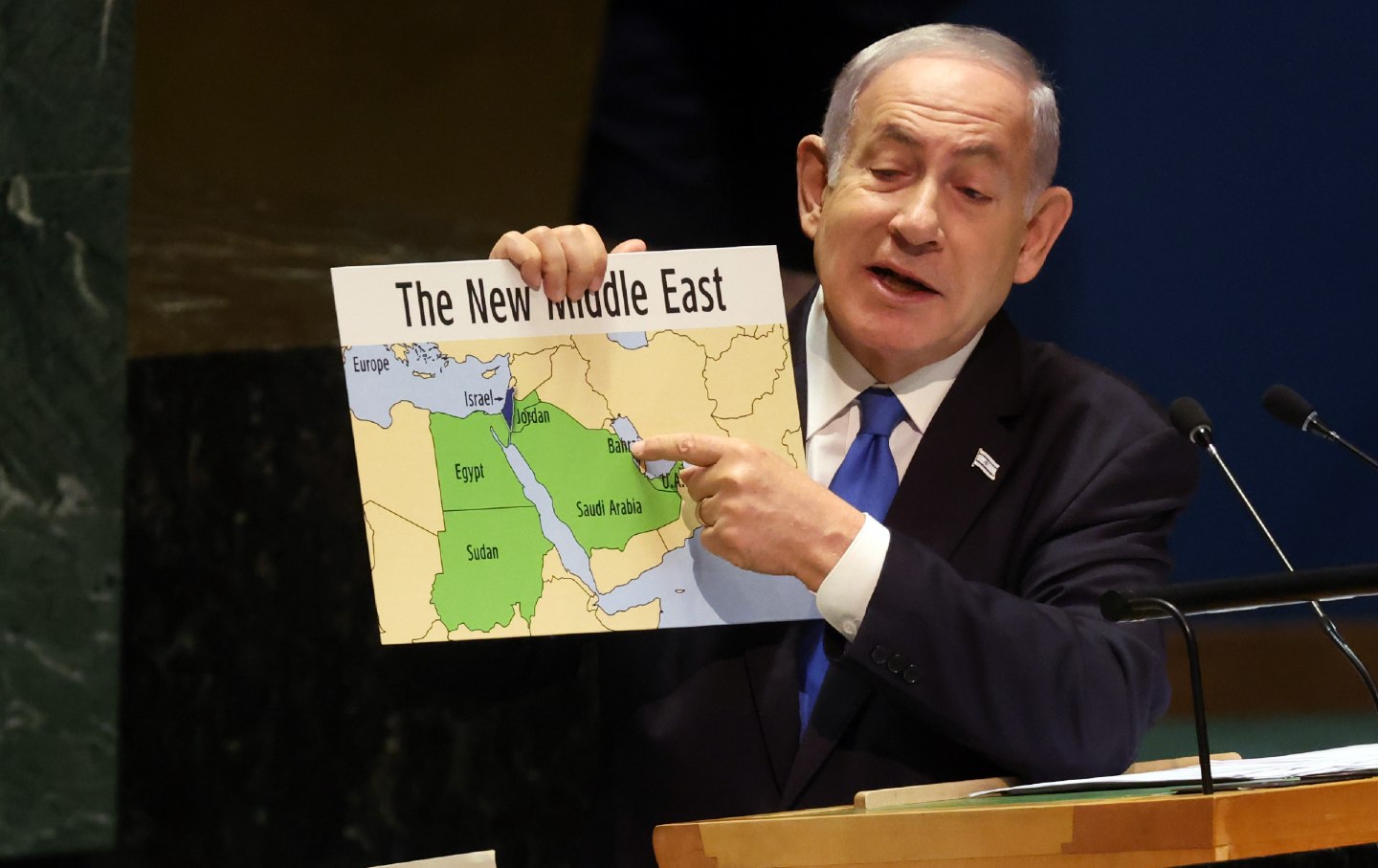
During a speech before the United Nations General Assembly on September 22, 2023, Prime Minister Benjamin Netanyahu holds up a map that shows Israel stretching “from the river to the sea.”
(Spencer Platt / Getty Images)The right of the Jewish people to the land of Israel is eternal and indisputable… therefore, Judea and Samaria will not be handed to any foreign administration; between the Sea and the Jordan there will only be Israeli sovereignty. —Likud Party Platform, 1977
The slogan “from the river to the sea” apparently has great power, so great that it led the US House of Representatives to censure one of its members who invoked it, and Columbia University to shut down two student organizations whose members repeated it, Jewish Voice for Peace and Students for Justice in Palestine. Other universities have since followed suit.
While these august bodies engaged in deliberations about the grave breaches that mouthing these words entailed, over 100 children per day were dying in Gaza under a rain of tens of thousands of Israeli bombs, rockets, missiles, and artillery shells, many manufactured by American companies in which Columbia University has invested and paid for by US taxpayers.
Meanwhile, Israeli ministers were talking about inflicting “Nakba 2023” on Gaza (an echo of Israel’s 1948 ethnic cleansing of 750,000 Palestinians); over 1.7 million Gazans had been forced from their homes; over 14,000 had been killed (nearly 6000 of them children) and 30,000 wounded; most hospitals had been put out of service; and half the structures in the Gaza Strip had been destroyed or damaged. Beyond these numbers—and for many, they were just numbers, for how can you illustrate the names, faces, and personal stories of thousands of dead men, women, and children, especially when their tormentors have turned off the electricity and, at times, Internet and phone communications, and prevented Western journalists from being present to witness their ordeal?—lay some brutal facts.
From the first day of this war, Defense Minister Yoav Gallant, who said Israel was fighting “human animals,” ordered the cutting off not only of electricity but also supplies of water, medicine, food and fuel, in breach of Article 23 of the Fourth Geneva Convention of 1949, which requires “the free passage of all consignments of medical and hospital stores and…all consignments of essential foodstuffs.” While President Biden has called for the delivery of humanitarian assistance to Gaza, the United States has so far done little to make it happen, beyond persuading Israel to allow entry of a tiny trickle of relief supplies (excluding fuel), as if the US has no power to do anything more.
Cutting off these commodities, as well as water, electricity, and fuel, constitutes a war crime, no less than does the killing of noncombatants, whether Israeli or Palestinian, or the mass expulsion of 1.7 million people from one part of the Gaza Strip to another. But the Biden administration and its Western allies not only refuse to call for a halt to the bombing and ethnic cleansing. They cannot even bring themselves to demand, on pain of sanctions, that Israel turn on the electricity and water taps, or that Israel allow the delivery of the hundreds of trucks of medicine, food, and fuel a day that are needed to supply the needs of 2.3 million people, most of them children. The commander in chief is unwilling to order the huge American fleet stationed nearby in the Mediterranean to deliver the requisite supplies to Gaza and evacuate the multitude of wounded, which could easily be done, irrespective of the wishes of the besiegers.
Against the callousness of those in power who refuse to impose a halt to Israel’s rain of fire on the Gaza Strip, stand a few courageous members of Congress, campus demonstrators, and behind them huge numbers of citizens enraged at their country’s participation in the slaughter and collective punishment of the civilian population of Gaza. Instead of applauding their courage in demanding accountability for mass murder and ethnic cleansing, a shameless Congress and a spineless university administration hold them to account for use of a phrase demanding freedom in the entirety of their homeland for a people which, since 1917, has suffered under foreign rule and has never been allowed self-determination. Somehow, in the “land of the free” a call for Palestinian freedom becomes an odious and hateful demand.
The crowning irony regarding claims about the hatefulness of such a phrase—one university administrator described it as “genocidal”—is that this idea is far more than a simple slogan where Israel is concerned. Rather, it captures the reality Israel has imposed on Palestine since 1967. Israel controls all the land between the Mediterranean and the Jordan River, an area that for all intents and purposes constitutes a single state under a single security regime and a single sovereignty.
The drive to establish the “Greater Land of Israel” is the central ideological goal of the Likud Party, which has dominated Israeli politics since 1977. The commitment to Greater Israel was enshrined in the “Basic Laws” of the Israeli state in 2018 when the Knesset passed the “Nation State of the Jewish People” law. This law states that the right to national self-determination in Palestine “is unique to the Jewish People” and that “the State views the development of Jewish settlement as a national value, and shall act to encourage and promote its establishment and strengthening.” This commitment is one of the “guiding principles” of the current Israeli government, which stated that “the Jewish people have an exclusive and inalienable right to all parts of the Land of Israel,” including “Judea and Samaria.”
Thus, on one side, we have students and a politician representing the demands of tens of millions of citizens who call for freedom for the Palestinians. On the other, we have the power of the American state supporting the core policies of Israel’s government that over the past few decades has acted ceaselessly to ensure that “between the Sea and the Jordan there will only be Israeli sovereignty.” Rather than focusing on real war crimes designed to uphold Israel’s exclusive sovereignty over the entirety of historic Palestine from the river to the sea, the priorities of Congress and the paragons of the Ivy League lie elsewhere, as is evidenced by their disgraceful, laser-like focus on completely spurious thought crimes.
Become a Sustaining Donor This September
Between the reemergence of right-wing red-baiting and Donald Trump’s use of the chilling National Security Presidential Memorandum–7 to criminalize left political organizing, we’re seeing McCarthyism reborn before our eyes.
This assault on democracy cannot be ignored or wished away. Resisting it requires bravery in the face of threats and repression, a steadfast commitment to the truth, and the unwavering belief that we can—and will—overcome this darkness.
We must have an independent media that sets the record straight, unearths corruption and abuses of power, and advances a politics of justice and dignity for all if we’re to win this fight.
That’s why I’m writing to you today. This September, The Nation needs to add 100 monthly donors to sustain our progressive journalism. Your contribution makes the next investigative report, the next truth-speaking column, and the next pathbreaking essay all possible.
I hope you’ll support our work with a recurring donation today. If you donate $10 or more a month, we’ll send you a brand new “Hands Off the Free Press!” sticker to recognise your commitment to our cause. Please, donate today.
Onward,
Katrina vanden Heuvel
Editor and Publisher, The Nation