Student Loan Payments Have Resumed, but the Fight for Cancellation Isn’t Over
With Biden’s plan blocked by SCOTUS, borrowers find themselves closer to reaching $2 trillion of student debt. Now more than ever, we need to end this crisis.
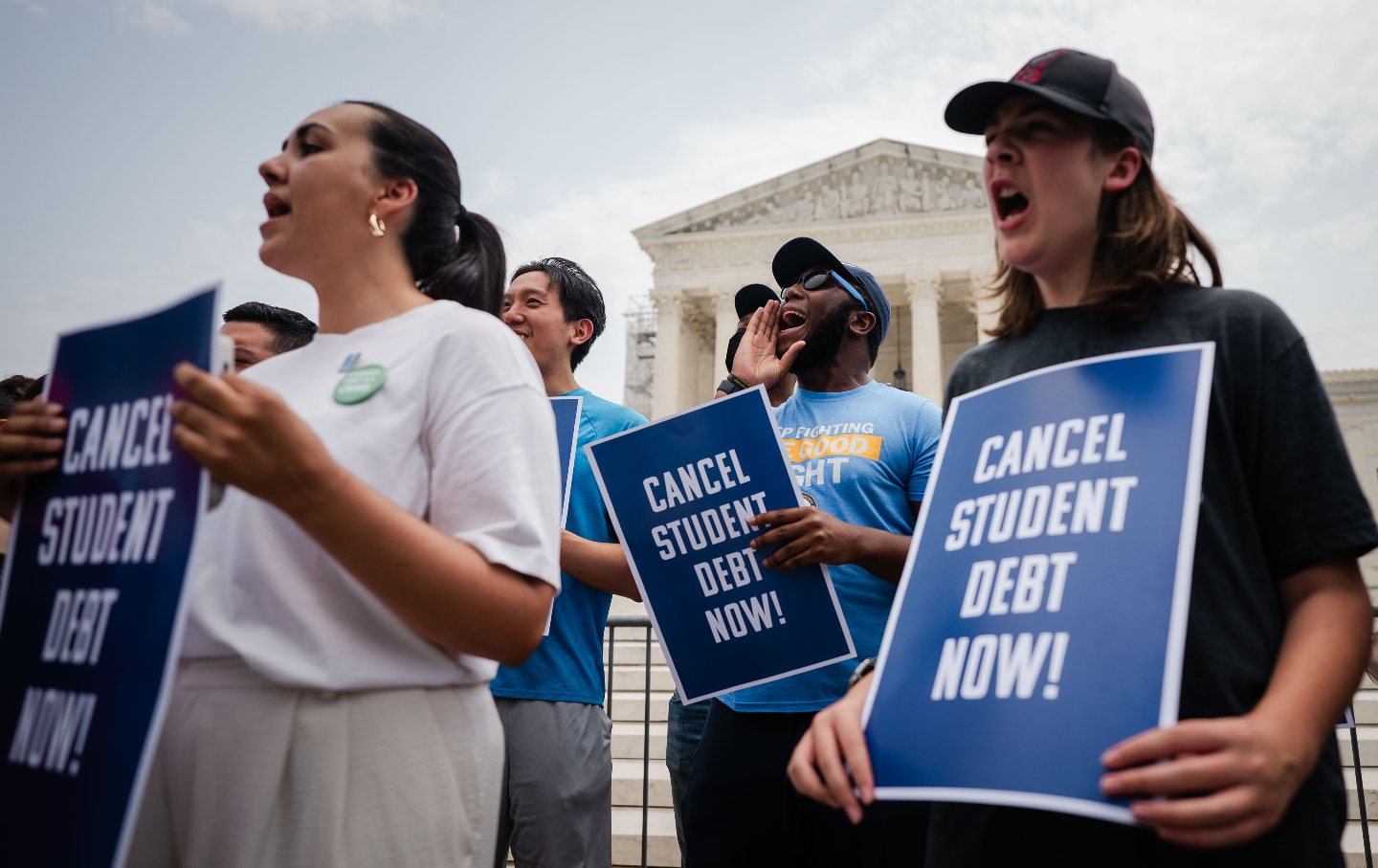
Student loan cancellation advocates rally outside of the Supreme Court Building in June 2023.
(Kent Nishimura / Getty)Earlier this summer, when the Supreme Court struck down President Biden’s plan to cancel student debt, millions of Americans’ hopes were dashed. Close to 20 million borrowers would have received full cancellation while others would have seen a significant reduction in their balances.
Instead, after three years of paused payments during the Covid-19 pandemic, student loan borrowers began receiving their bills this month. With another expense being added to their plate, many borrowers are concerned that student loans—coupled with the rising cost of living and inflation—will compromise their chances at a decent life. “It took me eight years from graduating to get a job that allowed me to feel financially stable,” said Joseph Cruz, a borrower from Oregon, “and 10 months into that job, I am no longer feeling as stable.”
With borrowers owing over $1.7 trillion in debt, these stories are far too common. “After starting graduate school this semester, I am running low on savings. The price of gas and inflation are also tightening my budget, plus I just learned that I will have to move in December, which will be a lot of money in terms of applications and deposits,” said Miranda Lopez, a student loan borrower in Arizona. “Payments will be taking money that I would have been putting into savings.”
In the past few months, we’ve seen a serious uptick of e-mails, phone calls, and folks reaching out with questions about their loans, as borrowers nationwide feel increasingly confused and overwhelmed. But our fight for student debt cancellation is not over. This month, the Biden administration canceled an additional $9 billion in student loans for 125,000 borrowers and announced a Plan B to keep widespread student debt cancellation possible, the process—known as negotiated rulemaking, which will take place later this month—is lengthy and uncertain, but still keeps hope alive.
More recently, the Department of Education announced new programs to support borrowers as payments resume. Debtors who cannot make a monthly payment—or don’t want to—can take advantage of the new “On-Ramp to Repayment” program that provides borrowers with a 12-month grace period, preventing them from default.
The new Saving on a Valuable Education plan—which can help lower borrowers’ monthly payments—will take effect in two phases, but borrowers can begin applying now. By next July, they’ll start seeing additional benefits, such as payments being cut in half for borrowers with undergraduate loans, and total debt cancellation for borrowers who have original balances of $12,000 and have been in repayment for 10 years. All federal student loans— except for Parent PLUS—are eligible for the SAVE Plan. In the meantime, the Student Debt Crisis Center will continue fighting for all loan types to be considered eligible for relief.
Each day, borrowers in the US find themselves closer to reaching $2 trillion of student debt. Now more than ever, we need more programs, more support, more empathy, and more understanding of the broad economic benefits that would result from an end to the student debt crisis.
Disobey authoritarians, support The Nation
Over the past year you’ve read Nation writers like Elie Mystal, Kaveh Akbar, John Nichols, Joan Walsh, Bryce Covert, Dave Zirin, Jeet Heer, Michael T. Klare, Katha Pollitt, Amy Littlefield, Gregg Gonsalves, and Sasha Abramsky take on the Trump family’s corruption, set the record straight about Robert F. Kennedy Jr.’s catastrophic Make America Healthy Again movement, survey the fallout and human cost of the DOGE wrecking ball, anticipate the Supreme Court’s dangerous antidemocratic rulings, and amplify successful tactics of resistance on the streets and in Congress.
We publish these stories because when members of our communities are being abducted, household debt is climbing, and AI data centers are causing water and electricity shortages, we have a duty as journalists to do all we can to inform the public.
In 2026, our aim is to do more than ever before—but we need your support to make that happen.
Through December 31, a generous donor will match all donations up to $75,000. That means that your contribution will be doubled, dollar for dollar. If we hit the full match, we’ll be starting 2026 with $150,000 to invest in the stories that impact real people’s lives—the kinds of stories that billionaire-owned, corporate-backed outlets aren’t covering.
With your support, our team will publish major stories that the president and his allies won’t want you to read. We’ll cover the emerging military-tech industrial complex and matters of war, peace, and surveillance, as well as the affordability crisis, hunger, housing, healthcare, the environment, attacks on reproductive rights, and much more. At the same time, we’ll imagine alternatives to Trumpian rule and uplift efforts to create a better world, here and now.
While your gift has twice the impact, I’m asking you to support The Nation with a donation today. You’ll empower the journalists, editors, and fact-checkers best equipped to hold this authoritarian administration to account.
I hope you won’t miss this moment—donate to The Nation today.
Onward,
Katrina vanden Heuvel
Editor and publisher, The Nation