What It Takes to Win Trump’s Voters
The GOP may have a diverse crop of primary candidates this election, but they all know that to win they need to appeal to racially resentful white voters.
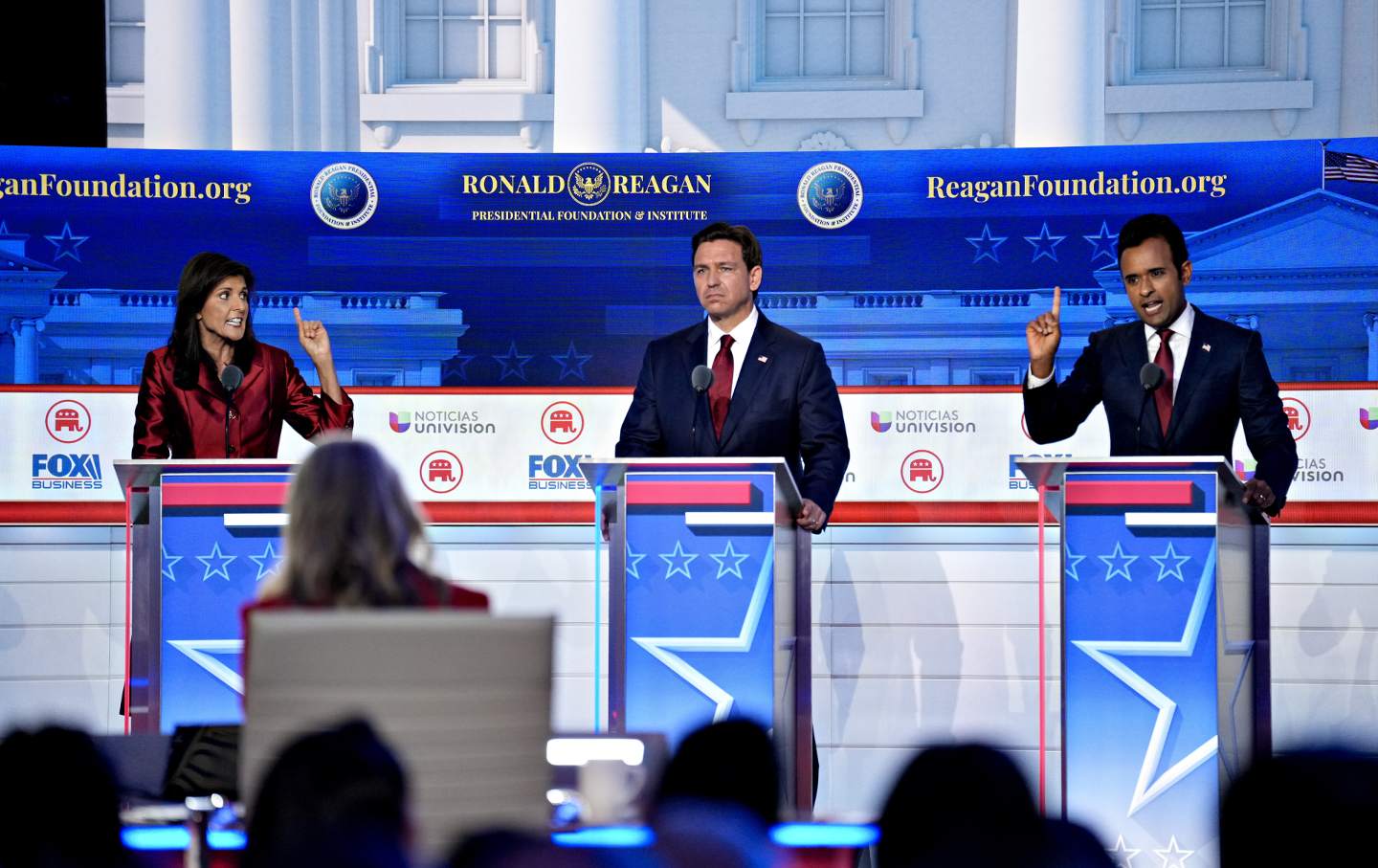
There are six non-white candidates vying for the Republican presidential nomination, making the 2024 primary field the GOP’s most diverse yet. In an alternate universe, the moment might be heralded as a historic step toward repairing America’s broken promise of multiracial democracy and equality. But in our Trumpian reality, where the Grand Old Party is best understood as a reactionary white grievance movement—eh, not so much. Non-white Republican candidates know that, to win, they need the support of Donald Trump’s 2020 voters. The same voters who, a July Yahoo News/YouGov poll found, are twice as likely to see racism against whites as a bigger problem than anti-Black racism. Eighty-four percent, a previous study showed, worry that “discrimination against whites” will increase in the coming years. The candidates have probably seen the research from Tufts University, recently cited in The Atlantic, showing that “the single best predictor of who voted for Trump was the belief that systemic racism no longer exists in the U.S.” And they’re surely aware of the report from researchers at the University of Chicago concluding that conservatives’ disbelief in structural inequalities, their feeling that “people get what they deserve,” means that they are invested in the idea of “individual effort as the solution for the challenges facing many racial and ethnic groups.” The outcome is obvious: Non-white Republican presidential candidates are using white supremacy and anti-Blackness as an electoral strategy.
Biotech entrepreneur Vivek Ramaswamy, who’s currently polling third in the field, has written that Black Americans are “the gold standard of constitutional victimhood”; has said that racism doesn’t crack the Top 50 list of America’s problems; and has called the Juneteenth holiday “useless” and “made-up,” despite the fact that Black folks have been celebrating the day marking slavery’s end since 1866. He has also called the destruction of affirmative action the “tip of the spear of [his] policy agenda,” suggesting that he believes the greatest threat to this country is Black students attending the colleges he has baselessly decided they don’t deserve to get into. Before the Supreme Court ruled that affirmative action was unconstitutional, Ramaswamy claimed that “anti-Black racism [was] on the rise” because of it. He reiterated that view on CNN one day after a racist gunman mowed down three Black folks in Jacksonville, Fla., in August, while also defending his comparison of Representative Ayanna Pressley with the “grand wizards of the modern KKK.”
Former United Nations ambassador Nikki Haley, polling just behind Ramaswamy, responded to the Jacksonville killings by briefly recalling the 2015 white supremacist massacre in her home state of South Carolina—though she skirted any mention of her decision to take down the Confederate flag, which, The Washington Post pointed out, Haley hasn’t drawn attention to since launching her campaign. She declared that “there’s no place for hate in America,” but she tempered that message by warning her audience not to “fall into the narrative that this is a racist country”—an echo of her campaign announcement video, in which she reassured voters that “nothing could be further from the truth” than the idea of pervasive American racism. Haley also seems more focused on attacking Vice President Kamala Harris—whom she has repeatedly referred to as “President Harris”—than President Biden. Perhaps she senses that it’s harder to stoke anger against an old white guy in the White House than a multiracial Black woman.
South Carolina’s Tim Scott, who is polling in the primary around 2 percent, must have seen that University of Chicago report (not least because, as the only US senator who is Black and also a Republican, he gets a mention in it) and its finding that “racially resentful [white] voters prefer to vote for a black candidate over a white competitor” when said Black candidate offers “a message that fits the racially resentful voter’s worldview.” (That “worldview,” as previous research noted in the study shows, includes an unwillingness to “recognize the unique historical plight of African Americans.”) The study’s authors write that those voters are highly receptive to politicking that negates the idea of institutional racism, “especially when those messages come from black candidates.”
Accordingly, on the campaign trail, Scott repeats the (possibly embellished) story of how his family, from his grandfather’s generation to his own, went from picking “cotton to Congress.” Though he has previously acknowledged being pulled over by cops, detained by Capitol Police, followed by store clerks, and targeted via voicemail with racist death threats, he has more recently maintained the GOP mantra that “America is not a racist country.” (Contrast that with the Scott who told Vice in 2017, “Racism is real. It is alive. It is here.”) These days, if he cites his personal experiences with racism at all, Scott is most likely to suggest that it flows from leftists and Black Democrats who question his allegiance to a racially regressive party.
Notably, an Associated Press survey of “dozens of Iowa Republicans interviewed over the past several months” found that the message of bootstrapping individualism “resonates more coming from Scott than from others.” One white supporter told the AP: “I don’t think I’m prejudiced, but I know a lot of people who are, and I don’t think the color of your skin should matter. Tim Scott says you can rise above the perception that you’re stuck, and you can make it, and I like that a lot.” A 77-year-old retired white woman said, “It definitely means more from him. He is saying, ‘This is me. I’m Black. But I succeeded because I worked hard, and those opportunities remain in America.’”
Even as the Republican candidates take the fairy tale of a post-racial America on the campaign trail with them, a Washington Post–Ipsos poll released in June found that just over half of Black Americans believe that racism will only get worse in their lifetimes. Almost 60 percent report being “very or somewhat worried they or someone they love will be attacked because they are Black.” It’s all just more proof that for 2024’s most ambitious non-white Republicans, Black folks aren’t their target demographic anyway.