
Will the GOP’s Hard Right Dismantle PEPFAR?
The AIDS relief program is helping to keep some 20 million people alive in Africa. Now a group of Republicans wants to sabotage it.
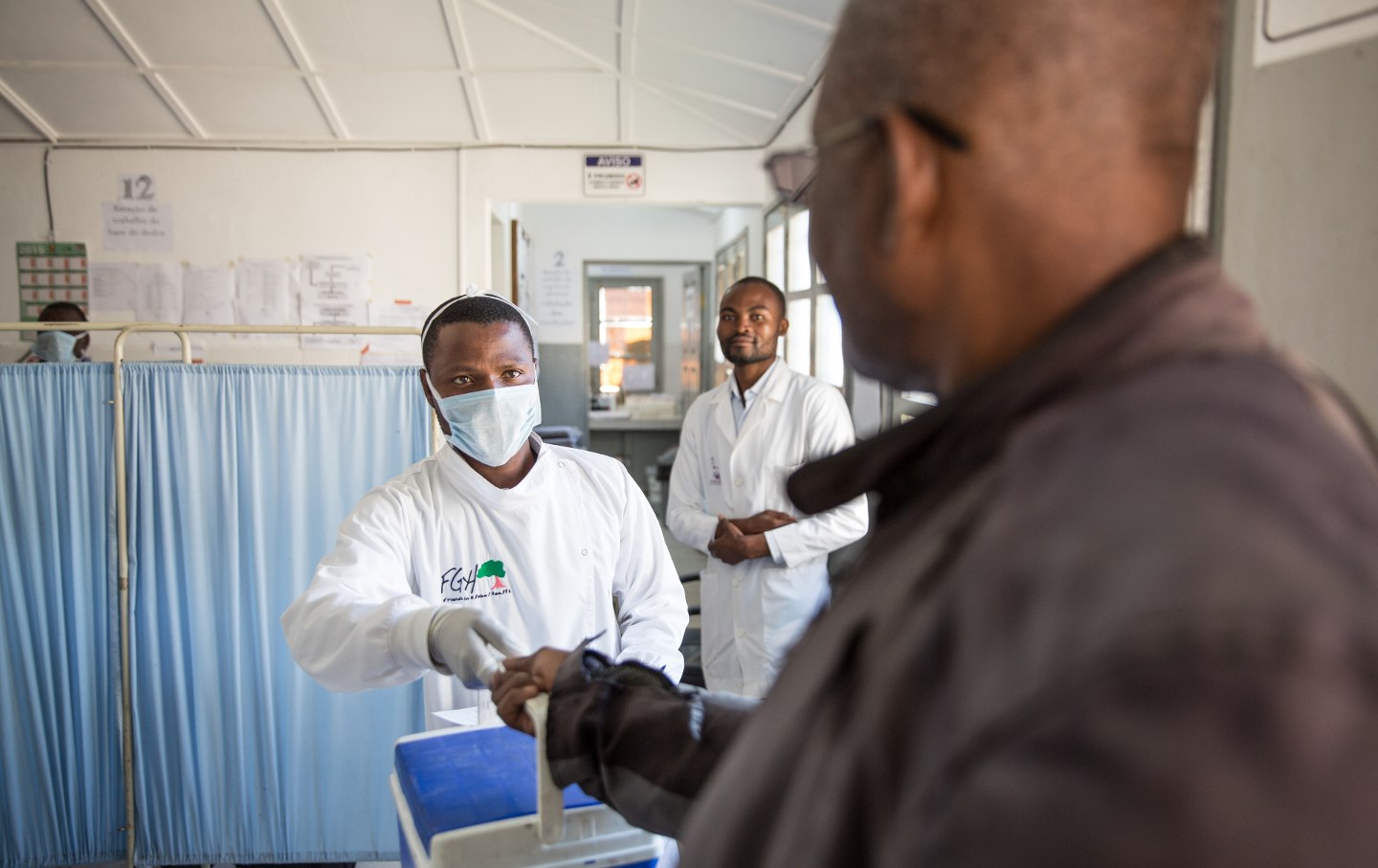
A courier collects HIV viral load samples at a rural health clinic funded by PEPFAR in Zambezia, Mozambique.
(Ricardo Franco / CDC)The statistics are astonishing. Since President George W. Bush announced the program in 2003, the President’s Emergency Plan for AIDS Relief (PEPFAR) has saved 25 million lives, most of them in Africa. An additional 5.5 million kids have been born disease-free because the US government paid for the drugs that reduce the risk of mother-to-child transmission. Today, PEPFAR funds the medications that are keeping some 20 million people in 54 countries alive.
But PEPFAR is in danger. A small group of right-wingers in Congress are lying about the program, dishonestly claiming that it promotes abortion. The GOP’s hard right is threatening to eviscerate a public health campaign that has always enjoyed bipartisan support. A broad coalition of evangelical groups representing hundreds of millions of people in the United States, Africa, and around the world has just endorsed an open letter to the US Congress, rebutting the abortion allegation.
More on Global Health
The deadline in Congress to reauthorize the program for another five years is September 30. After that, funding will begin to dry out. PEPFAR supporters from across the political spectrum are rallying support, including a peaceful sit-in at House Speaker Kevin McCarthy’s office on September 11 and vigorous phone and letter-writing campaigns.
If PEPFAR is weakened, the danger is not only to Africans. If Covid-19 taught us anything, it is that pandemics are global. Dan Foote was the US ambassador to Zambia from 2017 to 2020 and was in charge of the PEPFAR program there. He told me, “Cut off PEPFAR now, and be ready for a resurgent AIDS epidemic in the United States in 10 years.”
The extreme right-wing clique in Congress is basing its opposition on a single inaccurate article that a Heritage Foundation fellow published back in May. It insinuated that PEPFAR could somehow be manipulated into promoting “abortion on demand.”
At first, there were rumblings to cut it entirely. Now Representative Chris Smith, a New Jersey Republican, is talking about funding it for only a single year, and he heads a key House foreign affairs panel that oversees the program.
Emily Bass, a Brooklyn-based longtime activist/writer whose book To End a Plague is an indispensable and comprehensive history of PEPFAR’s success in Africa, explains that a one-year reauthorization would profoundly damage the program. She says that PEPFAR requires comprehensive strategic planning, data collecting, and reacting to changes on the ground. She points out that over the two decades of its existence PEPFAR has been reauthorized three times, always for five years, including under President Donald Trump in 2018. “Cutting the program to one year sends a signal that PEPFAR is being deprioritized,” she said.
I have seen the PEPFAR miracle up close. In the early 1980s, I was based in Swaziland, covering the regional struggle against apartheid for The Nation. Years later, HIV/AIDS struck at a swath of eastern and southern African nations, eventually hitting Swaziland the hardest. During my return visits, I witnessed first the devastation and then the recovery. In 2008, despair ruled. But by 2014, Precious Dube, a nurse matron, told me, “People in America have saved the Swazi Nation. If you had not helped us, our people would be sleeping in the streets and dying of disease and hunger. Instead, now, we are about to contain AIDS.”
Evangelical Americans have been a key part of the PEPFAR campaign from the start, both pushing it in the US Congress and also helping to provide health care in certain African nations. (The US-based Church of the Nazarene runs an important hospital in Manzini, Swaziland’s second city.) Shepherd Smith and his wife, Anita Moreland Smith, are evangelicals, and they started doing HIV/AIDS relief work back in the middle 1980s. They say they have visited Africa 65 times. (“We counted.”) They head an organization in the Washington, D.C., area called Children’s AIDS Fund International, and they helped organize the evangelicals’ letter to the Congress.
The letter, already signed by more than 350 African church leaders, asks Congress to promptly reauthorize PEPFAR for another five years. “PEPFAR has been a lifesaving, pro-life program that has succeeded in protecting our families and children beyond our greatest expectations,” the letter says. “It has been an answer to prayer.” And it adds: “We assure the United States Congress that the claim that PEPFAR supports or promotes abortion is to us strange, unfounded, and unfortunate.”
Three giants in the global faith-based community have endorsed the letter—the World Evangelical Alliance, which represents an estimated 600 million evangelicals; the National Association of Evangelicals, based in the US and including 40 denominations and thousands of churches and schools; and World Relief, a 75-year-old global Christian humanitarian organization.
Foote, the former ambassador, lauded the program: “PEPFAR is the best foreign policy tool that the United States has ever had.” He went on, “I never heard one bad word about PEPFAR from any American or Zambian in my time as ambassador. I never even heard the word abortion while talking about the program over my entire career.”
Bass explains in her book that PEPFAR succeeded in part because the United States controlled the program at the ambassador level and gave its leaders top priority within the State Department. That hands-on management may partly explain why none of the experts can think of a single significant case of corruption over PEPFAR’s 20-year history, a minor miracle in the foreign-aid world, especially when you consider that the program has so far spent more than $100 billion.
Popular
“swipe left below to view more authors”Swipe →Shepherd Smith warned, “A one-year reauthorization for a program that is hugely dependent on looking into the future will kill it.”
Both Bass and Smith encouraged concerned Americans to contact their representatives—“calling is better than writing,” Bass said—to urge their members of Congress to support a five-year reauthorization. Bass said she’s heartened by the program’s continuing broad base of support. “PEPFAR has truly been a bipartisan measure right from the start, which is another part of the explanation for its success,” she said. “I believe that this time around it may be the communities of faith that save it.”
Shepherd Smith, who has decades of experience lobbying Congress, is optimistic. Can Representative Chris Smith and his small group of allies damage PEPFAR? “If the vote were held today, I’d say maybe,” Smith told me, but “if we have a little more time and we continue organizing before the September 30 deadline, I don’t think they can stop it.”
Disobey authoritarians, support The Nation
Over the past year you’ve read Nation writers like Elie Mystal, Kaveh Akbar, John Nichols, Joan Walsh, Bryce Covert, Dave Zirin, Jeet Heer, Michael T. Klare, Katha Pollitt, Amy Littlefield, Gregg Gonsalves, and Sasha Abramsky take on the Trump family’s corruption, set the record straight about Robert F. Kennedy Jr.’s catastrophic Make America Healthy Again movement, survey the fallout and human cost of the DOGE wrecking ball, anticipate the Supreme Court’s dangerous antidemocratic rulings, and amplify successful tactics of resistance on the streets and in Congress.
We publish these stories because when members of our communities are being abducted, household debt is climbing, and AI data centers are causing water and electricity shortages, we have a duty as journalists to do all we can to inform the public.
In 2026, our aim is to do more than ever before—but we need your support to make that happen.
Through December 31, a generous donor will match all donations up to $75,000. That means that your contribution will be doubled, dollar for dollar. If we hit the full match, we’ll be starting 2026 with $150,000 to invest in the stories that impact real people’s lives—the kinds of stories that billionaire-owned, corporate-backed outlets aren’t covering.
With your support, our team will publish major stories that the president and his allies won’t want you to read. We’ll cover the emerging military-tech industrial complex and matters of war, peace, and surveillance, as well as the affordability crisis, hunger, housing, healthcare, the environment, attacks on reproductive rights, and much more. At the same time, we’ll imagine alternatives to Trumpian rule and uplift efforts to create a better world, here and now.
While your gift has twice the impact, I’m asking you to support The Nation with a donation today. You’ll empower the journalists, editors, and fact-checkers best equipped to hold this authoritarian administration to account.
I hope you won’t miss this moment—donate to The Nation today.
Onward,
Katrina vanden Heuvel
Editor and publisher, The Nation
More from The Nation

Trump’s “Warrior Dividend” Might Be His Scariest Idea Yet Trump’s “Warrior Dividend” Might Be His Scariest Idea Yet
This week’s “Elie v. US” explores the authoritarian threat beneath Trump’s bonuses for military families. Plus, a case for getting rid of the Second Amendment.


HUD Is Refusing to Enforce Anti-Discrimination Law—and Won’t Let Anyone Else Do It, Either HUD Is Refusing to Enforce Anti-Discrimination Law—and Won’t Let Anyone Else Do It, Either
The initial chaos of layoffs has been followed by a concerted effort by the Trump administration to halt the enforcement of the Fair Housing Act.

Brad Lander on What It Takes to Win as a Progressive Brad Lander on What It Takes to Win as a Progressive
The outgoing New York City comptroller discusses governing on the left, his run for Congress, and why housing and affordability should define the next Democratic fight.

Why Ilhan Omar Makes the Right Lose Its Mind Why Ilhan Omar Makes the Right Lose Its Mind
Trump and his MAGA allies want people like Omar to vanish from this country—and they hate her for refusing to do so.

