
The Complex Politics of South Africa’s Genocide Case Against Israel
The ANC’s legal fight at The Hague is based on sincere principles—but it’s also given South Africa’s beleaguered government a crucial boost in an election year.
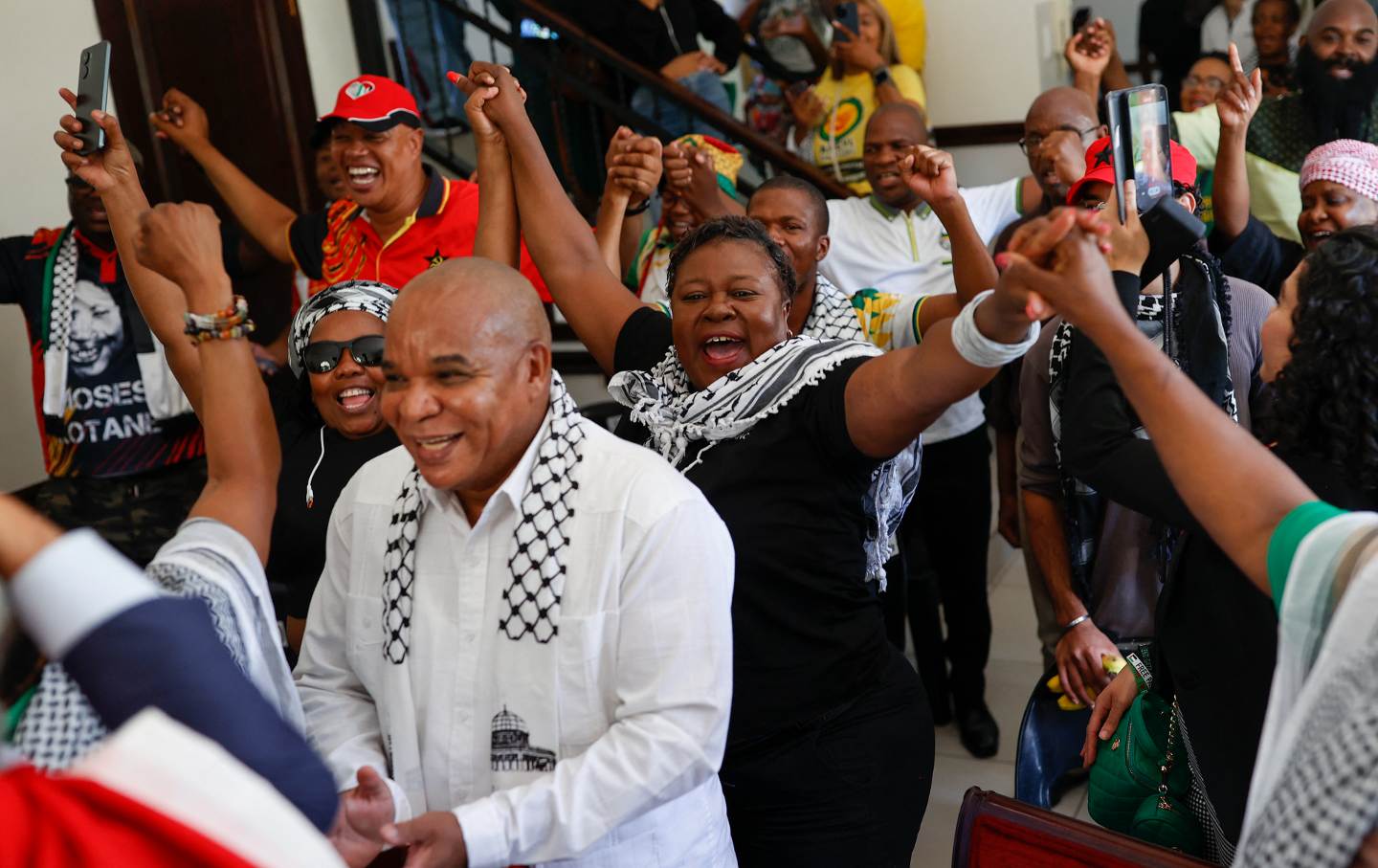
Pro-Palestinian supporters react in celebration after watching the International Court of Justice deliver its decision following a hearing of the case against Israel brought by South Africa in The Hague at the Embassy of Palestine in Pretoria on January 26, 2024.
(Phill Magakoe / AFP via Getty Images)The decision by the International Court of Justice last Friday to order Israel to prevent genocide in Gaza has largely been welcomed as a triumph in South Africa. The lawyers who fought the country’s case in The Hague were greeted like victorious sports heroes on their return.
It has been remarkable to hear so many previously skeptical international law experts in the country say how proud they feel of South Africa’s solidarity toward Gaza. The plight of the Palestinians has resonated with many South Africans who have heard an echo of their own struggle for freedom from apartheid over 30 years ago.
Beyond the celebrations, some divisions remain. In South Africa, most issues still tend to split on racial lines. On the Israel-Palestine question, generally, too, the majority Black population has largely backed Pretoria and Palestine, while the white population has tended to back Israel.
But it’s also apparent that the massive destruction of life and infrastructure that Israel has wrought in Gaza over the last three months recruited many to the South African government’s cause.
The mainstream Jewish community, though, remains firmly behind Israel and has been outraged by the South African government’s use of the Genocide Convention—which the world adopted in 1948 in the wake of the Holocaust—against the Jewish state.
On December 31, two days after Pretoria submitted its application to the ICJ, the South African Jewish Board of Deputies (SAJBD) blasted the move, accusing Pretoria of “doing the bidding of its friends Hamas” rather than using its supposed influence on Hamas to persuade it to release Israeli hostages.
It also saw, as some other commentators did, a glaring inconsistency in the ANC government’s defending the human rights of Palestinians thousands of miles away while paying comparatively scant attention to those of the oppressed people of Sudan and especially of South Africa’s neighbor, Zimbabwe.
But it was a measure of the court’s diplomatic skill—or perhaps just the inherent tendency to compromise from such a politically diverse bench of 17 judges—that both the South African government and the SAJBD were able to welcome its ruling on Friday.
The Department of International Relations and Cooperation hailed the decision as a “decisive victory for the international rule of law and a significant milestone in the search for justice for the Palestinian people.” President Cyril Ramaphosa said, “Today the International Court of Justice has vindicated us.”
The SAJBD, meanwhile, welcomed what it called the ruling’s ’s “recognition of Israel’s right to defend its citizens by denying the ANC Government’s request for a ceasefire,” and the ICJ’s demand for the hostages to be freed.
It took quite a lot of selective reading for both sides to claim victory in this way. One should recall that the Israeli lawyers at The Hague had called for the case to be thrown out entirely. By accepting the case and issuing any provisional measures at all, the ICJ had accepted that there was prima facie evidence that Israel was committing genocide in Gaza—though of course it could take many months, even years, for the court to determine that conclusively one way or another when the merits of the case are argued.
Conversely, Greg Mills and Ray Hartley of the Brenthurst Foundation—a Johannesburg-based think tank and policy adviser to African governments—argued in an article in the Daily Maverick this week that Pretoria was claiming “easy victories” by suggesting that the ICJ had already concluded that Israel was committing genocide and also by glossing over the crucial fact that the ICJ had not granted South Africa’s main request by ordering a cease-fire.
It’s also not completely coincidental that South Africa’s campaign at the ICJ comes months before critical elections when, for the first time since coming to power in 1994, the ruling ANC faces the real prospect of losing its majority in the national parliament and also perhaps losing its political hold on two more of the country’s nine provinces, Gauteng—the country’s economic heartland—and Kwa-Zulu Natal. It already lost the Western Cape to the opposition Democratic Alliance (DA) years ago.
Though the Palestinian cause is genuine for the ANC and has been on its foreign policy agenda for decades, it is also clear that it is using it as an important election plank, tapping into the nostalgia that many feel for South Africa’s own liberation struggle and also distracting the electorate from the ANC’s many failures of governance since then. The ANC’s mobilization of the ICJ issue as an election instrument has been evidenced not only by its zealous proclamation of victory last week but also by its prominent display of the slogan “#CeasefireNow” at its rallies.
Popular
“swipe left below to view more authors”Swipe →Conversely, the generally pro-Israel DA has been treading carefully around the issue, in an attempt to keep its white voter base in the fold without alienating other groups—particularly the Muslim vote, which is about 1.6 percent of the total nationally but 5.2 percent in the DA’s Western Cape stronghold.
The DA recently criticized Israeli Prime Minister Benjamin Netanyahu for opposing the establishment of a Palestinian state as part of a postwar scenario. The party firmly reaffirmed its commitment to a two-state solution.
It also urged Israel to abide by the ICJ’s ruling to avoid and prevent genocide while calling for Hamas to disarm and return Israeli hostages.
The ANC government has also won plaudits for this ICJ campaign as a rare triumph of foreign policy after 30 years of varying and often inconsistent policy abroad, as Peter Vale of the University of Pretoria and Vineet Thakur of Leiden University commented in The Conversation last week.
“As observers of South Africa’s international relations, we believe this move to be the high-water mark in the country’s foreign policy since the end of apartheid in 1994,” they wrote.
The ultimate success or failure of last Friday’s ruling will be determined by Israel itself and how far it goes in implementing the order of the world’s highest court.
But, for all its own internal contradictions, South Africa deserves considerable credit for putting the plight of the Palestinians front and center of national and international attention—and to leave it to a court to decide the merits of a highly contentious issue.
Support The Nation’s June Fundraising Campaign
With the midterm elections now firmly upon us, the question is whether Democratic candidates will do more than merely occupy ballot lines as mild alternatives to the red-hot crisis that is Donald Trump.
As Trump spends over $1 billion a day on a globally destabilizing war on Iran and admits that he doesn’t “think about Americans’ financial situation,” millions across the country are struggling with the surging costs of essentials. Democrats must seize this moment and advance bold, small-“d” populist ideas—not settle for cynical caution that once again snatches defeat from the jaws of victory.
The Nation elevates progressive ideas, movements, and elected officials achieving real change across the country into the national conversation. At the same time, our journalists are exposing how crypto and AI-funded super PACs are spending hundreds of millions of dollars to knock out candidates they oppose, reporting on the devastating impact of the Supreme Court’s evisceration of the Voting Rights Act, and sounding the alarm on attempts by red states to quickly redraw electoral maps, disenfranchising Southern Black voters.
We can play this critical role because of support from readers like you. This June, we’re raising $20,000 to power The Nation’s independent journalism in the run-up to November’s immensely consequential elections.
It’s in our power to build a more just society, and your support at this critical moment brings us closer to that bold vision. I hope you’ll donate today.
Onward,
Katrina vanden Huevel
Editor and Publisher, The Nation
More from The Nation
The Revolution Heard Around the World The Revolution Heard Around the World
The global politics of 1776.
Daniel Ellsberg vs. “Ordinary Insanity” Daniel Ellsberg vs. “Ordinary Insanity”
A new documentary issues an urgent warning about our dangerous nuclear delusions.
How Trump Has Boxed Himself Out of a Face-Saving Iran Deal How Trump Has Boxed Himself Out of a Face-Saving Iran Deal
By failing to absorb the lessons of Iran’s strategic victories, the White House is on course to turn the present stalemate into a disastrous quagmire.
How Jared Kushner Sparked a Political Crisis in Albania How Jared Kushner Sparked a Political Crisis in Albania
Outraged Albanians are targeting the presidential son-in-law for pursuing a $4 billion luxury resort deal in a business climate rife with corruption and environmental neglect.
Trump’s Disregard for International Humanitarian Law Won’t End When the Iran War Does Trump’s Disregard for International Humanitarian Law Won’t End When the Iran War Does
As political pressure to end the war grows, Americans must not overlook the president’s blatant violations of the rule of law, abroad and at home.

