Occasionally in the murky wasteland of Broadway, where nostalgia reigns
and revivals rule, the hopeful theatergoer is led to an oasis advertised
as fertile enough to water the desert. Suzan-Lori Parks's
Topdog/Underdog, which has just won the Pulitzer Prize, is one of
these. Even if its success were to be
measured solely by the numbers of young people and black people, both
young and old, in the audience on any given night, Topdog could
be considered a healthy sign. Parks has been writing praise-winning
plays since the 1980s, but Topdog, which premiered last year at
the Public Theater, is the first one to make it to Broadway. For a play
by Parks it is uncharacteristically conventional--a straightforward
story with familiar characters that comes close to observing the
classical unities. Her earlier plays, such as The Death of the Last
Black Man in the Whole Entire World, Fucking A and The
American Play, are bold, disconcerting experiments in theatrical
form. But Topdog is more remarkable in some ways because it
unleashes the radical potential inside the well-made play.
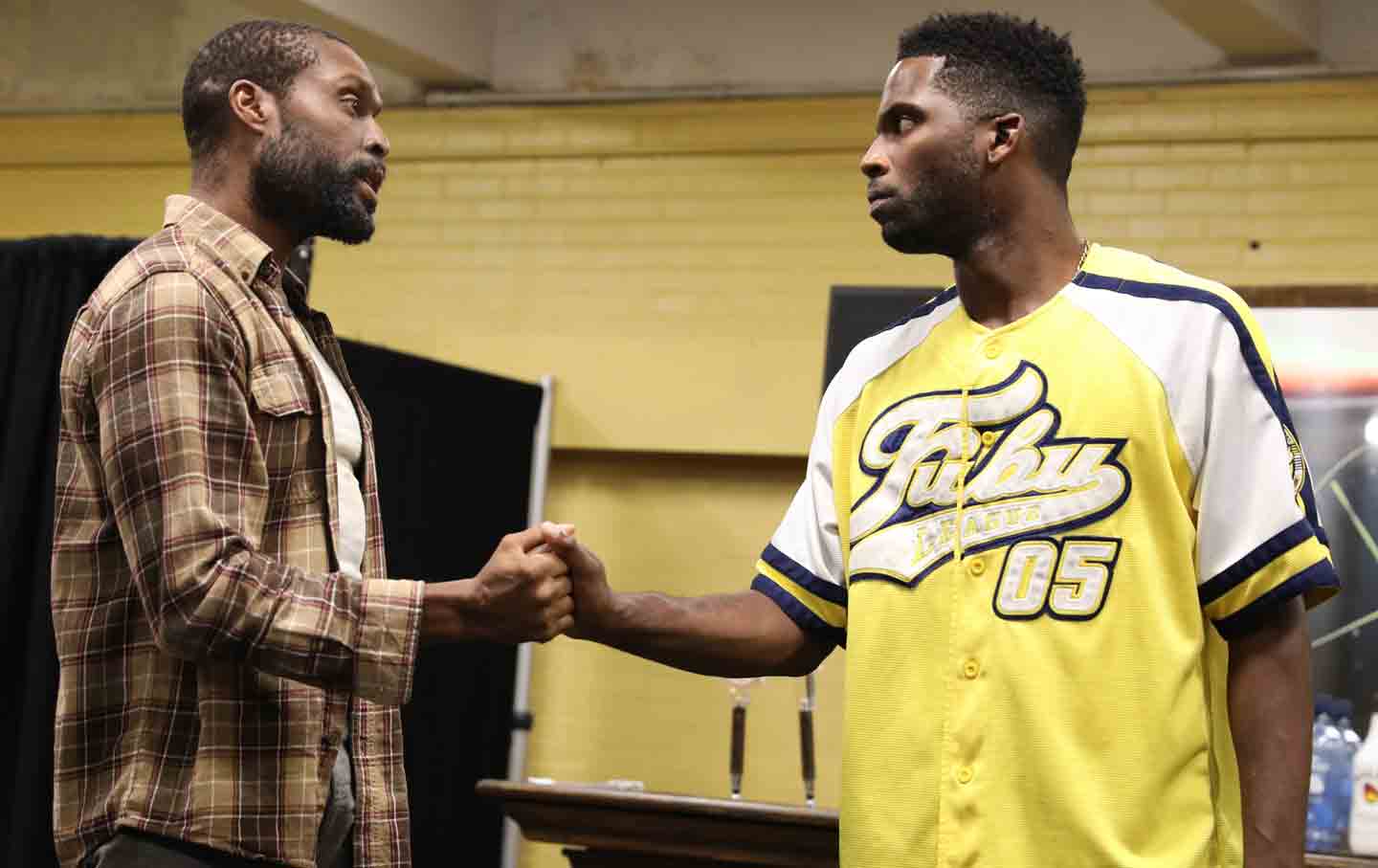
Booth and Lincoln, two African-American brothers in their 30s, share an
SRO where all the action takes place. The time is a few days in some
city probably in the 1960s. The period, like the location, is
deliberately vague enough to warn us off the issue beat. This is not
social realism, even if it looks a little bit like it. Lincoln, the
elder brother, was once a legendary three-card monte dealer. He left the
game after his partner was shot, and has been working as a whiteface
Abraham Lincoln impersonator in an arcade. Customers can re-enact the
sixteenth President's last moments by stealing up behind the costumed
Linc and firing a cap gun into his skull. Legitimate work, maybe, but
humiliating from the point of view of little brother Booth, who hopes,
with Lincoln's help, to get himself into the street game as a three-card
dealer. He wants the women and the money and the props that come with a
dealer's success. He can move his mouth and he can move his body. He's
just no good moving his hands.
Lincoln, former master of this street hustle, is the topdog. As superbly
performed by Jeffrey Wright, he is sly, sometimes robotic and
calculating, all knowingness, drink and disappointment. Booth, played by
rap artist and actor Mos Def, the other half of the most thrilling duo
on Broadway, is the antic underdog--a self-deluded, sweetly homicidal
baby. We know, given their names, how they will end up. This is not the
point.
The game is the point. Both brothers are trying to follow the moves in
their family history, looking for a clue to the winning card; they each
sense--but can't quite see--a pattern as formal and controlling as the
one in the game. Their father gave them these ridiculous names as a
joke. If their life is a game, it's one their parents quit when the boys
were still teenagers: First the mother moved on, and then, as if by some
mysterious prior agreement, the father vanished. (If this were a
strictly realistic piece, some of this retelling of family history might
sound slightly off. Nevertheless...) The brothers are still in the game.
Their moves may have been determined by some destiny or joke, but their
language flows. Parks writes dialogue so vigorous and beautiful and
hilarious you'd almost think these men were free. Lincoln has more lines
and better ones, but Mos Def's strutting, styling Booth is language made
physical.
The vivid exchanges between the brothers are punctuated by the dealer's
hypnotic, mechanical patter. Lincoln's is loose and hypnotic, Booth's
mechanical and jerky:
Lincoln: Lean in close and watch me now: who see thuh black card who see
the black card I see thuh black card black cards thuh winner pick thuh
black card that's thuh winner pick the red card that's thuh loser pick
thuh other red card that's thuh other loser pick thuh black card you
pick thuh winner.
Every time the patter appears, the relationship between the brothers is
slightly revised. Like the shabby set by Riccardo Hernandez, which
undergoes minor transformations that softly indicate rearrangements in
power and psychology, these improvisations are small, but they are all
the latitude these two men have been given. In addition to relying on
sleight of hand, three-card monte works by creating confusion about what
is real and what is part of the game. The dealer always has his shills
who work the crowd by seeming to be part of it; he usually pretends to
be reluctant to throw the cards. The question of what's real requires
some careful thinking, as Linc is wise enough to point out to his
heedless brother: "First thing you learn is what is. Next thing you
learn is what ain't. You don't know what is you don't know what ain't,
you don't know shit."
It's important to stress that as audience members, we often don't know
shit. We don't know when Linc is playing for real and when he is conning
his brother by letting him pick correctly. But Linc is being played too,
and soon enough the game slams shut on both brothers.
Theater pieces have been made from games like this since the
Renaissance. They appeal to audiences, and especially to critics,
because they invite us to indulge in the kind of metaphorical musings
that make us feel connected and smart. But Parks has always insisted
that her work must be immune to such readings. In interviews, where she
is either faux-na*f or simply exasperated with the press ritual that
accompanies every production ("I'm less interested in 'meaning,'
whatever that word means? I'm not quite sure, I keep meaning to look up
meaning"), she sensibly tries to redirect attention to what is going on
between the people in her play. And one of the pleasures of
Topdog is that it doesn't give us any time to work in our
"issues." George C. Wolfe has directed the play with a swift, inevitable
momentum that keeps us trying and failing to keep up with the winning
card. Like his work with other strong playwrights like Tony Kushner and
Anna Deavere Smith, Topdog's staging has none of the
tendentiousness he laid on Jelly's Last Jam or Bring in da
Noise. This is not August Wilson or Athol Fugard or Tom Stoppard. If
Parks has a black man in white face, she has a black man in white face.
If there is a game of chance, there is a game of chance. Lean in close.
Watch the moves and turn off the metaphors. These lives are the shit you
don't know about. That's why you have to look close.
The power of our response to the murder we have been expecting at the
end of Topdog is thus more visceral than either awe or pity; if
we have been watching closely, we experience just how it went down. We
begin as spectators, like the crowd around the dealer and his sidemen
(to indulge in metaphor). If we look away long enough to worry about
meaning, we'll miss the moves and the game will vanish, as it does on
the street with the first sign of authority (to extend the metaphor).
But if we pay attention, we will be in the game when the final card is
thrown. I think this special kind of immediacy is what distinguishes
Parks's work, especially the more experimental pieces, which draw us in
through their language but keep us off-guard with their form. And I
suspect that having taken the trouble to create it, she is determined to
safeguard it against too much talk and interpretation, especially of the
what-this-means-about-African-American-theater/life variety. This is the
stuff. This is it.
There is a moment at the end of the hourlong monologue that constitutes Act I of Tony Kushner's Homebody/Kabul when I realized I'd be happy to sit and listen to this mentally promiscuous, verbally curious London housewife (played so superbly by Linda Emond) for another two hours. Or more. Like many theatergoers, I was soon to wonder why her thrilling meditation on history, calamity and Afghanistan had to be followed by the events of Acts II and III, when the Homebody has vanished, leaving her husband, daughter, a British aid worker and various Afghans to play out their all too obviously caricatured lives. Kushner wrote the opening monologue as a stand-alone piece for the English stage, after all. Surely it could have been left at that.
Or could it? The problem, if we are to take this theater piece as something more than a dutiful twitch of political concern, is that the Homebody and her monologue require some consequence to her wandering thoughts. For one thing, these thoughts are way too winning, and Kushner, whose writing oozes charm like toothpaste from a tube, knows the dangers of charm. The woman is talking about suffering, after all. She is speaking to us from the security of her living room, safe in her culpable life, dilating on the most hopeless of catastrophes. And we are listening from the comfort of our theater seats. The setting is 1998 and the United States has just bombed supposed terrorist camps in Afghanistan, one more episode inflicted on a place that, as a character later comments, is not so much a country as a populated disaster. The Homebody wants to tell us about buying Afghan pakools as party hats for her guests, for God's sake. She needs to describe finding them on an unnamed London street in a shop run by a man who has had three of his fingers neatly severed by--well, by the mujahedeen, by the Russians, by the Northern Alliance, by, in short, the calamitous history of his country. She is not at all immune to the horrible dislocations that the hats may represent or to the transformation they can effect on her life, or to the corruption of culture into consumerist junk. She reads to us from Nancy Hatch Dupree's heartbreaking 1965 guidebook to Kabul, goes from there to the antidepressants she and her husband take, and on to infant mortality rates and back again to the guidebook. In between she serves up the many cast-off bits of knowledge left by history's losers that she treasures as important clues to understanding whatever it is she needs to understand. She loves the world; she makes all the connections. The act ends. As I say, dangerously charming because the question remains: What exactly does a person do when faced with a calamity of historic proportions? When we are so overwhelmed, she says, we succumb to luxury. Or to words.
Instead, she goes to Kabul. Thus the unlovely Acts II and III begin with the aftermath of this latter-day Clarissa Dalloway's disappearance. She may, following one local account, "have been torn apart to pieces" by an angry mob, or she may have traded places with Mahala, a Muslim woman, so that, according to her hilariously xenophobic husband (the superb Dylan Baker), who has set off with their daughter (Kelly Hutchinson) to find her, "she can spend the rest of her life in what must never have been more than a Himalayan bywater at the best of times, draped in parachute sheeting stirring cracked wheat and cardamom over a propane fire." The point is she's gone, and her family can't mourn her any more than we do. From now on there is nothing for them (or us) but the harshness of history, as daughter Priscilla and her guide (Dariush Kashani) search for her mother's body, while her father moves swiftly from whiskey to heroin holed up with Quango Twistelton (superbly played by Bill Camp), an aid worker left over from the great colonial joke. Even the gruelingly spare sets make you want to leave your seat.
The transition from the lonely housewife's antic mind playing upon the great and tiny themes of the opening to the Brechtian drama of the last two acts asks a lot of an audience, but Kushner is used to waging war on the way things "have to be" in the theater. It's one reason that, even without having a major play produced since 1992's Angels in America, he seems to be among its principal saviors right now. Angels, among other wayward things, ran to something like seven hours on two separate nights; its ambition was huge, and the result was a vast, chaotic kaleidoscope that managed to bring nothing less than an entire zeitgeist into momentary focus. Homebody/Kabul has big ambitions too, so it's not surprising that its author is willing to court our hostility in pursuit of them. One hallowed rule of stagecraft holds that after a play has established its contract with the audience, the rules of the game can't be changed. Homebody violates its contract by abandoning the character, mood, pace and manner of address that have brought us into the evening.
Thematically, the shift makes sense. As the father and daughter struggle to understand the Homebody's act, they are able, by the end, to move from their domestic hurt to the universal disaster of Afghanistan. It is a painful struggle--especially for the audience, who must wait a long time for these thin characters to, so to speak, get out of the house. The daughter, who suffers from the therapeutic malaise of her inarticulate generation, is particularly annoying. This seems a deliberate choice on Kushner's part, but it's hard not to wince whenever she opens her mouth. It surprised me at first that a playwright who rarely uses stereotypes without shedding some light on them, whose plays are literature on the page as well as the stage, has written a character so easy to dismiss. Her father is more appealing because he has the outlandish bigotry of his class; but he too is a stock figure, enlivened by Kushner's willingness to give him better lines than he deserves. These are the sleeping souls of the Homebody's world, unmoved by any pain but their own, so perhaps they need to be thin until the very end, when they are transformed by love and suffering and loss. But their journey is so arduous, and often so irritatingly melodramatic, that by the time the transformation comes, it has too little force. Whether some of this is a matter of the pacing in Declan Donnellan's directing, it's hard to say.
The mullahs, poets, prophets and especially Mahala, the errant Muslim wife (played so well by Rita Wolf), leaven the action even when they are speaking in untranslated Pashto, a risky theatrical device meant to increase our discomfort and confusion. The playwright's insistence that many of the characters speak over each other at crucial moments is less effective, even if we get the point of the Babel. I much preferred two running jokes about universal understanding: Priscilla's guide speaks and writes in Esperanto: "It is a language that has no history, and hence no history of oppression," he says. "A refugee patois. The mad dream of universal peace. So suitable for lamentation." A seller of hats and a former actor (Zai Garshi) speaks in the universal currency of Sinatra: "The Taliban, yes? They go to extremes with impossible dreams, yes? And so my record player is smashed and all each of the LPs of me, Popular Frank Sinatra Sings for Moderns slips through a door a door marked nevermore that was not there before. It is hard you will find to be narrow of mind." Witty lines on serious matters, reminding us that this playwright has not given up on the possibility that mainstream entertainment can address big issues, that serious politics arise out of very basic needs, that theater can be a force for transformation. The issues of Homebody/Kabul may be complex and irresolvable, but the dramatic mission is not. It's as simple as Brecht's response to an interviewer who once asked him what theater should do: "Try to discover the best way for people to live together," he said. How many living dramatists other than Tony Kushner would know how to begin to do that?