
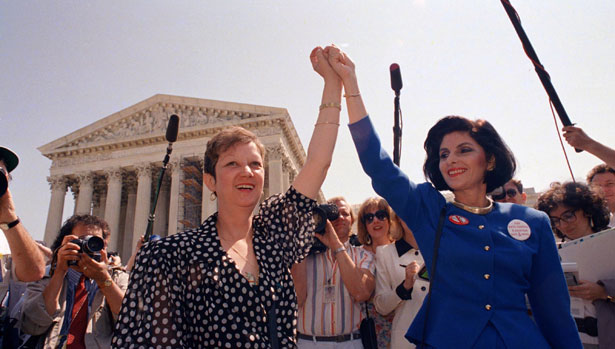
Norma McCorvey, Jane Roe in the 1973 court case, left, and her attorney Gloria Allred hold hands as they leave the Supreme Court building in Washington, DC, Wednesday, April 26, 1989, after sitting in while the court listened to arguments in a Missouri abortion case. (AP Photo/J. Scott Applewhite)
Forty years after Roe v. Wade, do you have a problem calling yourself pro-choice? Apparently a lot of people do. In 2009, abortion opponents broke out the champagne and the media went wild when for the first time since polling began on this issue, more people told Gallup they were pro-life than said they were pro-choice. Despite annual fluctuations since, 50 percent of those polled last year described themselves as pro-life, and 41 percent as pro-choice—a record low. Less noted were Quinnipiac findings that nearly two-thirds of registered voters agree with the Roe v. Wade decision, a number that has actually increased a bit in recent years. Surprisingly, other research has found that support for Roe includes 35 percent of those who call themselves pro-life.
Planned Parenthood is betting there are a lot of people out there who support abortion rights but are turned off by the word “pro-choice.” “The labels have become irrelevant,” PP president Cecile Richards said in a press briefing. People don’t want to see Roe overturned, but they feel “abortion is a complex, deeply personal issue.” Executive vice president Dawn Laguens suggested that when Roe was decided, women had far fewer choices, but today we are so bombarded with choices the word sounds “frivolous”—“like choosing your cellphone plan.”
PP is not completely abandoning “pro-choice”—the word has a history, and Richards acknowledged with a smile that the new message won’t exactly fit on a bumper sticker. But expect to hear more often that “we’re not in her shoes” when it comes to a woman’s “personal decision.” Indeed, a National Women’s Law Center Tumblr, Not In Her Shoes, invites women to “Submit a picture of your own shoes—tell us why no one can walk in them but you, and why no one knows your personal situation.”
In PP focus groups, people in the “middle ground” called for a more nuanced conversation. Typical quotes: “It’s not just black or white, there’s gray.” “We define it so many times by the extreme of the viewpoints rather than the moderation.” “Labels don’t matter.” In a follow-up e-mail, Laguens told me, “It was clear from the research that, for most of them, their struggle was with what their own decision would be and under what circumstances.”
I often find public relations a bit bewildering, so maybe it’s my problem that I worry when people say the term “pro-choice” is “oversimplifying” and “extreme” and call for “moderation” and an acknowledgment of “gray areas.” To me, “pro-choice” means you believe that whether or not a woman keeps a pregnancy is up to her—the position most Americans say they support when asked about Roe. That is the “moderate” position. The exact opposite of the pro-life position would be to override the woman’s will and let others—parents, doctors, social services, the government—decide she must have an abortion, as is happening in China. An “extreme” pro-choice position would be the one pro-lifers falsely claim Roe protects: it would permit abortion on demand up until the day before birth. No pro-choice organization calls for that.
Popular
"swipe left below to view more authors"Swipe →
According to one poll PP handed out, 40 percent say their personal view of abortion “depends on the situation.” Polls show a large majority support a woman’s right to abortion in cases of rape or risk to her life or health, and about half would permit it when the fetus is mentally or physically impaired. But a majority oppose abortion when the woman is poor, young, wants to finish school or keep a job, has all the kids she can handle, doesn’t feel ready to be a mother—in other words, they disapprove of about 90 percent of the abortions women actually have. Does that mean people who say abortion is a “gray area” would support more restrictions if they were tailored to those preferences? Or do they just want to feel they have the right to judge? In any case, I don’t know how we get from “it depends” to reclaiming the ground we’ve lost, including overturning such restrictions as parental notification and consent (“it depends” on parental approval), waiting periods (“it depends” on proof that a woman has thought hard), stricter time limits (“it depends” on the woman overcoming obstacles more expeditiously than many of them can) and bans on federal funding (“it depends” on taxpayers not being involved in this morally suspect activity).
I’m old-school about labels. I don’t see what was gained by dropping “liberal”—aka “the L-word”—for “progressive.” It just looked cowardly and evasive. I like “feminist” too. People who say they identify with the goals but reject the designation (I’m not a feminist, but…) may think they are making fine ideological distinctions, but basically they are fleeing stigma: “feminist” means you’re a hairy man-hater, so call yourself a womanist, a humanist, a slutwalker, a supporter of gender justice. The trouble is, the stigma is not about the word, but about the concept behind it, and eventually the negative connotations migrate to the new term. That girl may call herself a humanist, but the way she goes on about rape, you can tell she’s just a hairy man-hater!
As a message, “personal decision” is fine. It may even be better than “choice.” “Personal” reminds us both that abortion comes down to a woman’s own body and that we never know another’s whole circumstances; “decision” sounds thoughtful and serious. But neither one is stigma-proof: after all, “personal” has its own trivial connotations (“personal hygiene” “personal pizza”), and decisions can be willful and hasty as well as deliberate. If the problem is that lots of people support Roe in the abstract but think it’s too easy to get an abortion and too many women who have them are heedless sluts, it won’t be long before “personal decision” sounds as lightweight as “choice,” and “you’re not in her shoes” summons up visions of Carrie Bradshaw’s Manolos.
Meanwhile, New York Governor Andrew Cuomo got a standing ovation when he thundered, “It’s her body! It’s her choice!” while introducing a ten-point women’s rights agenda in his State of the State address. There’s life in the old word yet.
In “This Is Roe at 40,” the editors say that, after taking some hits, the movement for abortion rights is pushing back—and has some new tricks up its sleeve.

