
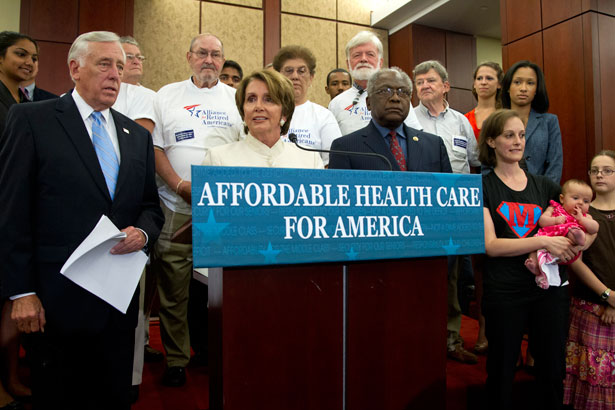
House Minority Leader Nancy Pelosi of Calif., flanked by House Minority Whip Steny Hoyer of Md., left, and House Assistant Minority Leader James Clyburn of S.C., speaks about the Affordable Care Act, Wednesday, July 11, 2012, on Capitol Hill in Washington. (AP Photo/Haraz N. Ghanbari)
Health insurance executives breathed a sigh of relief when the Supreme Court upheld their favorite part of the Affordable Care Act (the part that is one of the least popular among the rest of us)—the individual mandate. And then, I’m confident, moments after they exhaled, they were on a conference call with their army of lobbyists and PR people to approve a strategy, developed months ago, to gut the provisions that the rest of us do like. These are the parts of the law that require insurers to provide coverage to millions they have long shunned like lepers, and that make the most egregious but profitable industry practices a thing of the past, like canceling our policies when we get sick.
Part of their strategy will be a propaganda campaign to persuade us that the consumer protections in the law are not in our best interest. “The new health care reform law includes a number of provisions that will increase the cost of health care coverage,” warned America’s Health Insurance Plans (AHIP), the industry’s largest PR and lobbying group, after the ruling. The provisions in question are the ones that help finance the expansion of coverage, make premiums more affordable for older Americans and outlaw benefit plans that provide inadequate coverage. AHIP’s real concern, of course, is that such measures will negatively impact insurers’ profit margins.
The strategy will also encourage the industry’s political and media allies to keep referring to “Obamacare” as a “government takeover” of healthcare. This fabrication has been widely accepted as truth—one reason the Affordable Care Act polls so poorly.
Finally, the strategy will seek to exploit the hostility many on the left feel toward the ACA—and the deep divisions among progressives over whether it really is a step in the right direction. Insurance executives are counting on single-payer progressives to stay so disillusioned with the law and those responsible for it that they will boycott the November election, helping the industry’s Republican friends to take back Washington.
I’m sure that conference call took place because I was a regular participant in many like it while serving as head of communications for Humana and, later, Cigna, two of the country’s largest insurers. Right up until the day I walked out the door in 2008, I was working with my peers at other companies on such a strategy to influence public opinion. One of the reasons I quit—and became a vocal critic of the industry I served for two decades—was that I didn’t have the stomach to be a part of yet another deception-based effort to undermine reform. During my career I helped implement the industry’s game plan to defeat the Clinton reform proposal. A few years later I helped lead a behind-the-scenes fearmongering campaign, fronted by the National Federation of Independent Business but planned and financed by the insurance industry, to make sure Congress never passed a Patient’s Bill of Rights. Congress never did (although the Affordable Care Act does contain some of those “rights”).
One of the things that differentiates insurance company executives from many healthcare reform advocates, I’ve learned, is that the former never approach any high-stakes political game without a well-planned strategy, one that seeks to take advantage of their opponents’ weaknesses and divisions. It’s true that without reform advocates, President Obama wouldn’t have had a bill to sign into law. But in other battles, we in the industry found that advocates could almost never seem to craft a well-planned strategy or sustainable coalition. One reason we don’t have universal coverage in the United States today is the failure of these same advocates to recognize the need for a strategy—and the need to compromise.
Popular
"swipe left below to view more authors"Swipe →
Senator Ted Kennedy, who fought so hard for universal coverage, learned a tough lesson on compromise when Richard Nixon was president. Worried that Kennedy and other liberal Democrats might be able to get enough votes in Congress to pass a single-payer bill, Nixon proposed an alternative plan that would have required employers to provide health insurance to their workers. It also would have had the government finance coverage for low-income Americans who didn’t have a job. Kennedy refused to negotiate seriously, thinking he could get his own reform plan enacted the next time a Democrat—maybe even himself—occupied the White House. He condemned Nixon’s plan as a windfall for insurance companies. (Sound familiar?)
Kennedy said years later that his refusal to bargain with Nixon was the biggest regret of his career. He had underestimated the ability of the insurance industry, the American Medical Association and other entrenched special interests to join forces and forge a strategy to ensure that, even after the Democrats took back the White House in 1976 and solidified their control of both houses of Congress, single-payer legislation would go nowhere. This experience was one of the reasons he supported reform legislation nearly forty years later that he knew would fall short of achieving universal coverage and that would be condemned by many die-hard single-payer supporters as, yes, a windfall for insurance companies.
Among today’s die-hards (many of whom are good friends) are members of Physicians for a National Health Program and Healthcare-NOW! They are still furious at the president and the Democrats for their baffling decision not to give single-payer legislation a decent hearing and for compromising too early and too often, in their view, with the special interests. Many are no longer on speaking terms with the staff of Health Care for America Now, the umbrella organization for unions and advocacy organizations, which didn’t join their calls to kill the bill when the public option was stripped out. They believed, as Kennedy did years earlier, that more could be gained by starting over. Many still do and could be seen alongside the Tea Partiers on the steps of the Supreme Court, demanding the entire law be struck down.
These divisions are playing right into the hands of my former colleagues. Progressives must bury the hatchet and get down to the business of developing a strategy to move forward. The two factions actually see eye-to-eye on many things, including the fact that the law does much good but does not get us close enough to universal coverage, and that Obama and Congressional Democrats made strategic and tactical blunders throughout the reform debate. Now they must recognize that their true opponents are the people I used to work for—not one another.

