The UN Can’t Stop Gaza From Being a Hostage to American Power
The dismissal of the Security Council’s cease-fire resolution shows why the world can no longer look to Washington as the arbiter of a rules-based order.
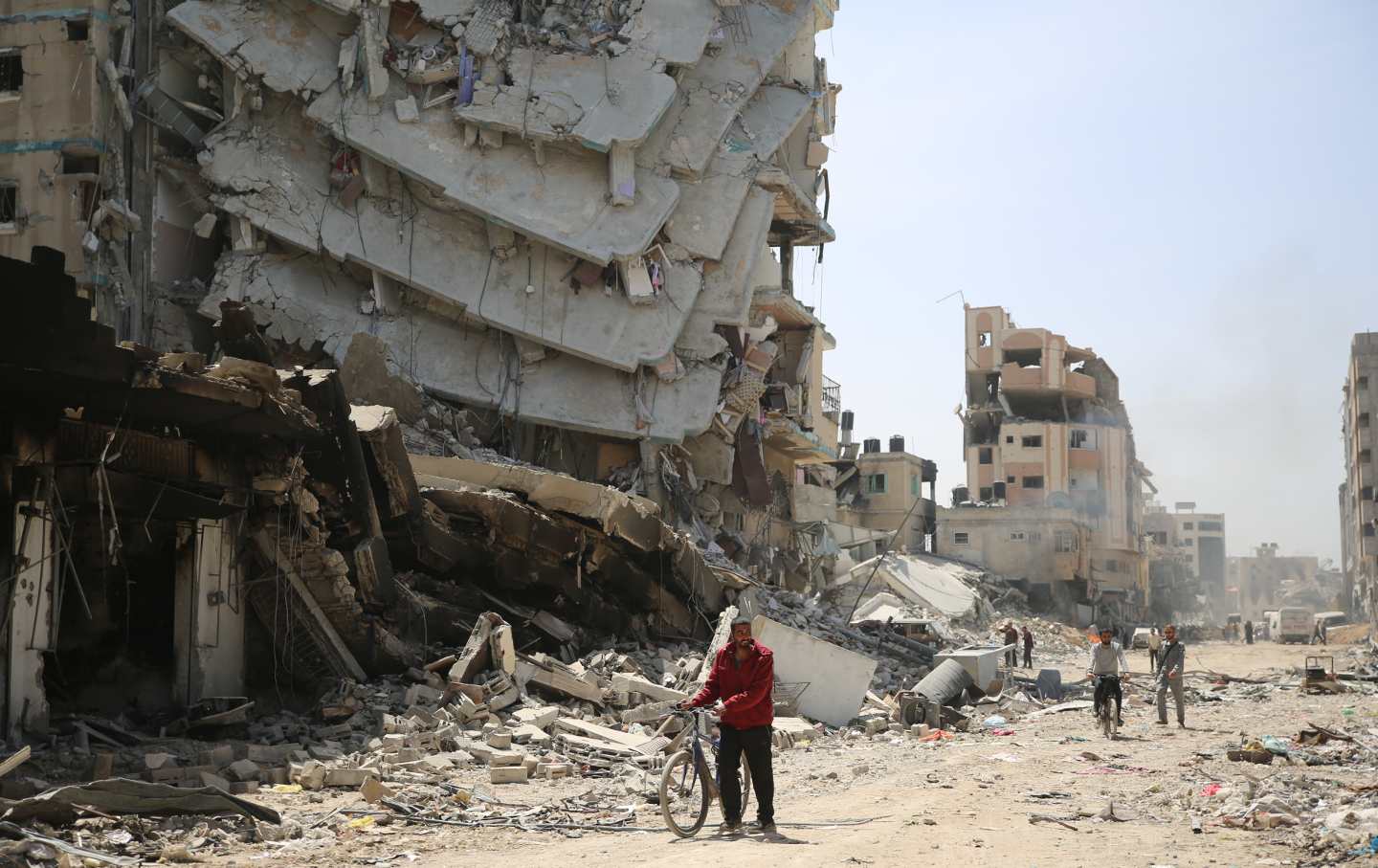
The devastated area around the Al-Shifa Hospital in Gaza City, Gaza, on April 1, 2024.
(Omar El Qattaa / Anadolu via Getty Images)When the United Nations Security Council passed its long-awaited Gaza “cease-fire” resolution last week, the United States wasted no time shamelessly downplaying the move. If the scale of the slaughter in the besieged enclave—and Americans’ widespread disapproval of it—had pressured Washington into abstaining from, rather than vetoing, the measure, US Ambassador Linda Thomas-Greenfield made sure to insist, falsely, that the resolution was “non-binding.” Despite its baselessness, her remark was surely heard in the war rooms of Tel Aviv and Jerusalem. Hours after the vote, Palestinians in Gaza reported an uptick in Israeli military attacks, including upon the masses who have sought shelter in the Strip’s southern half.
In Gaza’s southernmost city, Rafah, the White House’s half-hearted admonitions against an Israeli ground invasion had already revealed the cruel insincerity of American diplo-speak. As +972 Magazine’s Ruwaida Kamal Amer and Ibtisam Mahdi have documented, many of Rafah’s 1.4 million people, nearly all of them displaced from Gaza’s north, have been in Israel’s crosshairs for months—long enough for some to risk returning to their destroyed homes. There, they told Amer and Mahdi, they might avoid dying in tents or, if they are lucky, survive long enough to see a cease-fire.
Luck, however, will not halt the killing. In a measure of the international community’s desperation, America’s abstention was enough to prompt some hope that, after months of failed attempts, the UN might finally find a way to restrain Israel. Palestine’s Permanent Observer to the UN, Riyad Mansour, even called the resolution “a turning point.” In reality, though, Israel’s blatant disregard for its demands stripped the text of all meaning, even though—unlike the January 26 “provisional measures” ordered by the International Court of Justice—it explicitly demanded a cease-fire.
But that, too, was hardly groundbreaking. Unlike the resolution’s other demands— releasing all hostages and complying with international law on detainees—the “immediate cease-fire” came with an expiration date; it was to last only through Ramadan, the Muslim holy month that will end in early April. Knowing this, State Department spokesperson Matthew Miller, speaking to reporters on the morning of the UN vote, offered a blunt assessment of the resolution’s prospects. Asked by AP reporter Matt Lee if he expected Israel to cease hostilities, Miller responded, “I do not.”
That, presumably, is why the US saw no need to vote down the resolution. It may also explain why the ICJ did not bother ordering a “cease-fire” in a March 28 addendum, issued three days after the Security Council vote. Although the court lamented “changes in the situation” since its original orders were released, the addendum’s operative clauses made no mention of Israel’s war on a civilian population, the indisputable driver of those changes (which now include widespread starvation).
Amid the ongoing spectacle of violence, Miller saw fit to proclaim Israel’s actions in line with international law, a conclusion that presumably relies on the same “because we said so” Israeli claims used to target hospitals, schools, media organizations, and UN facilities. Speaking to reporters a day after UN Special Rapporteur Francesca Albanese said she had “reasonable grounds” to suspect Israel of genocide, Miller countered that his bosses opposed her mandate—as if the US’s objection was reason enough to dismiss the allegation. He then went a step further by accusing Albanese of making antisemitic comments, a deflection that echoed that of Israel’s former ambassador to the US, Ron Dermer, who had told NPR that accusing Israel of blocking food aid was nothing less than a “blood libel.”
White House National Security Council spokesperson John Kirby was equally dismissive of the UN vote. Kirby told reporters that the Security Council resolution, which calls for the “lifting of all barriers to the provision of humanitarian assistance,” would have “no impact at all on Israel” and that there is “no change in [US] policy” on Gaza, a stance that directly contradicts the collective will of the international community.
In the end, whether that will is “binding” or not matters less than whether it is enforceable. And tragically, without US backing, it is not. Evidence of that was in ample supply in the week following the resolution’s passage. As the bloody assault on Gaza continued, the Biden administration approved yet another transfer of “bunker-busting” bombs to Israel—all while acknowledging that hunger among Gazans has reached a tipping point. A recent report showed that mass starvation is “imminent” and that Gaza has more people at the highest risk for starvation than Somalia had at the peak of its 1992 famine.
With no indication that Israel will heed the Security Council’s demands or, indeed, that it will implement the ICJ’s provisional measures, holding the state accountable may fall to individual countries with the temerity to challenge Washington’s example. Shortly after the Security Council vote, Colombian President Gustavo Petro said he would cut ties with Israel if it refused to comply with the resolution. His admonition that others follow suit is already gaining traction, and many countries, including the staunchest US allies, are finding other ways to break with the Washington consensus on Israel.
The fault lines may be most visible around the UN Relief and Works Agency, the only organization with the infrastructure to manage aid distribution at the scale Gaza needs. As Congress passed a stopgap funding bill that included a year-long ban on UNRWA payments, France joined Australia, Canada, and Sweden in doing the opposite.
In that schism may lie the larger lesson of Gaza’s sacrifice. If the international community aspires to a rules-based order, it can no longer look to Washington as its arbiter. Neither can the global institutions that, for too long, have been hostage to American power.