
The War on Terror Paved the Way for Trump’s Rise—Now He’s Making It His Own
Only the total abolition of the DHS can restore freedom.

In January 2026, Donald Trump’s foreign and domestic policies achieved a certain synergy.
Following a months-long naval buildup off the coast of Venezuela, US Special Operations forces invaded the country, kidnapped its president, Nicolás Maduro, and decapitated his authoritarian socialist regime. Then Trump kept US weapons trained on Caracas to pressure Maduro’s vice president, Delcy Rodríguez, into giving him control over some of the world’s largest oil fields. These acts of naked imperialism were a reversal of Trump’s repudiation of US regime-change efforts as a presidential nominee. But only a few on the right, such as Senator Rand Paul, expressed any discomfort with this blatant about-face. Trump immediately let it be clear he would not stop at Venezuela. “We have a big armada next to Iran,” Trump said to reporters in late January as the aircraft carrier USS Abraham Lincoln moved into position in the Middle East. “Bigger than Venezuela.” On February 28, Trump used that armada to launch alongside Israel an illegal, unprovoked war of aggression against Iran, with the aim of destroying the Islamic Republic.
Trump has also advanced US designs on Cuba, Gaza, and Greenland. He bombed Somalia repeatedly in January, continuing an onslaught that began in 2025 and has received far less media attention. And as the administration’s foreign policy grows more openly acquisitive, its domestic policy grows more overtly aggressive as it carries out what amounts to an occupation of Minnesota.
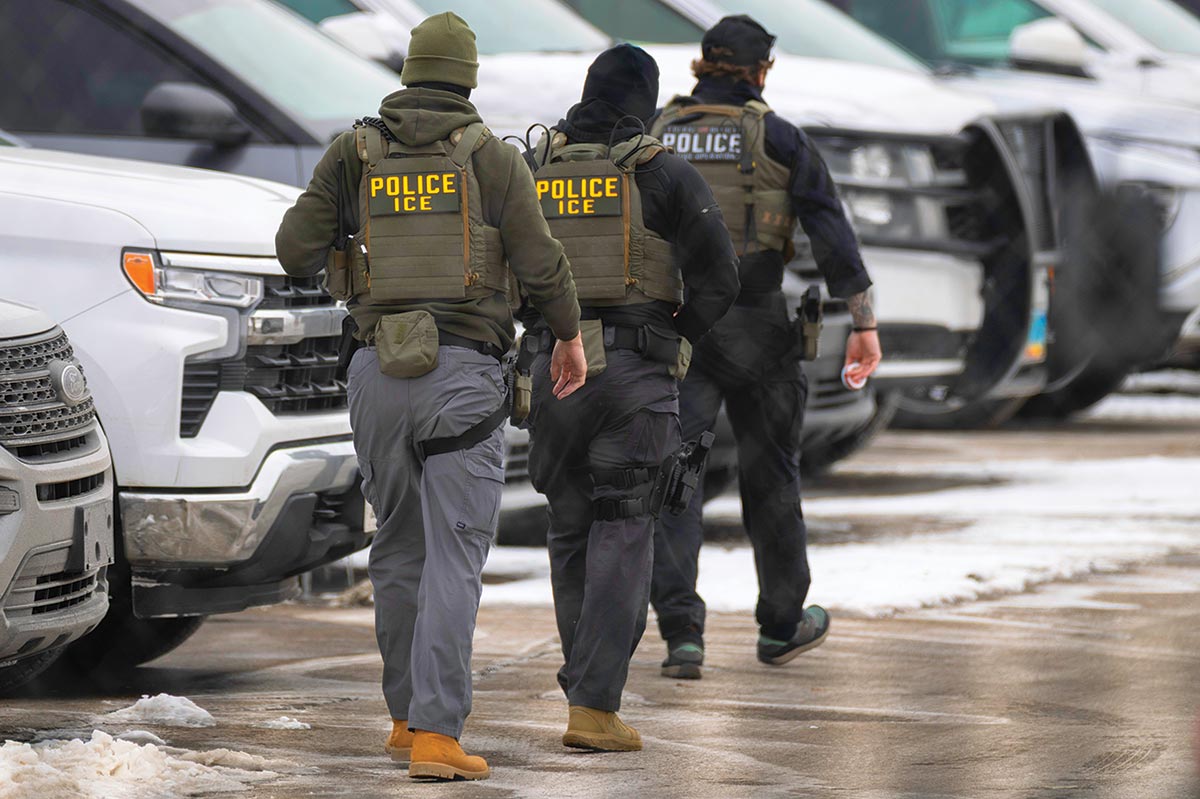
A task force consisting of Immigration and Customs Enforcement and Customs and Border Protection has invaded the Twin Cities, in defiance of state and local elected leadership. ICE and CBP agents demand that nonwhite residents prove their citizenship, kidnap children as young as 2 years old, and murder citizens who get in their way, all in the name of “law enforcement.” They have shown that they will refuse to be bound by any law or tradition that inhibits their agenda. The architect of Trump’s mass-deportation agenda, White House deputy chief of staff Stephen Miller, described Alex Pretti, a nurse whom five Border Patrol agents had subdued before a sixth shot him in the back, as a “domestic terrorist,” repeating what Kristi Noem, the secretary of the Department of Homeland Security (DHS), said of Renee Good, whom an ICE agent had killed in Minneapolis two weeks earlier.
Calling people who seek to protect their neighbors “terrorists” provides a crucial clue to the lineage that has led to Minnesota, Venezuela, and now Iran. The so-called War on Terror, a period many think of as having ended, shapes and enables Trump’s aggressions in ways both structural and direct. The Delta Force raid on Maduro’s fortified compound followed on decades of experience—and increased budgets—conducting similar raids in Iraq and Afghanistan. The ICE and CBP agents who have descended on Minnesota are kitted out in the kind of military-style camouflage and body armor that Iraqis and Afghans would recognize. The operation’s initial targets—Black immigrant Muslims from much-bombed Somalia—represent a trifecta of cohorts that were villainized by the nativist politics that the War on Terror revitalized. Both supporters and critics of the Minnesota deployment have compared it to a counterinsurgency campaign. Miller, who was also behind the kidnapping of Maduro, began his rise to White House deputy chief of staff through the ranks of the far right as a campus activist against Islam. Like Trump, Miller has long understood how to take post-9/11 fearmongering about Muslims and direct it toward nonwhite immigrants more broadly.
While many elements of the War on Terror shape Trump’s actions, the significance of the backlash against American power that the War on Terror inspired has, dangerously, not sunk in. After Trump demanded that Denmark cede Greenland to the US as imperial tribute, Canadian Prime Minister Mark Carney drew a rare ovation at the World Economic Forum in Davos for a speech abandoning the “pleasant fiction” that the “rules-based international order” was anything other than a vehicle for US prerogatives. Carney told Europeans horrified at being treated as the sort of foreign possession they themselves used to seize, “We are in the midst of a rupture, not a transition.” But with an insurgency yet to develop in Venezuela, and with NATO hustling to secure a deal to prevent a US move on Greenland, Trump has encountered little to deter him from his mode of imperialism before it reached Tehran. That’s ominous for Havana—and beyond.
Historians will spend decades debating the exact moment when the US empire discredited itself and irrevocably hobbled the international law that it masquerades as. Carney marked it at the Greenland crisis. Many others mark it at the beginning of Israel’s US-sponsored genocide in Gaza in October 2023. I would offer that it’s the War on Terror—corresponding as it does with all but the first 10 years of US global dominance—that defines American power during its period of supremacy. It is an era in which the United States inflicted sustained violence throughout the Global South and called it “order.” But the waves of resistance that US actions generated exposed American weakness. Resentment over the agonies of the War on Terror played an enormous role in Trump’s rise to power.
Every historical era is shaped by its predecessor. The War on Terror was shaped by the Cold War, and it now shapes the empire Trump is constructing. That makes the path of resistance to this new era of imperialism clear: The tools of the War on Terror must be destroyed before Trump uses them to finish building his world order, at home and abroad.
Trump’s unpopularity, both nationally and globally, is no constraint on his administration’s ambitions. Secretary of State Marco Rubio achieved a long-standing goal of his Miami-based Cuban American milieu by ousting Maduro. Venezuela’s oil subsidies to Havana make it the crucial domino to topple in pursuit of the Cuban émigrés’ supreme aspiration since 1959. According to The Wall Street Journal, the administration seeks to do exactly that this year.
Notwithstanding the recent talk about his “Donroe Doctrine,” Trump does not confine his imperial project to what the State Department recently called “our hemisphere.” On January 27, Trump threatened to end US aid to Iraq if that country’s parliament restores the troublesome Nouri al-Maliki to power, right after the Iraqis agreed to take thousands of Islamic State prisoners who were being held by the collapsing US-backed Kurdish forces in Syria.
Decapitating and coercing a regime instead of overthrowing it is a departure from recent modes of US imperialism. But Trump is also pursuing the familiar versions. His “Board of Peace” proposal places him atop a new, US-selected international coalition—one that includes Israel—that will govern Gaza like a 21st-century version of the British Mandate that gave Great Britain control over Palestine. Not only will Palestinian survivors of the Israeli genocide lose what remains of their sovereignty, but according to documents acquired by Sharif Abdel Kouddous of Drop Site News, they will be concentrated into “planned communities” built to monitor every aspect of their lives through “biometric surveillance, checkpoints, monitoring of purchases, and educational programs promoting normalization with Israel.” The Board of Peace also has value to Trump beyond the Levant: His administration floats it as a program to replace crucial functions of the United Nations and further undermine the creaking international institutions it considers unfit for the new era.
Another Trumpian innovation has been a lack of interest in manufacturing consent for any of this. One reason is the persistent rhetoric of the War on Terror: Trump simply called Maduro’s government a “terrorist organization,” much as Noem and Miller did to justify the executions of Good and Pretti, and much as Trump did in his first term when describing the protesters who marched against the killing of George Floyd in 2020. When Pretti’s status as a gun owner wobbled conservatives’ faith in ICE, MAGA strategist Steve Bannon, who occasionally postures as an opponent of endless war, doubled down on the “terrorist” rhetoric on his podcast. All of it attests to how durably the politics of counterterrorism has stifled dissent, intimidated opposition, and enabled state violence—and to how well Bannon, Trump, and MAGA learned from the ever-shifting targets of the War on Terror that, ultimately, the terrorists are whoever the powerful insist they are.
Of course, Trump can also rely on a pliant media to color inside the lines he draws. After the Caracas raid, mainstream news outlets breathlessly foregrounded its tactical acumen and backgrounded the reality that the US had once again overthrown a sovereign head of state to seize oil resources. As the Iran War coalesced, with the buildup of US sea and air forces, news coverage became as bellicose and hidebound as during the buildup to the Iraq invasion. “Before Any Strike on Iran, U.S. Needs to Bolster Air Defenses in Mideast,” read a typical Wall Street Journal headline. You didn’t learn anything in that article about any planning for what would happen the day after Trump and Israeli Prime Minister Benjamin Netanyahu launched their illegal and unprovoked aggression, an omission reminiscent of the disinterest that 2003-era journalism had in what would happen after George W. Bush overthrew Saddam Hussein. That day after, it turns out, is characterized by the assassination of Supreme Leader Ayatollah Ali Khamenei; the shocking bombing of a girls’ elementary school in Minab that killed at least 153 people, including dozens of children; the deaths of three US troops; and destruction in the UAE, Bahrain, Kuwait, Israel, and elsewhere.
It has become fashionable to speak of Minnesota as the War on Terror coming home. The truth is that the War on Terror was always being waged simultaneously at home and overseas. Federal forces targeted non-Muslim immigrant communities along with Muslim ones as soon as the Twin Towers fell on 9/11. Not only were ICE and CBP created in that climate, but as early as the multi-state raids on Swift meatpacking plants in 2006, ICE was terrorizing working-class immigrants at scale. What is happening now is that US citizens are getting a taste of the treatment previously reserved for noncitizens—and for marginalized communities who live the vulnerable reality of conditional citizenship.
ICE has all but announced that it is beyond the reach of the law. In addition to the slayings and the roundups—if such things can be set to the side—the agency has declared that it needs no judicial warrant to enter someone’s home. On January 28, a judge identified at least 96 court orders that ICE had violated in that month alone.
ICE agents seem gleeful about inflicting the “reckoning and retribution” that Trump promised. One muttered “Fucking bitch” after executing Good; another applauded after Pretti was shot. According to a lawsuit, ICE delivered a detainee with a “catastrophic” head wound to a Minnesota hospital and claimed that he “purposefully ran headfirst into a brick wall.” After an agent filmed a protester in Maine—apparently as part of an effort to feed a growing number of watch lists, according to the journalist Ken Klippenstein—he taunted, “We have a nice little database and now you’re considered a domestic terrorist. So have fun with that.” Good’s killer, Jonathan Ross, is another example of the dialectical advance of the War on Terror: He joined the Border Patrol two years after returning from a combat tour in Iraq.

No amount of retraining can reform agencies that consider Americans an internal enemy. They must be abolished before they kill at greater scale. But the dominant faction in the Democratic Party is doing its best to avoid recognizing ICE for the threat that it is.
ICE is predicated on the post-9/11 idea that the civil offense of being undocumented ought to be met with a deportation force on the hunt in the interior of the country. Such operations cannot be divorced from nativist politics. Similarly, whatever legitimate border-control functions exist cannot be carried out by what the former Border Patrol agent Jenn Budd has called a “notoriously corrupt and racist federal agency.” Alongside abolition must come accountability for the crimes that federal agents have committed during this crackdown. A central lesson of the War on Terror is that impunity for one atrocity—the “absolute immunity” that Vice President JD Vance falsely declared ICE agents to possess—is a green light for the next.
And it’s not only the DHS. Months before Maduro’s kidnapping, when the US military was blowing up fishing boats in the Caribbean, Adm. Mitch Bradley, then the commander of the Joint Special Operations Command (JSOC), approved the shocking “double-tap” strike on survivors clinging to the wreckage of a boat that the US had just destroyed. Killing the shipwrecked is as blatant a violation of the Geneva Conventions as exists. The Pentagon’s own manual on the law of war uses “orders to fire upon the shipwrecked” as an example of a “clearly illegal” command that service members have an affirmative duty to refuse. The New York Times reported that one of the aircraft involved in the strike was painted like a civilian plane. That is known as the war crime of “perfidy,” and it’s the central charge before the military commission trying the Guantánamo Bay detainee Abd al-Rahim al-Nashiri, accused of blowing up the USS Cole in 2000.
JSOC, the signature military command of the War on Terror, did not descend to this level overnight. Nearly 25 years of relentless deployment has resulted in a grisly moral rot that has recently been documented in books like David Philipps’s Alpha, Matthew Cole’s Code Over Country, and Seth Harp’s The Fort Bragg Cartel. A command structure that orders the shipwrecked killed cannot be tolerated by any military that postures as lawful, to say nothing of honorable. Special operations must be reconfigured under one that can be trusted to obey the law.
These are only the most urgent tasks; there will be much abolitionist work beyond. The Patriot Act, Section 702, and the rest of the post-9/11 surveillance authorities have decimated privacy and accelerated a surveillance-capitalist industry that has spawned companies like Palantir that build AI tools for ICE. But even with public outrage coalescing around Minnesota, the Democratic leadership cannot bring itself to call for the abolition of ICE. Its objections to Trump’s imperialism have been just as weak. At Davos, California Governor Gavin Newsom, a likely presidential hopeful, implored the Europeans to “have a backbone” against Trump, but Newsom also opposes abolishing ICE. New Hampshire Senator Jeanne Shaheen, a senior member of the Armed Services Committee, rejected the Pentagon’s recent National Defense Strategy not for its unapologetic imperialism but for not “taking China seriously as the pacing challenge to our nation.” Her Vermont colleague Peter Welch said that he supports “immigration enforcement, not these widespread roundups,” as if the widespread roundups are not the fruit of immigration enforcement.
Trump’s actions are reminiscent of the erratic bellicosity of collapsing empires. But the current Democratic Party cannot imagine a new order; it defaults to its Biden-esque preference for restoring a failed one. Representative Delia Rodriguez of Illinois is the rare Democrat who recognizes that the DHS “needs to be dismantled.” She reflects the explosion in public support for abolishing ICE, at which the party leadership rolls its eyes. It is tragic and typical for the Democratic Party to cynically cling to the politics of security at the moment when the security services—not Venezuela or Cuba or Iran—pose the greatest threat to American life and liberty.
Through every stage of the War on Terror, the establishments of both parties and within the security bureaucracy rejected the argument that their enterprise threatens the very freedoms they claim to defend. They succeeded in banishing from respectability the calls to abolish the institutions, authorities, and ever-metastasizing operations derived from the War on Terror. The results of their victory are on display from Minnesota to Venezuela. Never again can America afford the delusion that what it does abroad is cordoned off from what it does at home. But that is a lesson for after the destruction of this latest phase of the American empire.
More from The Nation
The Iranian Voices America Isn’t Hearing The Iranian Voices America Isn’t Hearing
We need to listen to those who oppose both the Islamic Republic’s authoritarianism and foreign military escalation.
The US Attacks Iran in a War of Aggression The US Attacks Iran in a War of Aggression
The US has waged many wars—but this is one of the most senseless we've ever seen.
Opposing Trump’s Cruel Assault on the Cuban People Opposing Trump’s Cruel Assault on the Cuban People
An interview with Representative Jim McGovern.
A New Report on Alexey Navalny’s Death A New Report on Alexey Navalny’s Death
Boris Kagarlitsky and hundreds of unknown political prisoners remain in Russia’s prisons.
Rubio, Rodeo, and Tall Tales of Empire Rubio, Rodeo, and Tall Tales of Empire
The secretary of state has provoked the ire of Britain’s first black woman lawmaker and put the spotlight once again on how the US has historically treated people of his own herit...
Mexican President Claudia Sheinbaum and the San Quintín Justice Plan Mexican President Claudia Sheinbaum and the San Quintín Justice Plan
Field workers’ highway blockades send a warning to Mexico’s president.

