
The Assassination That Paved the Way for Trump’s Venezuela Attack
How Trump’s illegal 2020 killing of Qassem Soleimani—and the West’s indifferent response—laid the groundwork for the brazen abduction of Nicolás Maduro.
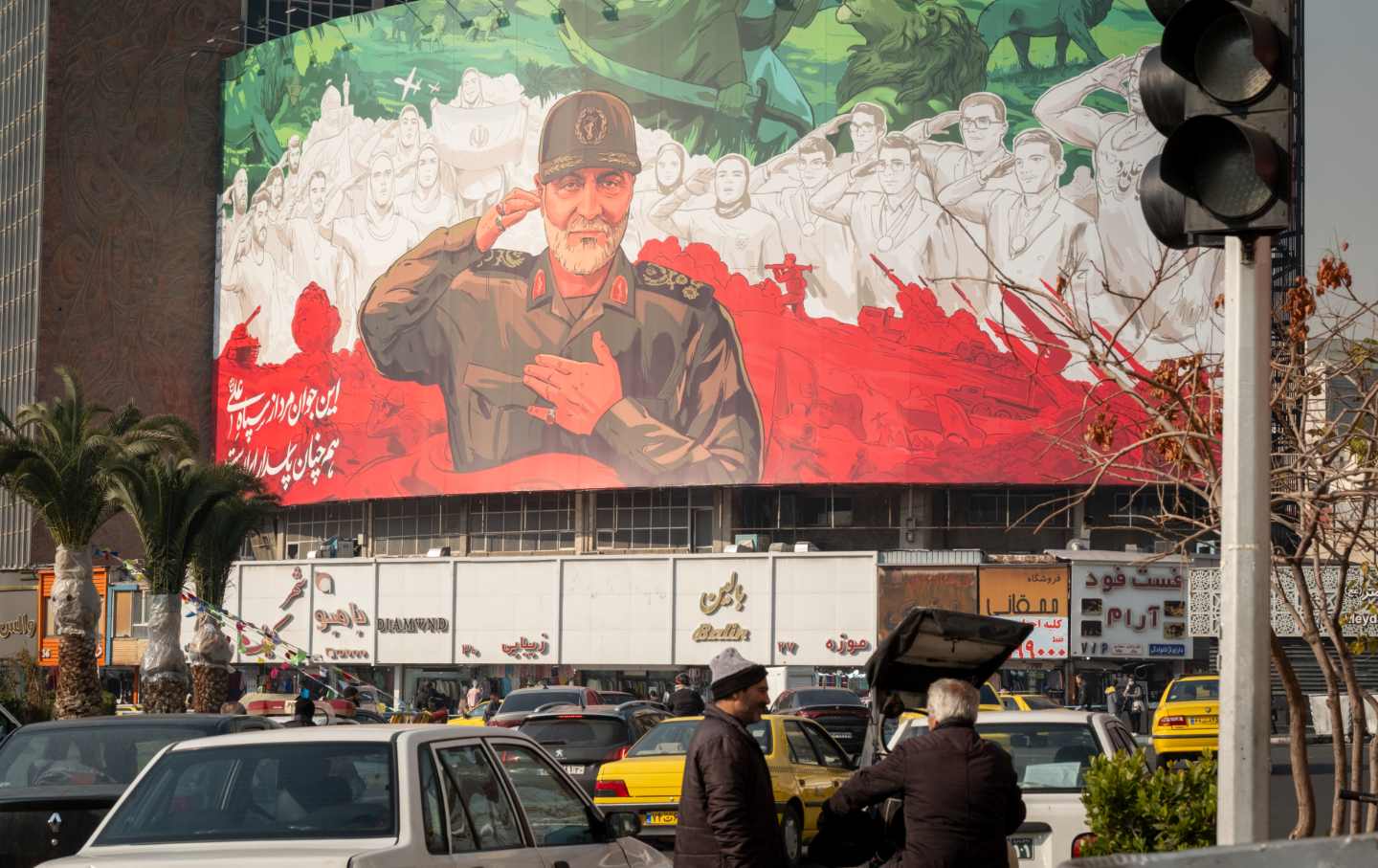
A billboard depicting symbolic images of former commander of the Islamic Revolutionary Guard Corps Quds Force Maj. Gen. Qassem Soleimani and Iranian athletes is hung on a state building in downtown Tehran, Iran, on January 6, 2026.
(Morteza Nikoubazl / NurPhoto via Getty Images)The American abduction of Venezuelan President Nicolás Maduro is undoubtedly a massive and significant historical moment. Yet, despite the headlines it has generated and the victories the US government is touting, it is being simultaneously treated as something of a banal event—an expected move for the American government to undertake.
The news of the seizure by American law enforcement of the leader of a sovereign state was met with some pro forma concern from the leaders of many European countries. But most of their statements were tinged with an element of plain relief, despite the obvious chasm that had just been opened up beneath the world.
Despite Greenland’s being threatened by Trump in the same breath as the announcement of Maduro’s abduction, there seemed to be no understanding that things could get worse. “We are not in the situation where we are thinking that a takeover of the country might happen overnight,” Greenland Premier Jens-Frederik Nielsen said on Monday. “You cannot compare Greenland to Venezuela. We are a democratic country.” To America however, democracy or dictatorship, or being a state or non-state actor, does not matter. All that does matter in the present day is “terrorist” and “non-terrorist.”
The most obvious comparison for this action would be the overthrow of Panamanian General Manuel Noriega, the de facto military leader of the country in the 1980s who was captured by his former allies in the US military 36 years to the day before Maduro’s kidnapping. Like Noriega, Maduro’s administration had been deemed thoroughly illegitimate by Western countries years earlier, and there had been many attempts from both within and without Venezuela to overthrow his government, spearheaded by US allies like Juan Guaidó and Maria Corina Machado. But Noriega’s arrest, though also in contravention of international law, was preceded by an invasion of the country, with Panama having declared a state of war with the United States, and with Noriega evading US troops for days after they landed on Panamanian territory.
Arguably a better point of comparison—and one much more in line with the White House’s current justifications and priorities—is another Trump administration operation that took place on January 3, six years ago: the 2020 assassination of Iranian military commander Qassem Soleimani.
Trump himself linked the two events in his press conference on Saturday. “And if you think about it, we’ve done some other good ones, like the attack on Soleimani, the attack on [ISIS leader Abu Bakr] al-Baghdadi, and the obliteration and decimation of the Iran nuclear sites just recently in an operation known as Midnight Hammer, all perfectly executed and done,” he said.
Soleimani’s killing is certainly within the lineage of the raids on Baghdadi, as well as the 2011 killing of Osama bin Laden, but it has much more in common with Maduro’s kidnapping than those actions that came before it. Bin Laden and al-Baghdadi were non-state and quasi-state actors, respectively. Soleimani, by contrast, was a sovereign actor, the head of a special operations branch of a UN member state’s armed forces. His killing, and the collective shrug with which it was greeted by the rest of the world, helped pave the way for the even more flagrant breach of international law that Trump has now carried out with his kidnapping of Maduro.
Iran was not at war with the United States at the time of the assassination. Congress had not authorized any kind of military action against it. But none of that mattered. An attack on a lieutenant general of a national military could now be undertaken as if it were a drone strike in Somalia or in Pakistan, normalized and routine despite the trampling of sovereignty it represented. Soleimani’s killing was the opening volley of that new world order, and from there, everything could be justified.
Soleimani’s assassination was justified by then–Secretary of State Mike Pompeo under the guise that he represented an imminent threat to US troops in Iraq, though no evidence of what Soleimani was planning in the future was ever provided. Post-hoc explanations relied instead on the actions undertaken by Iranian allies in Iraq at the US embassy that past December, where, in response to American airstrikes on an Iraqi militia opposed to the ongoing US occupation, demonstrators rammed the gates, set fires, and planted militia flags. No one was killed or seriously hurt, but the humiliation was evidently enough to warrant a response, and Soleimani, despite having no proven involvement in the attack, was named as the prime conspirator who needed to be killed for challenging American power in such a public manner.
While many countries in the Global South, such as China, India, and South Africa, responded with alarm at Soleimani’s killing and urged restraint, responses from Western nations—the ones who created the institutions of international law that were being so brazenly defied—ranged from relatively unconcerned to accepting America’s justifications to expressing satisfaction that a Western adversary had been killed. Then–UK Prime Minister Boris Johnson summed up the general attitude in a speech delivered later that same week. He called Soleimani “a threat to all our interests” and warned that “calls for retaliation or reprisals will simply lead to more violence in the region and they are in no one’s interest.”
In other words, the killing of another country’s military leadership was simply a bump in the road, perhaps even an ill-considered overreach, but by no means an an alarm bell being rung of actions to come, and certainly not a sign of a collapsing liberal order. The world could rest easy on this one.
The spurious designation of Qassem Soleimani as a global terrorist, something long requested by Benjamin Netanyahu, gave the green light for the expansion of the designation to other entities long held off from the moniker out of fear of its implications. The Houthi movement, despite its control of the Yemeni capital and its overseeing of humanitarian aid channels to alleviate famine, was designated as a terrorist organization by the Trump administration in its last days in 2021. (The Biden administration quickly revoked this designation, but Trump restored it when taking office a second time.) Then Israel’s genocide in Gaza, aided and abetted by the United States, poured gasoline on what was, in contrast, a small flame. Now seemingly anyone and anything could be a terrorist, related to terrorism, or useful to terrorism. This meant that world leaders, those who happened to be opposed to the maw of the Western war machine, were now ripe for the taking.
The dangers of not blowing the whistle when Soleimani was assassinated became more and more evident during Israel’s war with Iran, when Supreme Leader Ali Khamenei was directly threatened with assassination. National leaders, when killed by foreign adversaries, had usually been dealt with through coups and via proxy militias. Israel promised to dispense with any intercessors, with Defense Minister Israel Katz vowing that Israel’s “long arm” will “reach you personally.” Few condemnations of such a public threat emerged, and despite an American veto on an assassination, Israel continued to ratchet up its aims to not just kill one national leader, but an entire government.
Popular
“swipe left below to view more authors”Swipe →On August 28, amid Israel’s attacks on Yemen, the Israeli Air Force launched a strike that targeted what the Houthi movement-led government would later describe as a routine government workshop. Nearly the entire cabinet of the government in Sana’a was killed, alongside the Yemeni Armed Forces’ chief of staff. The IDF’s official communication phrased the killing of the prime minister, the minister for foreign affairs, the minister of culture, and a host of other cabinet officials, as a terrorist neutralization op:
ELIMINATED—Houthi Prime Minister, Ahmed Al-Rahawi, along with additional senior officials of the Houthi terrorist regime were eliminated during an IDF strike in Sanaa, Yemen. At the facility struck were senior officials responsible for the use of force, the military buildup of the Houthi terror regime, and the advancement of terror actions against Israel.
Despite the slaughter of an entire civilian government, there was only one condemnation from the government of another state: Iran, whose leadership had been threatened by Israel before. The actual complexities of the Yemeni state under the leadership of the Houthi movement were brushed aside. Everyone was deemed an armed terrorist, on par with the depictions of Al Qaeda operatives in Afghan caves, and thus the face of a minister for youth and sports could be plastered with a red X on Israel’s official government channels, the same as Osama bin Laden’s.
Those in the United States who did acknowledge the strike often did so with effusive praise; South Carolina Senator Lindsey Graham spoke of the “deserved” deaths of “religious Nazis” and said he hoped for “more action to follow.” Graham had also been a key supporter of escalation closer to home, in Venezuela, whose government was also being crumpled by the White House into the shape of a singular terrorist network.
Now in Venezuela we are seeing all of these threads—dubious claims of terrorism, trumped-up justifications for extralegal violence, blatant disregard for international law, and mass indifference from the political class—come together. The United States invented a narco-terrorist group out of whole cloth, “Cartel of the Suns,” to pin against the backs of Maduro and his government. (On Monday, it was reported that the Justice Department had quietly abandoned this false claim.) Despite the nonexistence of this organization—and the broader lack of evidence tying him to drug trafficking networks—Maduro has been retroactively turned into a terrorist mastermind, and thus, an expected recipient of American justice. If the response to the arrest of him and his wife has been any indication, Europeans and Canadian officials see no threat from this escalation, despite renewed threats to Greenland immediately following the strikes on the Venezuelan capital.
It is evident from Trump’s statements following Maduro’s arrest that he is not done with imposing his will over Venezuela. Already, threats are streaming in that Colombia’s President Gustavo Petro must be dealt with, and that Mexico and its president, Claudia Sheinbaum, are being controlled by cartels. Petro and Sheinbaum are nowhere near as demonized in the Western world as Maduro was, but they will inevitably become targets all the same.
It is easy to point obvious fingers at America’s adversaries being emboldened by such moves (Russia’s National Security Council deputy chair has already suggested abducting the German chancellor), but the arguably more dangerous threat comes from America itself. If Europe does not draw a line in the sand now, who knows where American crosshairs will eventually drift? They may come closer to the Arctic Circle than perhaps the Europeans would like.
More from The Nation
Mexican President Claudia Sheinbaum and the San Quintín Justice Plan Mexican President Claudia Sheinbaum and the San Quintín Justice Plan
Field workers’ highway blockades send a warning to Mexico’s president.
Inside the Iran War Industry Inside the Iran War Industry
Using an old playbook with powerful new tools, it may be closer than ever to turning a US–Iran war into reality.
The Cost of US Withdrawal From 66 International Organizations, Conventions, and Treaties The Cost of US Withdrawal From 66 International Organizations, Conventions, and Treaties
How going it alone reduces our own sovereignty.
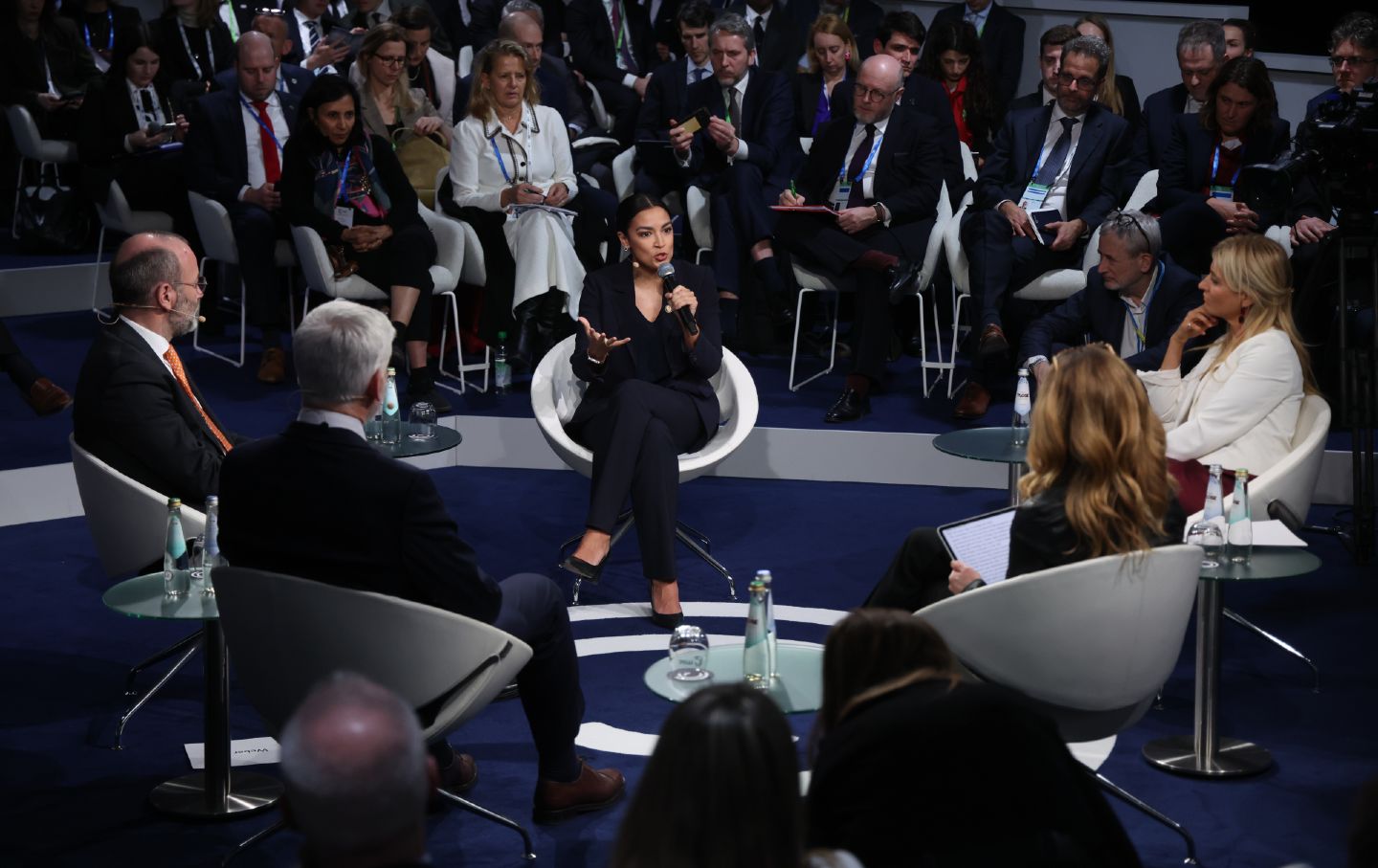
The Munich Security Conference Marks the End of the US-Led Order The Munich Security Conference Marks the End of the US-Led Order
US politicians flooded the summit—but Europe no longer sees the United States as a reliable partner.
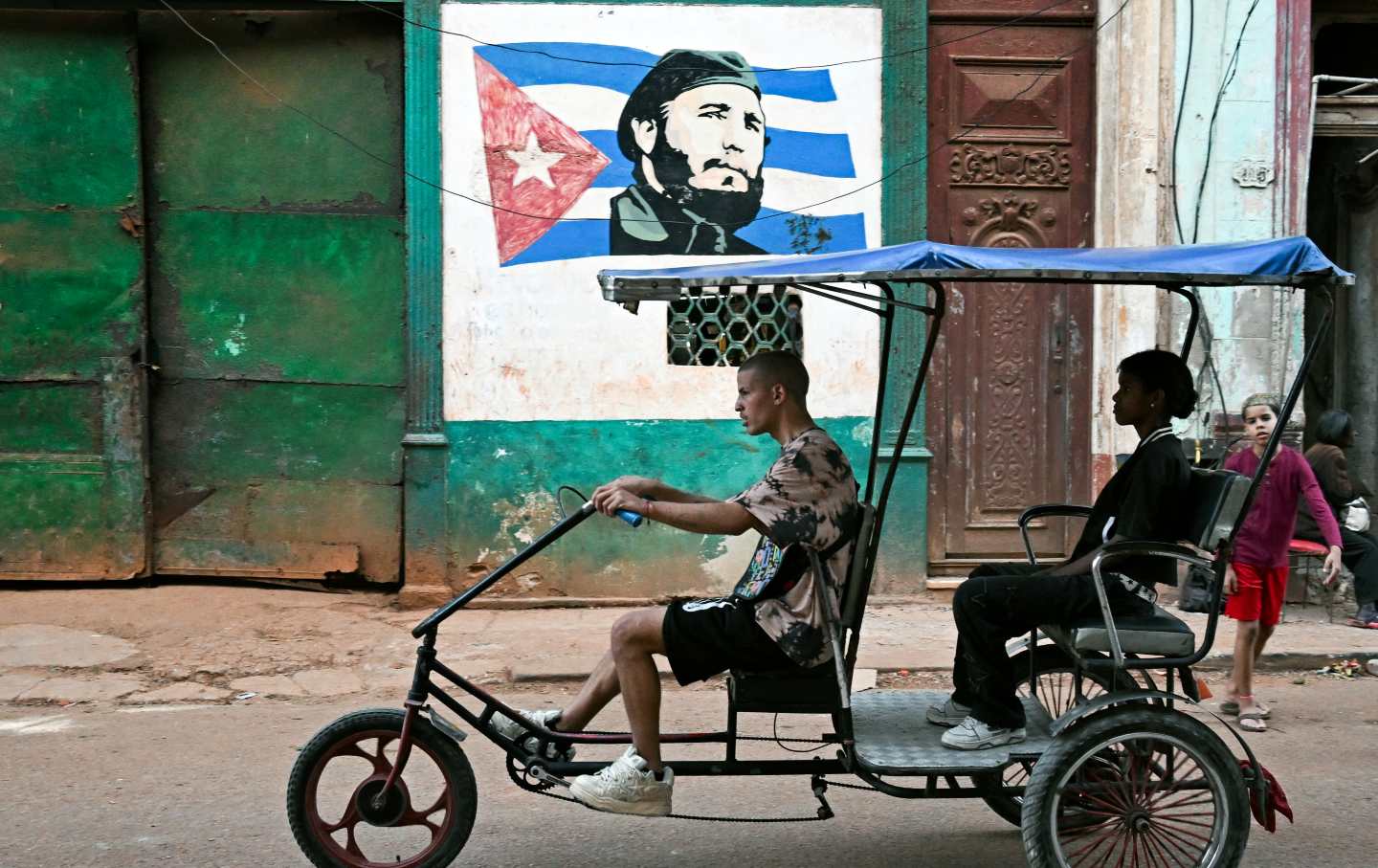
Cuba Hunkers Down as a US Oil Blockade Brings a Humanitarian Crisis Cuba Hunkers Down as a US Oil Blockade Brings a Humanitarian Crisis
Fear but no panic on the streets.
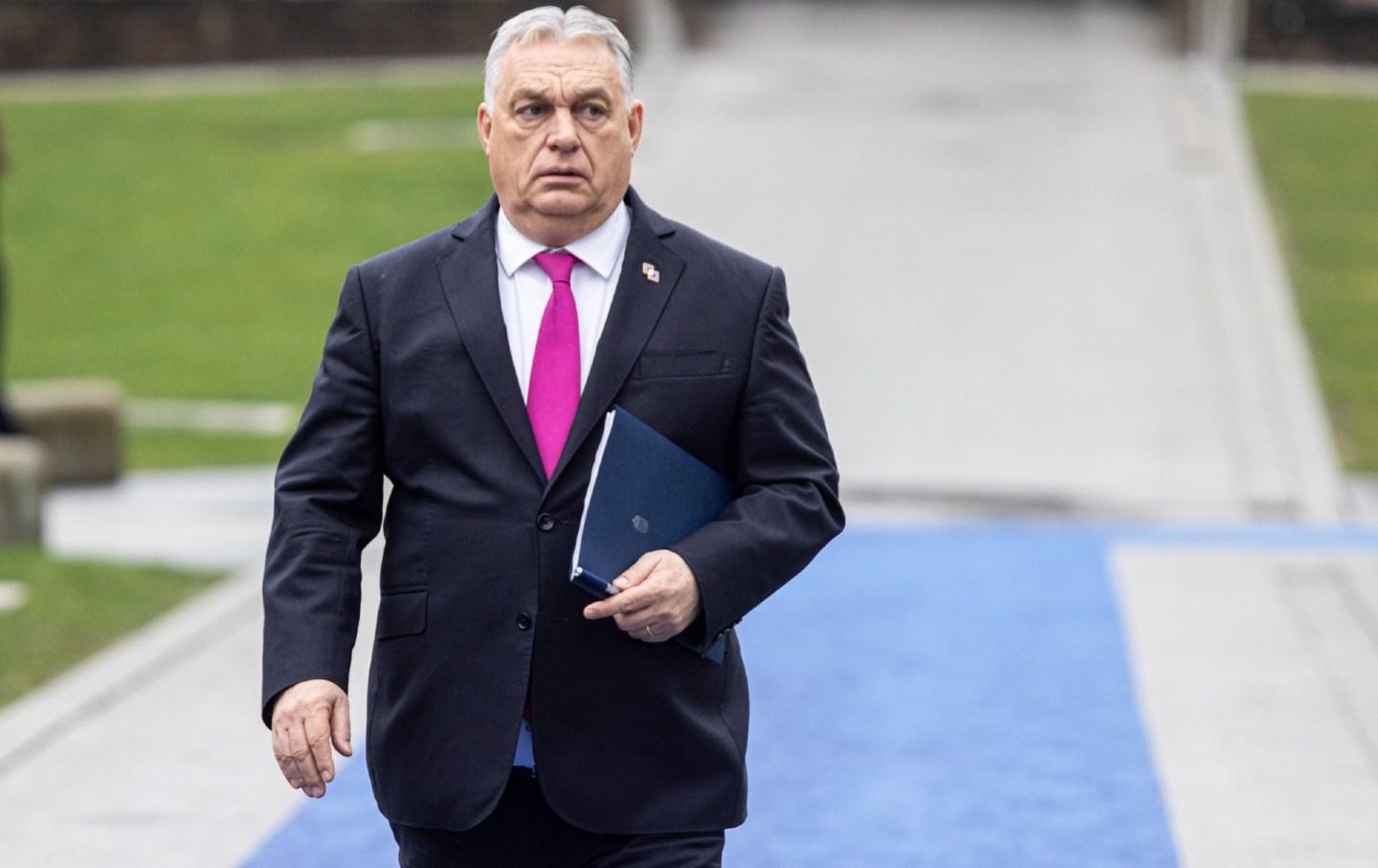
Is This Viktor Orbán’s Last Stand? Is This Viktor Orbán’s Last Stand?
After 16 years in power in Hungary, his Fidesz party is trailing in the polls by double digits behind a new opposition party.

