
Will Trump’s Threats Destabilize Relations With Pakistan and Afghanistan?
The president’s stated intentions to take over Bagram Air Base risk a departure from the détente of recent years.
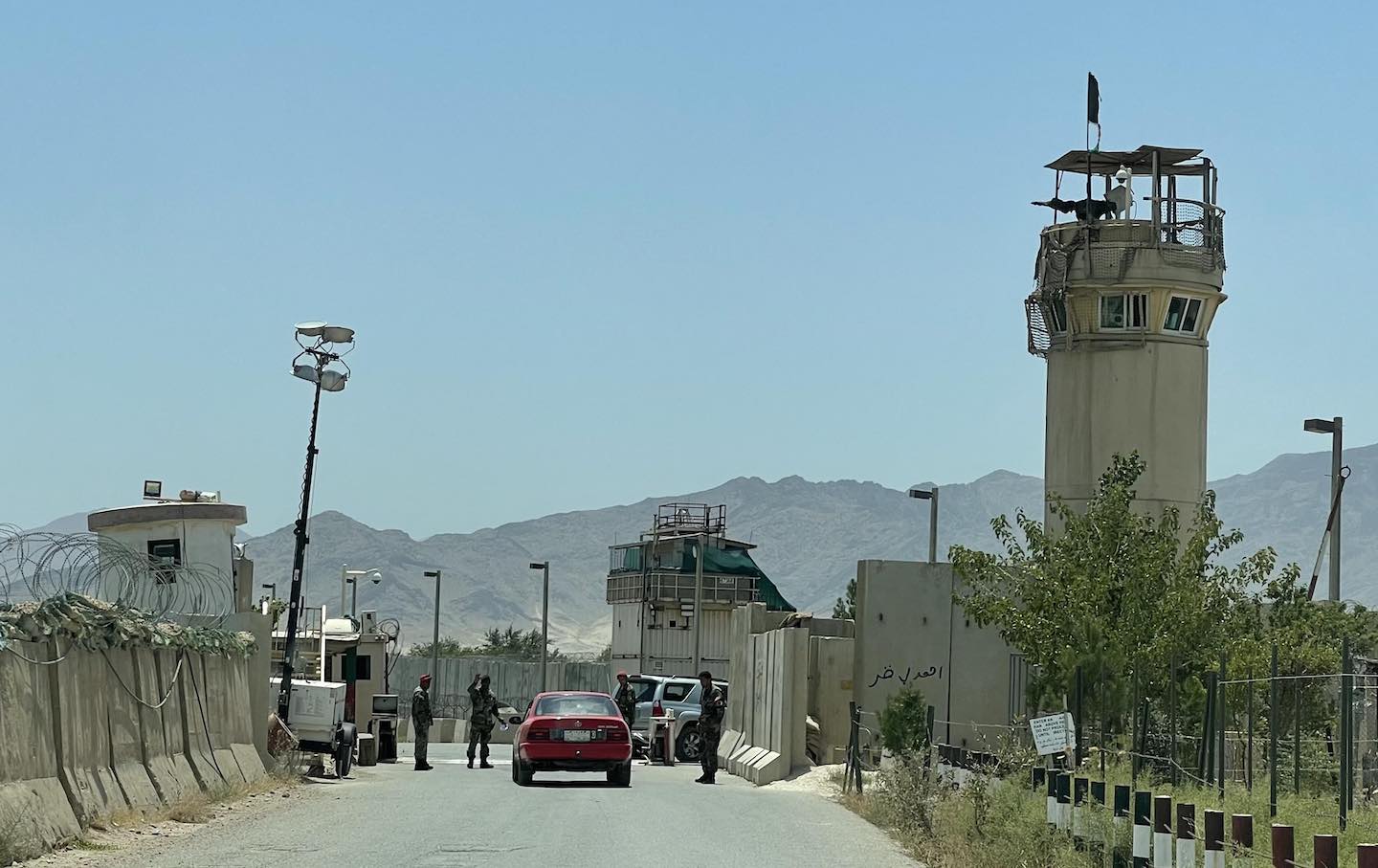
The Afghan National Army after US forces left Bagram airfield in the north of Kabul, Afghanistan, in July 2021.
(Haroon Sabawoon / Anadolu Agency via Getty Images)The Pakistan–United States relationship, historically a transactional one, has been frayed ever since Osama bin Laden was found hiding in a compound in the Pakistani garrison city of Abbottabad in 2011. Toward the end of the Imran Khan premiership in 2022, much was made of the fact that President Biden did not deem it necessary to speak to Khan over the phone—even when the Taliban were retaking Afghanistan.
But last summer’s conflict between India and Pakistan gave the latter an opportunity to massage President Donald Trump’s ego. According to geopolitical analyst Christine Fair, Pakistan did this by acknowledging Trump’s efforts in mediating a ceasefire to the conflict, and by nominating him for a Nobel Peace Prize. “I don’t think Trump is a sophisticated creature. I think with Trump, flattery goes a really, really long way,” she says. “He’s constantly referring to himself as a peacemaker. It’s a big part of his image and the Indians weren’t playing along.”
In the aftermath of that conflict, Trump has given a number of indications that the flattery is working. He has repeated the Pakistani claim that the Pakistan Air Force was able to shoot down seven Indian warplanes during the four-day war. He also hosted the head of Pakistan’s military, Field Marshal Asim Munir, at a White House lunch in June and reduced the tariff on Pakistani imports to 19 percent—compared to the 50 percent on goods from India.
In Pakistan, it is also being speculated that there is an element of quid pro quo to this rapprochement. On April 26—days before Pakistan and India went to war—Pakistan’s Crypto Council signed an agreement with World Liberty Financial—a firm in which the Trump family holds a 60 percent stake. The agreement came after a delegation led by Zachary Witkoff—the son of Trump’s Middle East Envoy, Steve—met with several members of the Pakistani government in Islamabad.
Today, there are whispers that Pakistan’s powerful military establishment, in collaboration with the United States, is considering a regime change operation to topple the Taliban government in Afghanistan. The speculation follows the deadliest wave of fighting between the two South Asian neighbors since the Taliban retook Afghanistan in the Summer of 2021. In the 10-day conflict, which ended in a ceasefire mediated by Turkey and Qatar, dozens were killed and hundreds injured.
The Taliban, many of whose leaders were educated in Pakistani madrasas, were once considered allies of the Pakistani state, which was instrumental in bringing them to power in 1996. But in the aftermath of 9/11, that relationship began to change. At the time, Osama bin Laden was living in Afghanistan under the protection of the Taliban, who refused to extradite him to the United States. The Bush administration responded by declaring war against the Taliban and strong-arming Pakistan into joining the campaign.
For the next 20 years, the Pakistani state was accused of playing a nefarious “double game” in the region, where it was said to be aiding the NATO war effort at the same time as it was helping to keep the Taliban afloat. Four years ago, when the Taliban retook Afghanistan, Pakistan’s then–prime minister, Imran Khan, lauded the Taliban for breaking “the shackles of slavery.” At around the same time, a video emerged of the head of Pakistan’s premier spy agency drinking a cup of tea in a hotel in Kabul and declaring that “everything will be OK.” It was, obvious to anyone watching that the victory of the Taliban was also being celebrated by the Pakistani state.
But everything was not OK. Ever since the Taliban returned to power in 2021, Pakistan has experienced a sharp uptick in terrorist violence along its Northwestern border. Many of these attacks have been perpetrated by the Tehreek-e-Taliban Pakistan—a militant offshoot of the Afghan Taliban with whom it shares religious and ideological similarities. Pakistan accuses the Taliban of giving these militants sanctuary, as well as a base of operations from which to plan their attacks. And though Kabul has repeatedly denied the accusation, including in this magazine in 2023, the relationship between the neighbors has become increasingly toxic.
Things finally came to a head on the morning of October 9, when Pakistan reportedly carried out a series of air strikes on Afghan territory. In the intense border clashes that followed, Islamabad claims to have killed 200 militants, while the Taliban have claimed the deaths of 58 Pakistani soldiers. Now, with the ceasefire agreement barely four days old, analysts are beginning to worry that Pakistan may be on the verge of becoming embroiled in a large-scale campaign to remove the Afghan government from power. Central to this hypothesis is the growing rapprochement between Islamabad and Washington, as well as President Trump’s desire to establish control over Bagram air base.
On September 20, two days after raising the issue of Bagram at a news conference in London, Trump took to his Truth Social platform to deliver a pointed threat to the Taliban. “If Afghanistan doesn’t give Bagram Airbase back to those that built it, the United States of America, BAD THINGS ARE GOING TO HAPPEN!!!” he posted.
Analysts have put together this stated desire on the part of the US president with the change in language of the Pakistani state toward Afghanistan and concluded that the United States and Pakistan may be planning to remove the Taliban by force.
South Asia scholar Farzana Shaikh points out that the Taliban government is now routinely being referred to as a “regime” by Pakistan, “with all sorts of suggestions that it does not enjoy popular support, that it is not inclusive and that it is not representative. All of this points to the fear that there may be some inside Pakistan’s security establishment who think that with all this US talk of seizing Bagram, this is the moment to just tighten the screws.”
But if history is any guide, Pakistan and the US should be wary of such an engagement. From the colonial era to the present day, anyone who has tried to interfere in Afghanistan has experienced defeat. The United States, having spent more than $2 trillion over a 20-year campaign, was forced to withdraw in ignominy less than five years ago. Pakistan, on the other hand, does not have that kind of money to spare.
More from The Nation
Trump and Netanyahu Want to Turn Iran Into a Failed State Trump and Netanyahu Want to Turn Iran Into a Failed State
This war looks designed to cause maximum chaos and instability. The world will pay a high price.

The War on Terror Paved the Way for Trump's Rise—Now He's Making It His Own The War on Terror Paved the Way for Trump's Rise—Now He's Making It His Own
Only the total abolition of the DHS can restore freedom.
The Iranian Voices America Isn’t Hearing The Iranian Voices America Isn’t Hearing
We need to listen to those who oppose both the Islamic Republic’s authoritarianism and foreign military escalation.
The US Attacks Iran in a War of Aggression The US Attacks Iran in a War of Aggression
The US has waged many wars—but this is one of the most senseless we've ever seen.
Opposing Trump’s Cruel Assault on the Cuban People Opposing Trump’s Cruel Assault on the Cuban People
An interview with Representative Jim McGovern.
A New Report on Alexey Navalny’s Death A New Report on Alexey Navalny’s Death
Boris Kagarlitsky and hundreds of unknown political prisoners remain in Russia’s prisons.

