
What’s Next for Syrian Refugees?
While Syrians around the world are celebrating the fall of Bashar al-Assad’s regime, they are still cautious about what comes next.
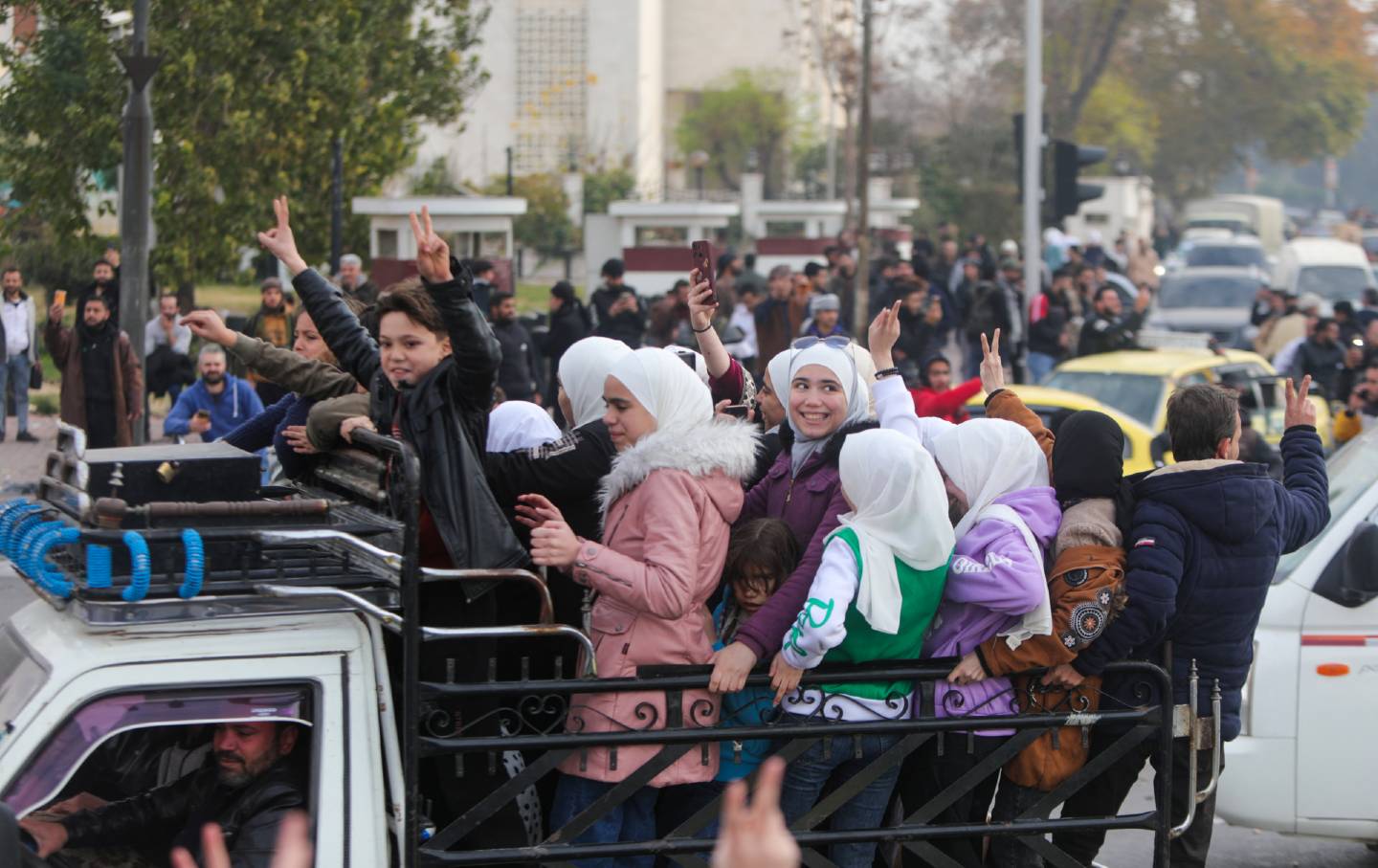
Celebrations erupted around Syria and crowds ransacked President Bashar al-Assad’s luxurious home on December 8 after Islamist-led rebels swept into Damascus and declared that he had fled the country, in a spectacular end to five decades of Baath party rule.
(Bakr al Kassem / AFP via Getty Images)
This article originally appeared at TomDispatch.com. To stay on top of important articles like these, sign up to receive the latest updates from TomDispatch.com.
Six years ago, at the time of the first Trump administration’s Muslim ban and its initial round of vicious anti-immigrant policies, I visited a refugee camp on the Greek island of Samos to see how Europe was handling its own immigrants and refugees. Within a day, I met two Syrians, Eyad Awwadawnan and Hasan Majnan, who had fled Bashar al-Assad’s brutal dictatorship only to end up in a filthy, overcrowded camp in a country that didn’t want them with a future they could not foresee.
That was June 2018, and I’ve kept in touch with them both ever since. So, when Assad’s regime fell on December 8, 2024, ending two generations of perhaps the most murderous dictatorship in the modern world, I contacted Eyad and Hasan to see how they felt.
“How am I feeling?” Hasan said over WhatsApp that day. “I’m flying in the sky! I have been watching the news for the last 24 hours. I’m feeling proud. I was on the right side of history. Finally, we won! The lion has fallen!”
In Arabic, Assad means “lion,” although that wasn’t his real name. Hafez, Bashar’s father, had adopted it to look strong.
Hasan was born in the northeastern Syrian city of Manbij, 18 years before the 2011 revolution and civil war that left some 580,000 civilians dead and displaced at least 13 million more.
Because Manbij sits in a strategic position near the border with Turkey, as soon as the first signs of revolution stirred in its streets, it became a battleground between multiple forces. First, it was under the control of Assad, whose military occupied the city until 2012. Then it fell to the revolutionary Free Syrian Army, which held it until 2014. Next, the Islamic State of Iraq and Syria (ISIS) seized and controlled it until 2016, only to lose it to the Syrian Democratic Forces, who, in turn, lost it again to the Syrian Army (then backed by Russia). Recently, Manbij has fallen under the control of Kurdish militias and their allies. And that is only a rough summary of the city’s grim and complex history.
For Hasan, growing up in such a political football of a place affected every aspect of his life. Yet many of his memories of Syria before the civil war are remarkably sweet. “In my school we had Christians and Muslims, we had Kurds and Arabs and Turkmen,” he told me. “We were friends, in the same class with the same teacher. I want Syria to be like that again. I don’t want different religions, with each of us hating one another because we’ve lost a brother or a friend. I don’t want any of that to come between us. And I don’t want ISIS to prevail either. I want us to live like before, or even better. To live in peace and build Syria together, be happy and help each other.”
In 2013, Hasan and his identical twin, Hussein, joined the Free Syrian Army to fight Bashar, as they liked to call him, and free Syria from his grip. Hasan was then captured by ISIS, who hung him from a ceiling and whipped him in public. After three weeks of such treatment, they let him go as long as he agreed to beg their forgiveness, attend Sharia lessons for 15 days, and then join them as a fighter. They took his ID and told him that, if he refused, they would arrest him or a member of his family. Appalled by their cruelty and narrow ideology, Hasan decided to flee to Turkey and, with his mother’s blessing, he did.
Shortly after that, his brother was killed in a battle with ISIS. They were both only 21 at the time and, even today, Hasan hasn’t fully recovered from his twin’s death. He showed me a photograph of Hussein in his coffin. It was like looking at Hasan himself.
After living hand to mouth in Turkey for a few years, Hasan caught a flimsy, overladen rubber dinghy to Greece, ending up in the Samos camp where we met.
At the time, Hasan was so worn down by his ordeals—his hair was partly gray, his face thin and lined—that I took him for a man in his forties. It was a shock to learn that he was only 25.
“Now I Can Go Home Walking, Laughing”
I’ve told Hasan’s story in Map of Hope and Sorrow: Stories of Refugees Trapped in Greece, the book I wrote with Eyad, but suffice it to say that, after many years of struggle, Hasan is now living in Germany and, in the wake of the fall of Assad, is full of hope for his country.
“Today, I remember my brother, my three cousins, a lot of my friends who died,” he told me. “Some were killed by ISIS, some by the Kurdish militia, some by the regime. They were killed by different enemies, but they were fighting for the same cause—to free Syria.”
After a pause, he added, “Yes, I have lost a lot of friends, but now I can tell them: rest in peace, Syria is free. I am proud of you and I know you are proud of me. I know you are watching me from heaven. And I am happy for us. We will join you later, but first we will make sure to build a safe place for every Syrian and a better, democratic future for our children.”
I’ve long been aware that Hasan always wanted to go back to Syria. He has never stopped missing it or his mother, who died while he was in Turkey, or his family, his language, and the city of Manbij. So, in the wake of the fall of Assad, I asked if he plans to return now that so much has changed.
“Going home was always my plan, but I never imagined that Bashar al-Assad would be gone,” he answered. “So, my plan was to write a letter to leave when I was dead alone somewhere in a room in Europe, asking that my body be sent back to be buried in my hometown. So that was my plan on how to go home—in a coffin. Now I can go home walking, laughing.
“The first thing I will do when I get back to Syria is I will kneel and kiss the ground and thank God for being on our side. We are free! We are rising again! Now I can walk the streets and smell the jasmine flower. Yes, I am going back home soon!”
Then Hasan spoke with more hope than I had heard in the six years I’ve known him.
“Maybe I will go and see my mother’s grave. See my old friends and start something good for my community. Maybe I will look for a job in the new government. Or work more on my English and open a small school and become an English teacher. It’s not easy, but it’s possible. I’ve learned in the last ten years that nothing is impossible. You just have to fight for it, stick to it until you get it.”
“First We Wanted Freedom. Now We Want Justice”
For all his hopes for a new Syria, Hasan is deeply disappointed that, in the wake of the collapse of his dictatorship, Assad managed to slip away and claim asylum in Moscow. “I’m sad that we didn’t catch him so he can go to trial,” Hasan told me. “I promise he will get a fair one. He’s going to spend the rest of his life in prison. If not in this life, definitely in the afterlife. One of the reasons I like to believe in God is because I believe in justice.”
My friend and co-author Eyad Awwadawnan, who found asylum in—of all places!—Iceland after a long ordeal in two refugee camps in Greece, is also concerned about justice and what the future might bring to Syria. Eyad was forced to flee Syria with his family after his uncle and several friends were killed, an experience he wrote about in 2018 when he was 23. After Assad fell, he, too, stayed up all night watching the news. Yet, his joy was tempered by concern.
“I can say that my happiness is incomplete because, even in its worst times, the regime has always found a way to benefit from the situation,” he wrote me, echoing the distrust of Assad and his regime felt by every Syrian I know. “There will be chaos now and the chaos could end up covering up Assad’s crimes.”
Popular
“swipe left below to view more authors”Swipe →Like Hasan, Eyad does not want to see Assad and his henchmen, the torturers and murderers, get away without consequence. As he put it, “First we wanted freedom. Now we want justice.”
We then discussed the happiness so many Syrians feel on seeing their loved ones released from Assad’s giant complex of prisons, notorious for their horrendous brutality. Records show that more than 100,000 women, men, and even children were whisked off to those grim citadels without trial or reason, often never to be heard from again. In Samos, I met a woman from the Syrian capital, Damascus, who told me that she had been arrested no less than seven times by the regime, raped and tortured, all for speaking out against Assad.
Yet Eyad, feeling unhappy about the haphazard, spontaneous way the prisons were being flung open, again expressed caution. “It is so unorganized that they might destroy a lot of evidence of the regime’s crimes,” he said. “I was hoping they would keep as much documentation as possible for evidence, take photos, and protect all the documents from the prisons. This chaos reduces our chance of bringing justice to the regime in the future.”
Indeed, Assad’s regime took a page from the Nazis by keeping meticulous records of the people they imprisoned, tortured, and killed. The question is: Where are those records now?
“A Revolution That Doesn’t Free Women Is No Revolution at All.”
Eyad and I also discussed the possible fate of women, something noticeably absent from news reports about Syria that I’ve seen in outlets like The New York Times, the BBC, and National Public Radio. The one exception: a blistering article in The Guardian by Syrian writer Mona Eltawy, suggesting that a revolution that doesn’t dismantle patriarchy and free women is no revolution at all.
The leader of the new government, Mohammad al-Jolani, used to be an Islamist jihadist, not exactly a group known for its tolerance of women’s rights. He claims to have stepped away from such extremism and promises that civilians of all faiths and ethnicities will be safe in Syria. But as far as I know, he has not uttered a word of reassurance to women.
Given the extreme suppression of women in Afghanistan by the Taliban, who also promised to be more tolerant when they first took control in 2021, it’s hard not to be skeptical. Afghan women can no longer study past the age of 12, hold jobs in anything but healthcare, go outside on their own, enter public parks, or even speak in public. Syria is not Afghanistan, and so far, there has been no documented change in the role of women, who are going about their studies and work as usual. But the new government has just appointed a minister of justice, Shadi al-Waisi, who was once a judge for an al-Qaeda affiliate in northern Syria, where he oversaw the public executions of two women accused of adultery and prostitution. One was a mother who, having been forced to her knees, begged to see her children moments before she was shot in the head. This, to put it mildly, does not bode well.
“We’re in Disbelief”
Speaking of women, I had one more Syrian friend to consult, Dunia Kamal. Once a student at Columbia University’s Graduate School of Journalism, where I teach, Dunia has since worked as a journalist and is now a public school teacher in Washington, DC.
She wrote this to me two days after Assad fell: “We, my friends, family, and I genuinely don’t know what to feel. We’re having a series of fluctuating and confusing emotions, from joy to fear to happiness, back to flashbacks of starvation in Yarmouk camp, then to images of Hafez’s statue decapitated, back up to hysterical euphoria, then to pain and anger mixed in with anxiety about what’s to come. Yes. All that.”
Yarmouk camp was an area in Damascus that held Palestinian refugees, some 200 of whom were killed by a regime bombing and then a siege in the civil war.
“Having seen many people plucked out of our communities for simply criticizing the regime, never to be heard from or seen again, we all grew up learning how to self-censor out of fear of retribution, even while in the U.S.,” Dunia wrote. “It’s rather jarring to suddenly be able to exchange messages so openly. For example, I wrote my first message to a friend in Damascus inquiring about the rumors that Bashar had fallen in code, only to receive a near-instant surreal reply: ‘YES! BASHAR AND HIS GANG ARE OUT!’
“All those years of bloodshed, torture, and utter disregard for human life. We’re in disbelief. We never thought a day like this would come. We had given up hope, only to hear Eid chants in unison from minarets across Damascus signaling the end of a dark and painful era.”
Now, not even two months after Assad’s fall, the world’s eyes have moved from Syria back to Gaza and the new ceasefire, as well as to the apocalyptic events that greeted our new year here in the United States: the devastating Los Angeles fires, the inauguration of a man with no interest in democracy, and the parade of incompetent, dangerous appointees Trump is now pushing through Congress. But many Syrian refugees have their minds on something else, for whatever happens now—a new Muslim ban in the US, more anti-immigrant sentiment around the world, maybe even deportation—one essential part of life for every Syrian refugee has changed. Eyad put it this way:
“For years, we have all been stateless. We were thrown out, we had nowhere to go, nowhere we belonged. Now, we do. Now, whatever happens to us, we once again have a home.”
More from The Nation

Garbage In, Carnage Out Garbage In, Carnage Out
The harrowing lessons of the Pentagon’s recently dissolved partnership with Anthropic.

The Iran War Could Be Catastrophic for the US-Israel Alliance. Good. The Iran War Could Be Catastrophic for the US-Israel Alliance. Good.
As Israel’s role in pushing the war with Iran comes into ever sharper focus, it’s up to us to turn outrage into change.

An Unlawful War An Unlawful War
The precedent being set by the US in launching this war of aggression against Iran will long live in infamy.

Trump and Netanyahu Want to Turn Iran Into a Failed State Trump and Netanyahu Want to Turn Iran Into a Failed State
This war looks designed to cause maximum chaos and instability. The world will pay a high price.
The War on Terror Paved the Way for Trump’s Rise—Now He’s Making It His Own The War on Terror Paved the Way for Trump’s Rise—Now He’s Making It His Own
Only the total abolition of the DHS can restore freedom.
The Iranian Voices America Isn’t Hearing The Iranian Voices America Isn’t Hearing
We need to listen to those who oppose both the Islamic Republic’s authoritarianism and foreign military escalation.

