
One More Discarded Ally
The Kurds of Syria.
President Trump’s tactic of “flooding of the zone” has focused much of the public sphere on issues and events generated by the president’s interests and whims, driving the suffering of millions of people into oblivion. Deserved attention is paid to Trump’s threats to annex Greenland, his intervention into Venezuela, the imposition of arbitrary and punitive tariffs on European allies, and the assault of ICE on Minneapolis. But the White House distracts and diverts attention away from the agony of Gaza and Ukraine, Trump’s undermining of the rule of law, the corruption and enrichment of his family and friends, and the crisis over affordability.
Trump’s comfort with strongmen and dictators and his hostility toward democrats, liberals, and socialists have distorted international affairs in fundamentally disruptive ways. A prime example—largely marginalized in the public sphere—is the fate of an ally of the Americans whom Trump is ready to betray once again: the Kurds of Syria.
As a scholar of nationalism and ethnic conflict who has written extensively on the history of Turks and Kurds, including the Ottoman genocide of the Armenians during World War I, and as a Kurdish teacher of philosophy deeply troubled by what is about to befall his people across the border not far from his hometown in southeastern Turkey, we are convinced that the impending tragedy awaiting the Syrian Kurds can be prevented—but only if the United States acts honorably to protect a people who have sacrificed their lives to carry out the US mission to defeat ISIS, the brutal jihadist movement that terrorized Syria, Iraq, and other parts of the Middle East.
The Kurds are a nation without a state of their own. Since World War I, the Kurdish people have repeatedly been used as a tool by global powers—supported when convenient, abandoned when no longer useful. Through a century of fragmentation and suffering, tens of millions of Kurds, divided across several states—Turkey, Syria, Iraq, Iran, and Armenia, each with its own “Kurdish Question”—have been seen as a problem rather than a nation entitled to self-determination. Divided by state borders, oppressed by fellow Muslims, and unable even to study in their own native language in schools in Turkey and Iran, the Kurds have endured systematic erasure.
For generations, Kurds have tried every path offered to live freely on their own land and with basic dignity. They have pursued armed struggle, achieving little beyond further destruction and loss. They have tried negotiations, peaceful compromise, and legal and political participation within systems that call themselves democratic, but their civil rights and representation have consistently been blocked. Within the states they live in, Kurdish politicians have given up their struggle for full independence and focused their efforts on securing autonomy within Turkey, Iraq, and Syria. But they have received little in return—no lasting protections, no recognition of their rights, and no significant measure of justice. Kurds have often been described as “the orphans of the world,” left without reliable allies in moments of crisis.
In Turkey, the Kurdistan Workers Party has given up armed opposition; its founder, Abdullah Öcalan, languishes on a prison island in the Marmara Sea; and those Kurdish political leaders not yet imprisoned by Turkish president Recep Tayyip Erdoğan are desperately trying to work out a program of rights and recognition with the Ankara government.
In Iraq, Kurds—dominated by authoritarian clans—have secured unrecognized and embattled autonomy in the north of that fractured country, but any attempts at independence have been opposed internationally.
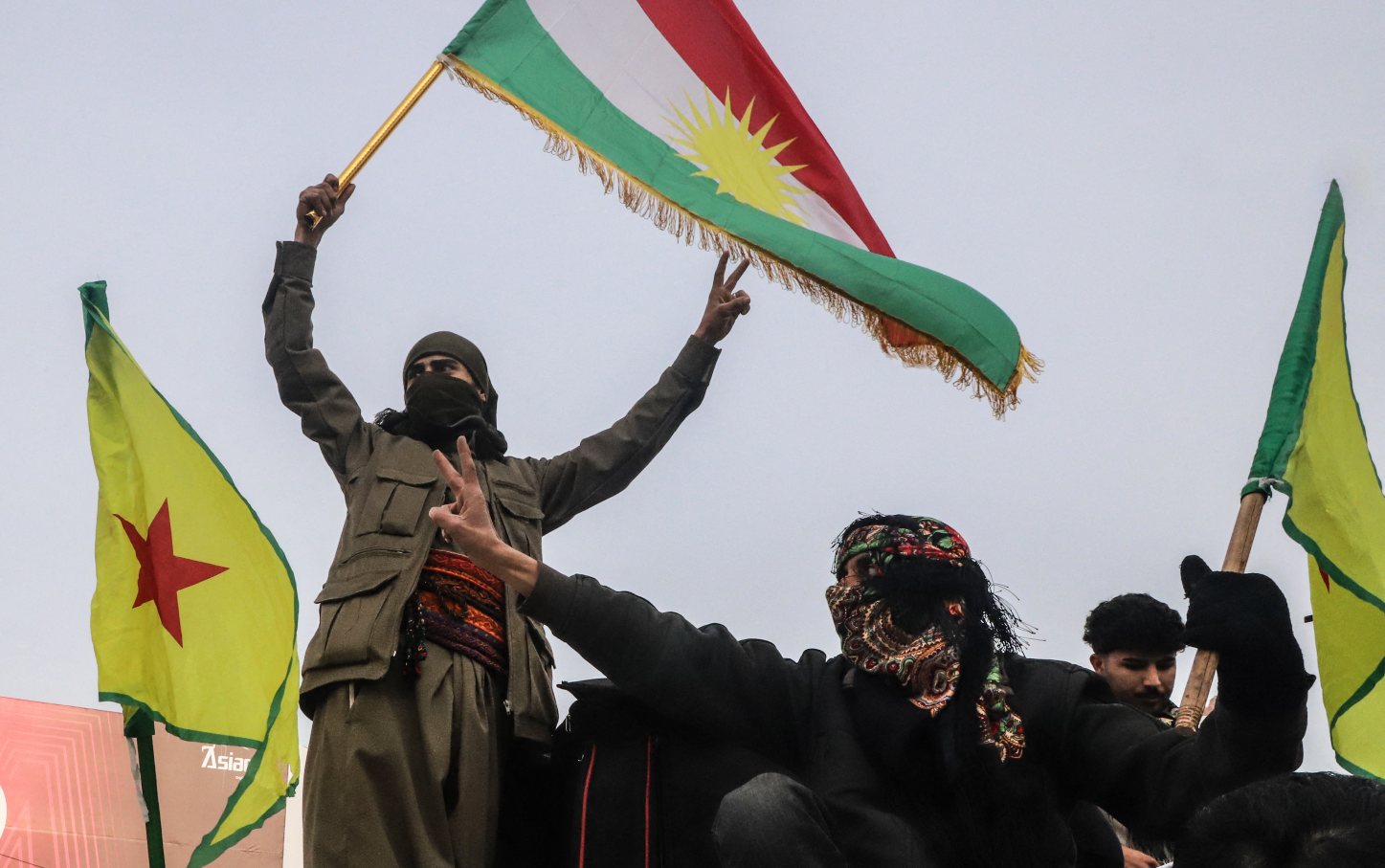
In Syria alone, during the 14 years of civil war between the brutal regime of Bashar al-Assad and Islamist and other insurgents, the Kurds—who make up 10 percent of Syria’s population—formed an autonomous, relatively democratic regional government: the Democratic Autonomous Administration of North and East Syria, known in Kurdish as Rojava (Western Kurdistan). Its ideological foundations and efforts at direct democracy arose from commitments to socialism and feminism. Kurdish armed forces, the Syrian Democratic Forces (SDF), commanded by women as well as men, fought alongside Americans against ISIS beginning in 2014, as ISIS seized much of northeastern Syria. With the SDF on the ground, and American air power, weapons supplies, and intelligence, ISIS was effectively defeated as a coherent movement by 2017.
Kurds ruled large swaths of Syria inhabited primarily by Arabs rather than Kurds, while at the same time resisting horrendously brutal incursions launched from Turkey by migrant anti-Kurdish Syrians.
The new Syrian government of Ahmed al-Sharaa, which came to power in late 2024, sought to centralize its authority throughout the country and demanded that the Kurds disband their militias and have their fighters join the Syrian national army individually. Kurds feared such a move would destroy their ability to defend their endangered autonomy. After a year of negotiations, government advances drove Kurdish fighters out of Aleppo. The Syrian Kurds agreed to a ceasefire—one of many—but it soon broke down.
To the cheers of local Arabs, government troops took the major cities held by the SDF: Raqqa and Deir ez-Zor, two cities known to Armenians as the last stop on the forced migrations from their homes during the Ottoman genocide of Armenians in 1915.
Another ceasefire was declared as videos of summary executions of Kurdish fighters surfaced. So far, Damascus has apparently agreed to recognize Kurdish as an official language in Syria and grant local autonomy to the Kurdish-majority city of Kobane, without extending it to the broader region. Syrian non-Muslim Arabs fear the centralizing, ideologically rigid rule of the al-Sharaa government. Non-Muslims and non-Arabs know too well that al-Sharaa began his career in Al Qaeda and has not renounced his jihadist origins.
In the ethnically and religiously mixed Kurdish town of Hasakah, an Armenian woman recalled that Assyrians, Kurds, Yazidis, and Arabs “lived together despite years of war.” “Until now,” she said, “the autonomous administration and the SDF provided protection. What comes next is uncertain—especially after reports of massacres” in other parts of Syria.
The SDF has been guarding thousands of ISIS prisoners for years. No country is willing to accept them, and militants as well as their wives and children wait for decisions about their fate. As the government advanced, Kurds withdrew from their guard posts. ISIS prisoners escaped and melted into the population; the US moved some to camps in Iraq. Authorities fear that the viral influence of ISIS—which influenced the killers in the December massacre of Jews on Bondi Beach in Australia—could erupt into violence and reemerge not only in Syria but without warning anywhere in the world.
The Americans were caught between the al-Sharaa government in Damascus—supported by Turkey, Saudi Arabia, and other Arab states—and their own loyal Kurdish allies, who can rely only on the Americans. Trump, whose foreign policies depend on his instinct, mood, and whom he last spoke to, was personally attracted to al-Sharaa when he met him in the White House. This was an ominous affective tie for the Kurds, as were reports that Trump viewed the Kurds as acting transactionally, just as he does.
“I like the Kurds,” Trump said, “but just so you know the Kurds were paid tremendous amounts of money, given oil and other things, so they were doing it for themselves more than they were doing this for us. But we got along with the Kurds and we are trying to protect the Kurds.”
Popular
“swipe left below to view more authors”Swipe →On Tuesday, January 20, 2026, the Kurds “were dealt a brutal blow…. [T]he US special envoy to Syria, Thomas J. Barrack Jr., announced that the United States had effectively traded the S.D.F. as a counterterrorism partner for Mr. al-Sharaa’s government.” In a post on X, Barrack wrote, “The original purpose of the SDF as the primary anti-ISIS force on the ground has largely expired, as Damascus is now both willing and positioned to take over security requirements.”
Northeastern Syria is rich in oil and gas. Analogous to the invasion into Venezuela—which Trump justified as being about recovering its oil—the fossil fuel resources in Syria have long been cited by Trump as a reason to keep American troops in the region. Not only Turkey but also the Trump administration is prepared to make a deal with Damascus, which could mean abandoning the Kurds and eliminating the most democratic, progressive political entity in the country.
This current betrayal of the Kurds—condemned even by Trump toady Senator Lindsey Graham of South Carolina—is reminiscent of the abandonment of the Kurds during Trump’s first administration, when in a phone call Trump promised Erdoğan he would withdraw American troops supporting them. Secretary of Defense James Mattis saw the SDF as “our boots on the ground” who for three-and-a-half years had been “the point of the spear in retaking Raqqa.” He resigned in disgust in December 2018.
It is estimated that over 11,000 Kurds perished in that war, along with two Americans assassinated by an ISIS gunman last December. The anti-ISIS campaign was a success for the American way of war: Arm others, let them fight and die, and limit American deaths. The capricious, transactional, and immoral nature of Trump’s treatment of the Kurds is a glaring example that other allies in Europe, Asia, and elsewhere already recognize as the new normal of American foreign policy.
Allowing Kurdish communities to be destroyed yet again will not create stability nor make the Middle East safer. It will only deepen the region’s wounds and turn an already fragile land into a cursed landscape of endless grief, revenge, and displacement. When people are denied any peaceful option—when every legal road is blocked, negotiation dismissed, and democratic hope crushed—resistance becomes not a choice but the last remaining form of survival.
As distant as the stateless Kurds are from our imagination at this pivotal moment, attention must be paid.
More from The Nation
“This Election Was a Defeat for Lies”: Read Lula’s Inspiring Victory Speech “This Election Was a Defeat for Lies”: Read Lula’s Inspiring Victory Speech
“I doubt that Russia, China, or the United States has an army as victorious as the army of democracy of this country,” the president told his supporters.

Lessons From Lula’s Historic Victory Lessons From Lula’s Historic Victory
The Brazilian left has stopped the right-wing wave in Latin America. Now it has four years to work out a succession plan.
France’s Permanent State of Emergency France’s Permanent State of Emergency
The bad habits Emmanuel Macron will pass on to his successor.
Democrats Can Contain the Donroe Doctrine Democrats Can Contain the Donroe Doctrine
Democrats have the tools to challenge Trump’s military interventions and electoral interference in Latin America—if they’re willing to use them.

Israeli Elections: Fanatics, Generals, and the Question of Palestine Israeli Elections: Fanatics, Generals, and the Question of Palestine
The central question is whether defeating Netanyahu would change Israel’s policies or simply change the people managing them.
“LULA!” Progressives Hail Brazil’s Stunning Election Result “LULA!” Progressives Hail Brazil’s Stunning Election Result
“The people united will never be defeated!” declares Zohran Mamdani.

