
The West Bank Is the Unseen Second Front of Israel’s War on Gaza
Emboldened by the world’s silence, Israeli settlers are working hand in hand with the military to terrorize Palestinians throughout the West Bank.
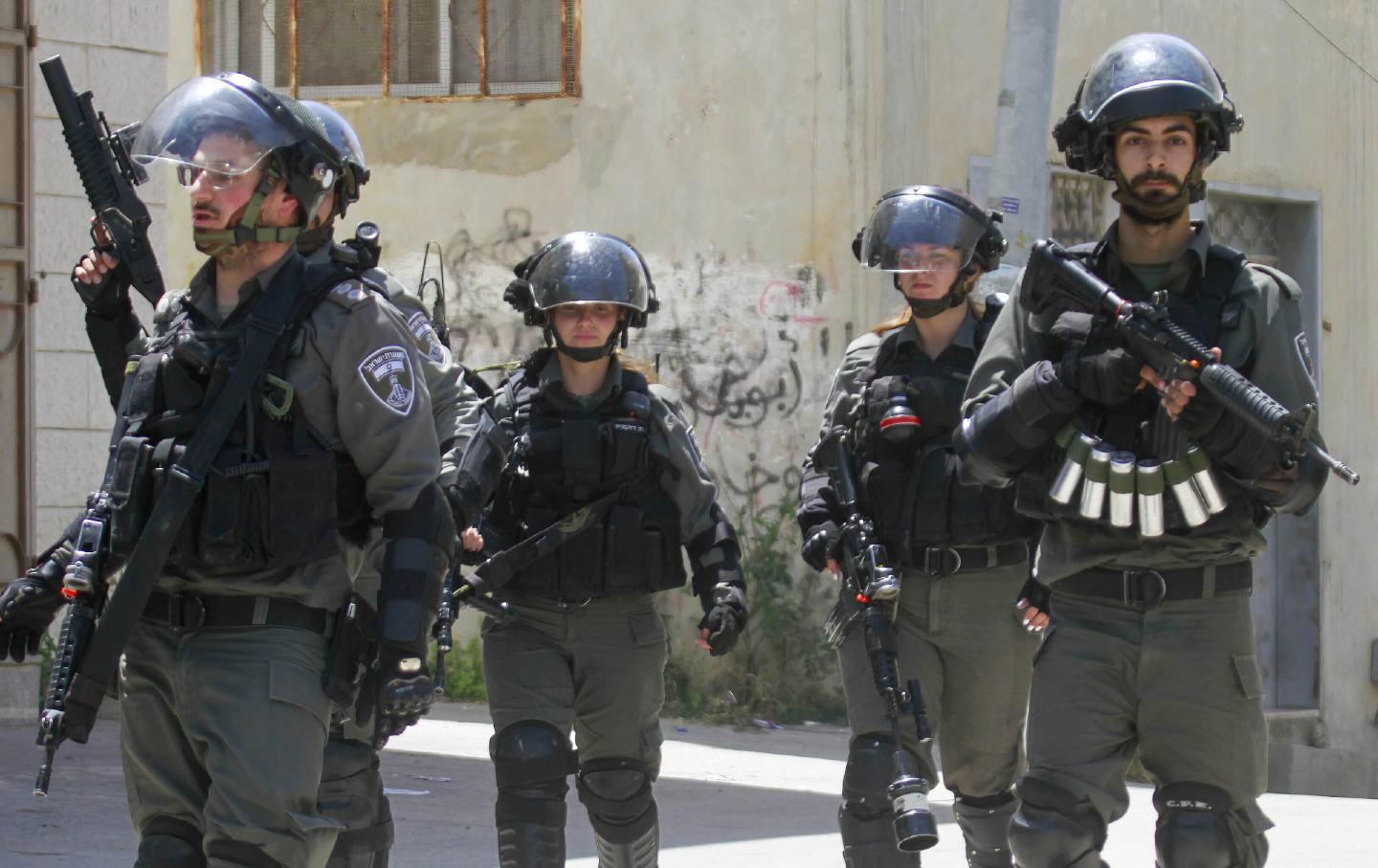
Israeli soldiers prepare to arrest Palestinians in the village of Shweika, near Tulkarm, in the northern West Bank.
(Nasser Ishtayeh / SOPA Images / Sipa USA via AP Images)There is a tendency to compartmentalize Palestinian existence, to treat the various forms of segmentation of Palestinian populations and their segregation from one another as something innate and natural, rather than the manifestation of colonial divide-and-rule tactics. Consequently, the bigger picture is often lost, producing an analysis that frames intimately linked events as fundamentally disconnected.
As the world’s eyes have been focused, understandably, on the atrocities Israel has been committing in the Gaza Strip, the Israeli military has been intensifying its assaults on Palestinians living in the West Bank. Israel has cordoned off Palestinian communities, blocking the entrances and restricting movement in and out, while settlers have been allowed to roam freely across rural areas, firing eagerly at Palestinians who cross their paths. At the same time, the Israeli military has stepped up their raids all across the West Bank of Palestine. Stories of abject cruelty and torture have emerged, as soldiers and settlers have together rounded up Palestinians and, in at least one case, allegedly stripped, blindfolded, sexually assaulted, and even urinated on them. More than 165 Palestinians have been killed over the last three weeks in the West Bank alone, with at least 2,200 arrested thus far.
This is an all-out campaign of revenge against Palestinians. But if we resist the trap of compartmentalization, we can see that it is also something else: It is an opportunity for Israel to intensify its colonization efforts across the West Bank, expediting plans set in motion long ago.
Palestinians understand that although the West Bank and Gaza Strip are separated geographically, they are nonetheless part of the same story. They serve as different battlefields in the same Zionist war to colonize the entirety of Palestine. The assaults on Palestinians everywhere form a continuum that can be traced straight back to the Nakba.
While many Israelis deny that the Nakba even happened, the Israeli right not only recognizes it but is also unabashedly and unapologetically in favor of its monstrous ethnic cleansing campaigns and calls for their replication. In Salfit, the capital of Palestinian olive oil production, settlers are attacking olive farmers in their groves, then leaving behind flyers threatening the farmers with a “great Nakba” should they not leave their homes and head to Jordan. In Masafer Yatta, settlers have been raiding multiple Palestinian communities, beating and torturing Palestinians, issuing ultimatums telling residents to leave within 24 hours or be killed and have their homes burned down. Collectively, the results have been as predictable as they have been horrifying: Since October 7, 828 Palestinians, including 313 children, have been expelled from over 13 communities in Area C.
These actions did not suddenly commence in October, however; instead, they represent a culmination of efforts over the last couple of decades to strengthen the settlement movement and to embed settler voices into the highest echelons of the Israeli regime. Leaders such as Itamar Ben Gvir, the minister of national security, have openly called for the annexation of the West Bank. His department has also been arming settlers with military-grade rifles, effectively giving them carte blanche to do as they please and seize as much land as they can.
Settler and State Violence
It is important to understand that settlers in the West Bank do not act alone. They enjoy the support and protection of the Israeli government and military. In such a context, there is no functional difference between settler violence and state violence. The settlers cannot sustain themselves without the constant flow of money, resources, and soldiers provided by the Israeli regime and by international aid and political support. They would, moreover, not feel so emboldened to commit their atrocities if they weren’t escorted to their victims’ houses by armed troops. It is not merely a question of complicity or inaction on the part of the soldiers—they also partake in the violent campaigns.
Since the beginning of 2023 to October, over 270 Palestinians had been killed, the majority of them refugees from the Nakba. Raids and incursions have been focused on refugee camps in Jenin, Tulkarm, Jalazone, and others, which have always been hubs of resistance. On October 22, for the first time since the Second Intifada, the Israeli air force bombed the West Bank, reducing a mosque in the Jenin refugee camp to rubble.
These refugee camps have haunted the Israeli regime for decades. They are living proof of the criminality of 1948 and the destruction of Palestinian society. They are symbols of steadfastness, of hope, creating new generations of resistance.
The Israeli regime understands this dynamic. It, too, views its activities in the West Bank as yet another front in the colonization of Palestine: the ultimate objective being the completion of the Nakba, from river to sea.
The events unfolding over the past few weeks threaten to be merely a prelude. Meanwhile, the Palestinian Authority is unwilling to advocate for its people, using its weaponry and armored vehicles to repress critics and crack down on youth trying to defend their communities. In light of its lack of legitimacy in the eyes of most Palestinians, a PA confrontation with Israel or the international community is out of the question. After all, Israel and the international community are the only ones prolonging its survival.
Ultimately, the expulsions—many would even say, ethnic cleansing—taking place in the West Bank represent the true face of Israel’s colonial ambitions. Encouraged by the unfolding genocide in Gaza, and emboldened by the world’s silence, there is no need to equivocate anymore. The endgame of Zionism has never been quite so clear. What’s left to be determined now is what we will do to stop it.
More from The Nation
Garbage In, Carnage Out Garbage In, Carnage Out
The harrowing lessons of the Pentagon’s recently dissolved partnership with Anthropic.
The Iran War Could Be Catastrophic for the US-Israel Alliance. Good. The Iran War Could Be Catastrophic for the US-Israel Alliance. Good.
As Israel’s role in pushing the war with Iran comes into ever sharper focus, it’s up to us to turn outrage into change.

An Unlawful War An Unlawful War
The precedent being set by the US in launching this war of aggression against Iran will long live in infamy.
Trump and Netanyahu Want to Turn Iran Into a Failed State Trump and Netanyahu Want to Turn Iran Into a Failed State
This war looks designed to cause maximum chaos and instability. The world will pay a high price.

The War on Terror Paved the Way for Trump’s Rise—Now He’s Making It His Own The War on Terror Paved the Way for Trump’s Rise—Now He’s Making It His Own
Only the total abolition of the DHS can restore freedom.
The Iranian Voices America Isn’t Hearing The Iranian Voices America Isn’t Hearing
We need to listen to those who oppose both the Islamic Republic’s authoritarianism and foreign military escalation.

