The Unexpected and Uncertain Result of Pakistan’s Elections
Former prime minister Imran Khan’s party was banned from running. But as independent candidates, Khan’s allies claim to have won a majority.
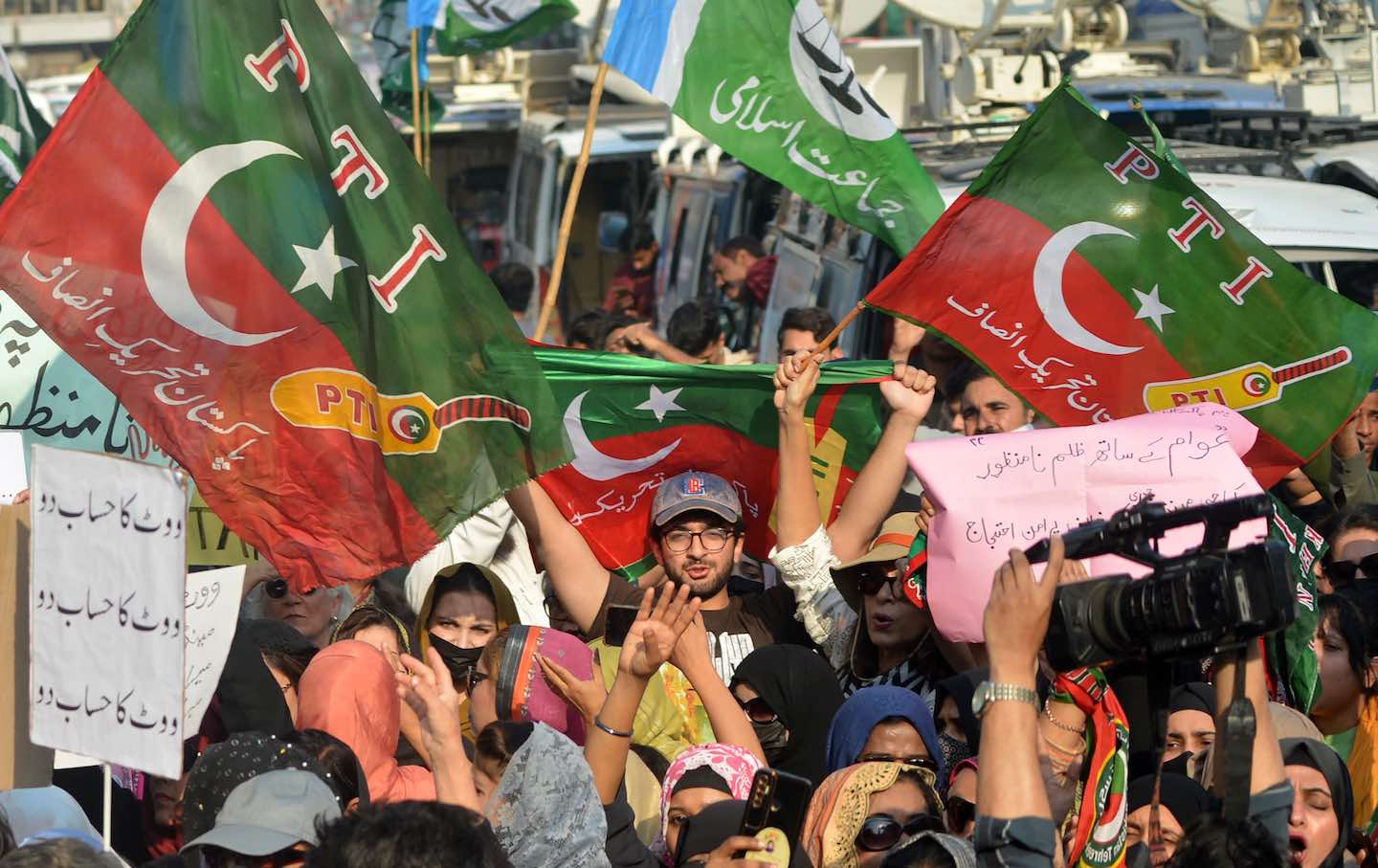
Supporters of the Pakistan Tehreek-e-Insaf (PTI) protest outside an election commission office in Karachi on February 10, 2024, amid claims the election result delay is allowing authorities to rig the count.
(Rizwan Tabassum / AFP)Islamabad, Pakistan—It was supposed to be a foregone conclusion. When the Pakistani public went to the polls last Thursday for parliamentary elections, nobody thought that Pakistan Tehreek-e-Insaf (Pakistan Movement for Justice, PTI), the party of former prime minister Imran Khan, stood much of a chance. Ten months after the riots of May 9, when activists from the PTI laid siege to a number of military installations in protest at the arrest of the cricketer-turned-politician, the party was clearly in a state of disrepair.
The powerful military establishment had cracked down on the PTI with an unprecedented ferocity. More than 100 of its politicians had been forced to disavow their support for Khan and leave the PTI, while many others had been coerced into withdrawing from public life altogether. Those who remained loyal to Khan, meanwhile, were either thrown in prison or forced underground. If that weren’t enough, the party was then stripped of its electoral symbol, a critical identifier in a country where around 60 million people are said to be illiterate. In effect, this meant that the PTI had ceased to exist as a political party, and that all of its candidates would have to contest the poll as independents. Finally, with about a week to go until the parliamentary election, Imran Khan was sentenced in three separate court cases: the first concerning his misuse of a diplomatic cable, the second a conviction for illegally selling state gifts, and the third a punishment for contracting an illegal marriage.
Amid this atmosphere of persecution, and with Khan languishing in a Rawalpindi jail cell, it was assumed that PTI voters would be too demoralized to turn out and that the election would be won by the Pakistan Muslim League (PMLN), the party of three-time former prime minister Mian Muhammad Nawaz Sharif. But within a couple of hours of the closing of polls on Thursday, it became palpably obvious that the military establishment would not prevail so easily. The numbers trickling in defied all expectations, demonstrating that Khan’s voters had not only turned out but had turned out in droves. Out of the 266 seats up for grabs, candidates affiliated with Khan’s party had taken the lead in more than 100, including many in the battleground province of Punjab. It was a development that left many in the commentariat stunned, and for a while it seemed that the voters had prevailed.
But then, as is its wont, the empire struck back. For several hours, the results stopped being released—which, in Pakistan, usually means one thing. Something similar had happened in the last general election, in 2018, when the Results Transmission System mysteriously went down after the close of polls. Except that in that election, unlike this one, the leadership of the army was supporting Imran Khan, and it was Nawaz Sharif of the PMLN who had been convicted of corruption and thrown in jail.
In the early morning hours of last Friday, long after the legal deadline for announcing the results had passed, the vote counts from various constituencies started trickling in again. Predictably, several seats where PTI-affiliated candidates were in the lead began to flip. It was the same script with the same cast as 2018, except the actors had been cast in different roles. This time, it was the PTI’s turn to allege widespread rigging and the PMLN’s turn to claim a contentious victory. PTI candidates allege that they have the documents to prove that they have won more than 150 out of the 266 constituencies being contested, a number that would grant them an absolute majority in parliament. But the official results released by the Election Commission of Pakistan show a split mandate, with no party having enough seats to govern alone.
What complicates matters still further is the issue of “reserved seats,” which are not directly elected. Under Pakistan’s electoral system, there are 70 seats reserved for women and religious minorities that are allocated to each party based on its strength in parliament. Because winning members of the PTI are technically classified as independents, they exist as a voting bloc but not as a political party. This means they will not be able to enhance their numbers with their share of reserved seats and may well cease to be the largest bloc in parliament once these are allocated to other parties.
The upshot of all of this is that the PTI’s main rivals, the PMLN and the Pakistan People’s Party (PPP), are in a position to form a coalition government with the support of one or a couple of the smaller parties in the next parliament. Negotiations are already underway to find a power-sharing agreement. This has sparked a number of demonstrations across the country, with police employing tear gas to disperse protesters.
Pakistan is therefore in a state of crisis. The country of 240 million people, which is reeling from chronic levels of inflation and an economic meltdown, needs a strong and stable government to address its problems. The official results of the election, however, have only added to the chaos. Any government that comes in, unless it is led by the PTI, will not have the legitimacy to make difficult decisions, and is likely to be dependent on the military’s support.
Pakistani progressives, too, have been left with a conundrum. It is clear that the PTI has the overwhelming support of the population, but the party appears ideologically committed to the twin pillars of religious populism and social conservatism. On the other side stands the Pakistan Army, which has destabilized Pakistani politics ever since the country gained its independence and made a habit of suppressing the rights of its citizens. The prevailing mood among the left thus far is that the people have made their choice in putting their faith in PTI and that this choice must be respected by the military establishment.
But with the results having already been manipulated, and much more brazenly than they were five years ago, it is not clear how such a rapprochement can even take place. What is certain is that the election will now be litigated in the courts and that the crisis will continue in the days to come.
Thank you for reading The Nation!
We hope you enjoyed the story you just read, just one of the many incisive, deeply reported articles we publish daily. Now more than ever, we need fearless journalism that moves the needle on important issues, uncovers malfeasance and corruption, and uplifts voices and perspectives that often go unheard in mainstream media.
Donate right now and help us hold the powerful accountable, shine a light on issues that would otherwise be swept under the rug, and build a more just and equitable future.
For nearly 160 years, The Nation has stood for truth, justice, and moral clarity. As a reader-supported publication, we are not beholden to the whims of advertisers or a corporate owner. But it does take financial resources to report on stories that may take weeks or months to investigate, thoroughly edit and fact-check articles, and get our stories to readers like you.
Donate today and stand with us for a better future. Thank you for being a supporter of independent journalism.
Thank you for your generosity.