To Those Who Have Just Awakened to the Horrors in Gaza
Yes, we should welcome the latecomers to the fight against genocide, but there also needs to be accountability.
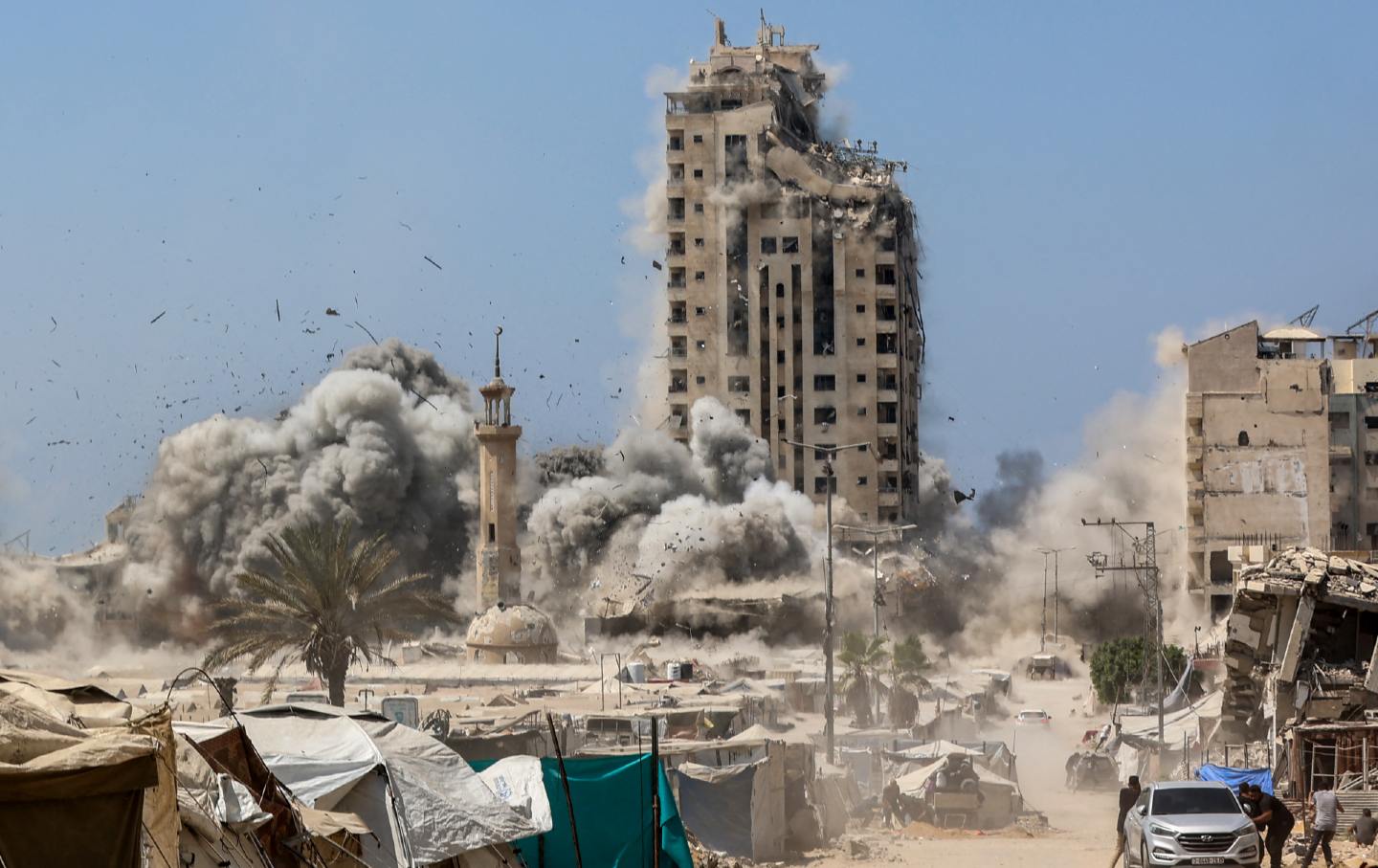
Less than a week after the Hamas attacks of October 7, 2023, the Israeli-born Holocaust scholar Raz Segal described Israel’s retaliation against Gaza as “genocidal”—a term he meant not rhetorically but literally, based on well-founded legal definitions. “Israel’s genocidal assault on Gaza is quite explicit, open, and unashamed,” he wrote. “Perpetrators of genocide usually do not express their intentions so clearly.”
While Segal’s deep academic expertise provided intellectual heft to his warning, it did not require years of study to see where Israel’s assault was headed; anyone who had been paying attention understood the designs of Benjamin Netanyahu’s far-right, settler-dominated governing coalition, which had been spewing eliminationist rhetoric about Palestinians and facilitating pogroms in the occupied West Bank for nearly a year before the attacks.
“It’s a choice to forget everything you knew yesterday about Israel,” I tweeted on the morning of October 7. Nonetheless, it was a choice many of my peers made—some for days, some for weeks, and some for nearly two years of slaughter in Gaza. But in late July, a memo seemed to go out that it was finally permissible, imperative even, for mainstream liberals and elected Democrats to call what Israel was doing to the Palestinians a genocide, or a man-made famine, or simply evil.
Better late than never, some might say. “Tweeting ‘I told you so’ at people who change their mind about what’s happening in Gaza does nothing to help the kids who are being starved to death,” former Obama administration staffer and Pod Save the World host Tommy Vietor tweeted on July 26. “Welcome people into the tent. Build a bigger coalition and use it to force political change.” I ended up discussing this at length with Vietor, who has been an honorable critic of Israel’s policies in Gaza from early on but who, as a political professional, operates in a different lane and with more generous instincts than I have.
I agree that the tent needs to be expanded, the coalition needs to grow, and minds need to change, and I agree that bragging about having been right early on is not useful to anyone. But there are also real dangers to sidestepping a reckoning—an enduring lesson from America’s reckless, criminal invasion of Iraq, which was supported by many prominent liberals who remain influential today. There were courageous critics urging Americans to take a breath after 9/11, but their words were ignored and their reputations often damaged. In general, it was a better career move to be wrong at the time and apologize later, if ever.
This crisis of accountability has haunted US foreign policy ever since. Joe Biden, who presided over and directly enabled more than a year of Israeli atrocities in Gaza before yielding the White House to Donald Trump, was one of the many Democrats who voted in favor of the Iraq War in October 2003—which did not prevent him from becoming Barack Obama’s vice president and eventually president himself. At the time of the vote to authorize the invasion, Biden was chair of the Senate Foreign Relations Committee, and his Democratic staff director in that role was Antony Blinken, who helped build bipartisan support for the Iraq War—which did not prevent him from becoming Biden’s secretary of state and running cover for the Gaza genocide 20 years later. Brett McGurk, arguably the single figure in the Biden administration most responsible for the circumstances that led to October 7, essentially launched his career in public life as part of the occupation regime in Iraq. The Democratic establishment in Washington abounds with people who faced no meaningful consequences for their disastrous judgment in the early 2000s, and who have gone on to exercise even more disastrous judgment in the 2020s.
The point is not that people can never change; in fact, there are some scattered public figures who initially supported the Iraq War and have spent the years since listening to more dovish voices, reexamining their priors, and working to prevent additional foreign policy catastrophes. But a far more common approach has been to glibly shrug off Iraq as an isolated error while continuing to back the same aggressive, militaristic US role in the world and to arrogantly dismiss and marginalize the very critics who got Iraq right.
This is why a certain degree of skepticism is warranted toward the many liberals—I’m referring especially to elected officials, policymakers, journalists, pundits, celebrities, and, not least, ostensibly progressive rabbis—who were able to disregard months of images of Palestinian children maimed or dismembered in Israel’s indiscriminate bombing campaign but who now claim that images of children emaciated by famine have stirred their consciences. No doubt some of them are sincere; no doubt some of them regret their earlier silence or active complicity. But others have simply decided that now, with Trump in the White House and public opinion rapidly shifting, it is finally time for them to whitewash their own records and obscure their roles in enabling crimes against humanity.
“One Day, Everyone Will Always Have Been Against This,” the writer Omar El Akkad famously declared in the weeks after October 7, as bombs rained down on Gaza’s dense urban neighborhoods. Like so much that has happened since, the liberal repositioning on Gaza has been predictable—and predicted. To applaud those making the long-foretold pivot for their moral courage is not only unnecessary but perverse; they are, at best, joining a coalition built by the people they insulted, scorned, and in some cases called for arresting when their words counted most. There may be room for them in the tent, but to meaningfully participate will require teshuva, the Hebrew word for “repentance”—honest self-examination and a dedicated, continuous, lifelong effort to atone for even passively supporting this genocide. That effort could begin with some displays of real courage—including the courage to take actual risks, like so many activists have already done, often losing jobs, friends, and even freedom in the process. It’s the very least we owe to the Palestinians of Gaza.