
All We Want in Gaza Is to Live
We don’t want condolences or speeches. We want to be treated like human beings, and we want less trauma in our lives.
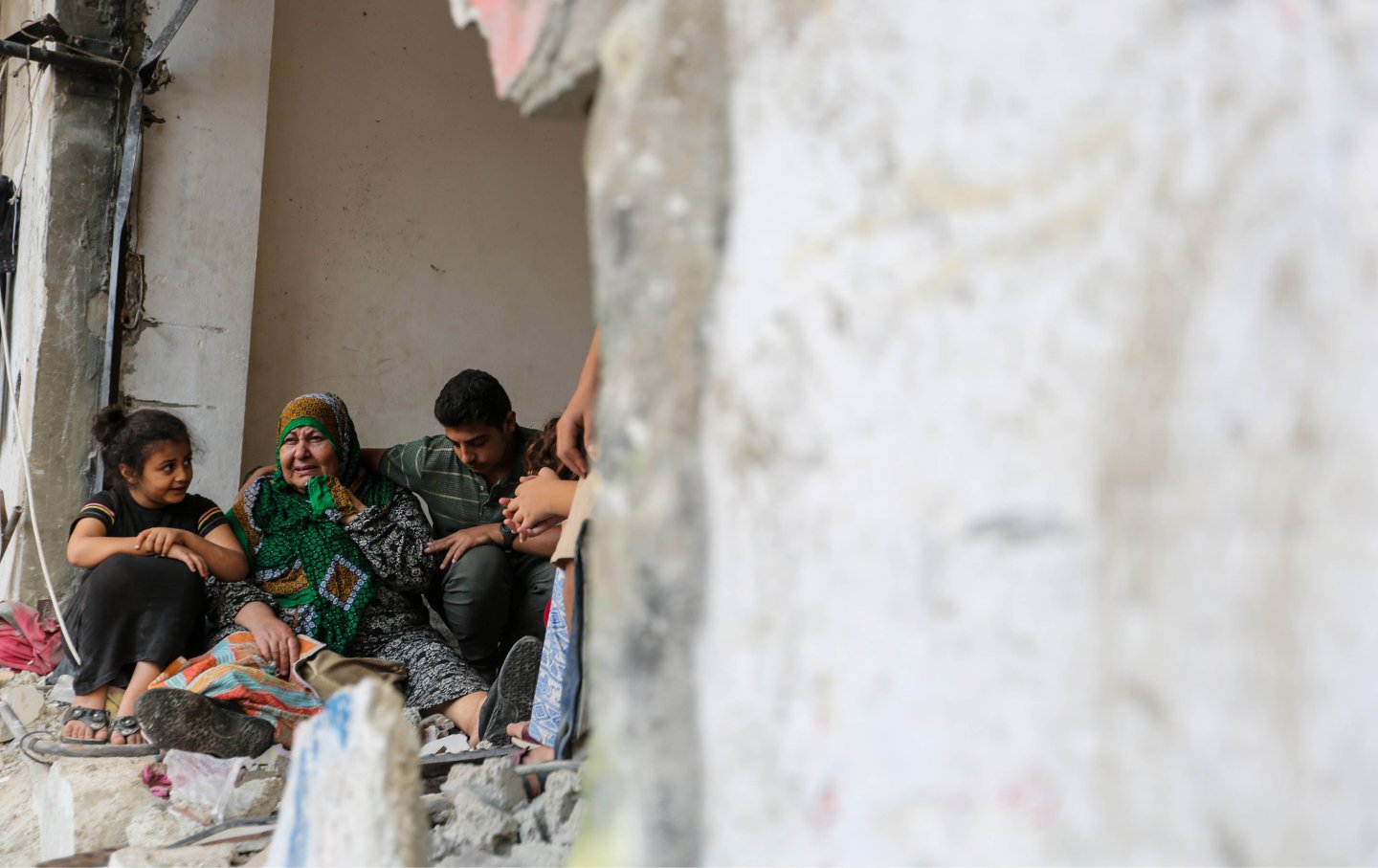
A woman is consoled as people search through buildings that were destroyed during Israeli air raids in the southern Gaza Strip on October 26, 2023, in Khan Yunis, Gaza.
(Ahmad Hasaballah / Getty Images)Gaza, October 25—In the past 24 hours, Israeli bombs have killed over 700 people in Gaza. Those who remained alive aren’t that lucky, though. They are left to continue breathing in the trauma and breathing out the heartbreak surrounding them on every side.
As a Palestinian journalist born, raised, and still living in Gaza, I have witnessed a harrowing, never-ending reality composed of two pillars: blockade and occupation. I took my first breath during the Second Intifada; the smoky smell of gunshots and the hovering of war jets enveloped my existence, shaping my life as a refugee in eternal exile.
Now, 24 years later, I am living a continuation of the same tragic history. This is the fifth war in my lifetime; I assume it will not be the last.
I had started writing earlier today, shortly before I paused to queue outside a bakery for three hours. I made it home before the bakery was bombed—a regular occurrence these days. I felt a world’s burden upon me, thinking of all the people who lost their lives just because they kept standing there, waiting for their family’s daily bit of bread as an Israeli air raid fell on them, their lives turned into more numbers on the news. Whether my survival was luck or fate doesn’t really matter.
The question now isn’t why or how, but rather how we can ever live normally again. In Gaza, to survive means to live eternally with the traumatic aftermath of war, and the miasma of death. The term “alive” in our terminology doesn’t necessarily mean being well and safe. It actually means anything but.
When a high-rise building sheltering tens of families—parents, grandparents, children, toddlers, a hundred people who only want to feed their hungry kids—gets blown up, even the people who make it out alive have a part of them die forever. The people who are pulled from under the rubble of their homes won’t forget. They will not heal. They will only be half alive.
For almost three weeks now, Israel has been shielded by the world’s most powerful countries, applauded by politicians, and given military support, all as it seeks to kill 2.3 million people that it has been imprisoning for the last 16 years. Over 7,000 people have been killed in Gaza. Thousands more have been injured. An untold number are still missing under the rubble.
On Wednesday, Joe Biden proclaimed that he did not believe the death toll figures from the Gaza health ministry, despite the fact that they are widely known to be accurate. For the US president, our deaths are apparently fake news.
The last thing we want as an occupied people is to be offered condolences or lip service. We are only trying to figure out how we can ever process the pain that will stay with us for the rest of our lives while the world claps for us for being “survivors.” We want our basic demands to be met not by speeches at the UN but by action. We want an acknowledgment that when we use our voices, they make a sound—that we are human beings, people with hopes and dreams, who just want a future.
Popular
“swipe left below to view more authors”Swipe →That is not to say that having the world’s spotlight on the brutality we are enduring is not important. But people need to know more than that—to know that our trauma is accompanied by a desire to live in freedom.
The people of Gaza have been accustomed to extraordinary routines that challenge their desire for life. People getting bombed after queuing for hours outside an aid agency to have their bite of crumbling bread do not dream of international solidarity. They dream of life, even a small amount of it. They dream of being something other than “seen,” of becoming something other than a statistic. When the world accepts the killing of 700 lives in 24 hours, how soon before it is 7,000?
We Palestinians have been asked to honor the humanity of the civilians killed by Hamas in Israel. I can do that, without hesitation. No civilian deserves to lose their life, and I have all too much experience of the suffering that war inflicts. But I cannot accept that it is right for the humanity of only one side of this conflict to be acknowledged. Three thousand children have died all around me in the past 20 days. Are their lives not worth mourning? Do they deserve to only be remembered as statistics?
I met a 6-year-old girl who went to buy her favorite candy bar and returned to see her house flattened. Her immediate and extended family members were all killed. All that remains of her bloodline is her. Terror and shock will be her lifelong companions. At that exact moment, I was not quite sure whether she cared or needed to speak to the world. She only wanted her family back.
When a woman promises her fiancé that she will wear the brightest dress he has ever seen, only to wear a burial shroud the next morning, all she wants to know is why. Was their wedding a threat?
When a 10-year-old refugee girl skips school in Gaza to protest not having her bottle of clean drinking water from the aid agency, she would not want the world’s rhetoric of condemnation and denunciation.
When a family of a senior student in college plans their graduation celebration meticulously, trying not to miss any detail, and they prepare a coffin instead a few hours before they were to see their loved son on the graduation stage, they will never need to speak to the world. What difference would it make anyway? They just need time to digest, and time to get over the fact that their son is gone forever.
I was taught not to take sides while covering war. But now, I am a side myself. The feeling of abandonment is not unprecedented, but the extent of the world’s complicity still stings. I have tried to keep my temper and not let my feelings control my journalistic endeavors.
After all, being a journalist in Palestine, and in Gaza particularly, means that I am not entitled to the protection the press vest is supposed to give me. Since October 7, nearly two dozen of my fellow journalists in Gaza have been killed. Just last night, Wael Al-Dahdouh, one of Al Jazeera’s veteran journalists in Gaza, lost his son, daughter, wife, and one-and-a-half-month-old grandchild. This is what it means to report in Gaza.
Life has become unpredictable and everyone everywhere is writing their final words at any moment. For now, all we collectively need is less trauma. All we ask for is time to grieve. It is important to grieve, so that later we can be able to heal—that is, if we can ever heal.
This essay has survived indiscriminate bombing that has been going on for 20 days now. But what does it really mean to survive, when I all do while writing is not drink my morning coffee, but clean the smoke from the air strikes off my laptop screen?
More from The Nation
Progressives Are Backing Puerto Rican Independence. It’s About Time. Progressives Are Backing Puerto Rican Independence. It’s About Time.
More and more leftists are concluding that statehood for the island is not enough.
The Saudi Phase of the Iran War Signals More Chaos to Come The Saudi Phase of the Iran War Signals More Chaos to Come
The conflict that Donald Trump has repeatedly proclaimed an unequivocal American victory keeps spiraling out of control.
Andy Burnham’s Speech to the Labour Party Conference Could Be the Start of a Positive Social-Democratic Politics Andy Burnham’s Speech to the Labour Party Conference Could Be the Start of a Positive Social-Democratic Politics
But the autumn budget to be released at the end of October will offer needed details.
Why Navi Pillay’s Receiving the Nobel Peace Prize Is So Important Why Navi Pillay’s Receiving the Nobel Peace Prize Is So Important
She believes that human rights and international law are universal principles that must be enforced regardless of violator’s ideology, ethnicity, or geostrategic alignment.
Writing About War as Bombs Fall Writing About War as Bombs Fall
While the Israeli government launched a well-orchestrated offensive of disinformation and hyperbole that would make the illegal permissible in the war on Gaza.

