
Beijing Calls Washington’s Bluff on Strategic Metals
China’s latest export restriction lays bare the complex geopolitics behind President Trump’s proposed tariffs—and the green energy transition.
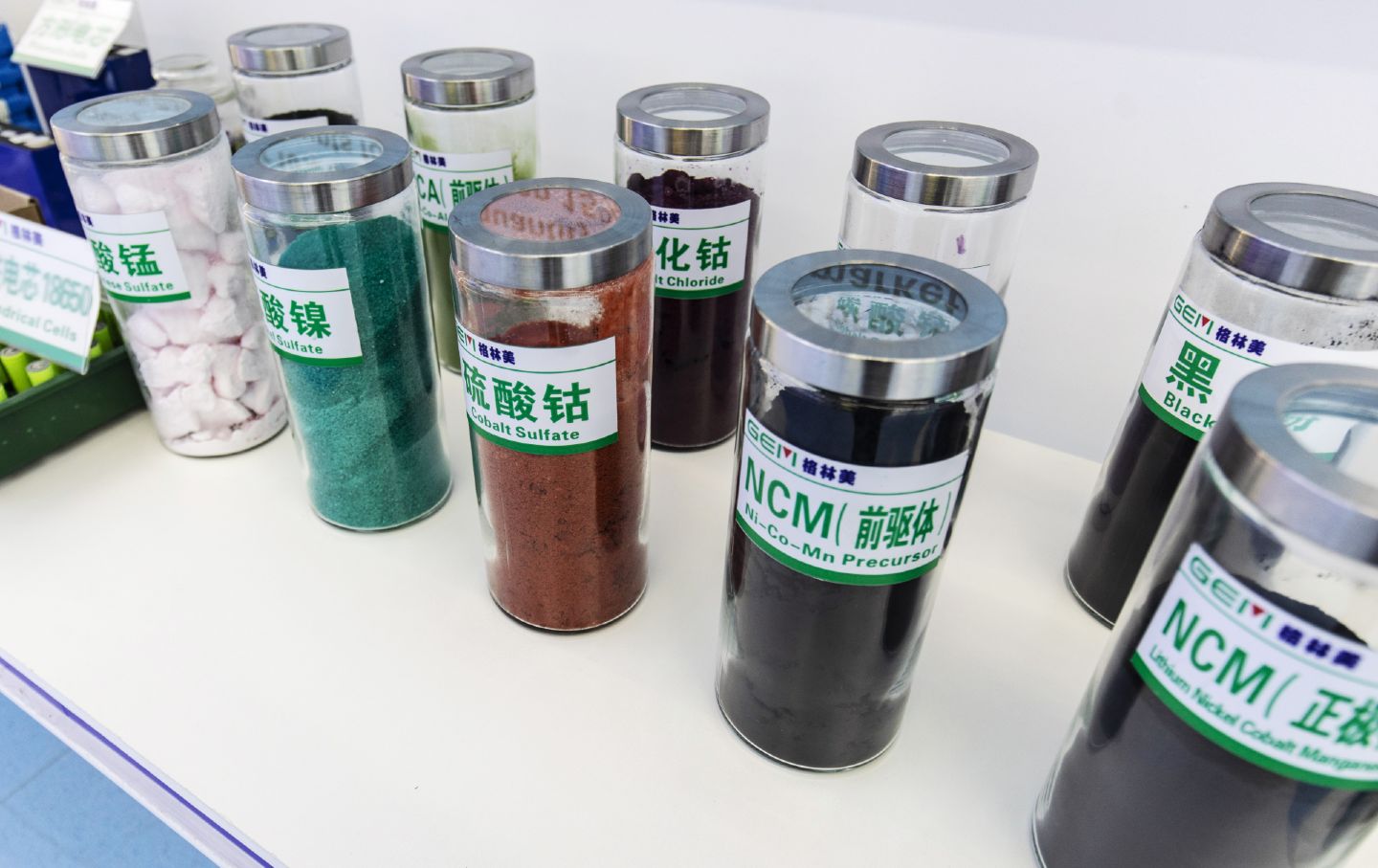
Earlier this December, the Chinese government announced that it would curb the export of several key industrial minerals, as well as certain types of graphite. The move came in the context of mounting pressure on China from Washington, and in anticipation of stringent tariffs that Donald J. Trump has promised to levy when he returns to the presidency next year.
Chinese government spokespeople have argued that curbing export of these minerals is in line with their government’s antiproliferation efforts. They have said that the materials are “dual use,” and that they might be used in manufacturing weapons. Officials in the United States have historically also argued the same thing about some of the minerals, such as graphite, which the US put under strict export controls in 2006.
Among the minerals are antimony (which is used in night-vision goggles and bullets), gallium (precision-guided weapons and radar systems), and germanium (powerful sensors that are mounted on tanks, ships and helicopters). Superhard metals like tungsten may also be included in the restrictions, as is graphite, a type of carbon familiar from its use in pencils. Certain types of graphite are used in gun barrels, and others are dispersed on the battlefield as a sort of smoke that confuses electromagnetic wave detection devices.
Most of these materials also have considerable civilian uses. For instance, graphite is used in the anodes, or negative electrodes, of almost all lithium-ion batteries. (If you’re reading this article on a battery-powered device, you’re probably using graphite in some form.) What export controls mean is that non-Chinese companies that use the material in products destined for the United States will have to apply for export licenses. Such licenses will be up to Chinese officials to grant or withhold.
China controls the vast majority of the processing of some of these materials—a fact that began to register widely in Washington only as tensions began to ramp up with China during the previous Trump administration. China, for instance, produces 61 percent of natural graphite and 98 percent of the world’s final processed graphite. Graphite is also a key material in the green energy transition and electric vehicles: Last year, some 50 percent of the world’s natural graphite went into electric vehicles.
Beijing has managed to extend its grip across the supply chain in recent years. Efforts have been made—most notably through Joe Biden’s Inflation Reduction Act—to create a supply chain for critical minerals that is independent of China, as well as the development of new technology that reduces the need for hard-to-get materials. But progress has been slow. “China is still set to be the dominant player,” said Tony Alderson, the senior anode and cathode analyst at Benchmark Mineral Intelligence, a specialist provider of supply chain and energy transition information. “I think the investment that they are putting in is huge, and it is more than the US with regard to the anode supply chain.” Despite paeans to progress from politicians in Europe and the US, 2024, he said, was “the year of delays,” and a widening gap between supply and demand for critical minerals in everywhere but China.
By banning the export of these minerals, the Chinese government is showing that it has leverage over critical parts of the supply chain for electronics. “We see it in the industry as a shot across the bow,” Michael R. Hollomon II, the commercial director at US Strategic Metals, a mining and processing firm focused on green transition materials, told me. He noted that the Chinese have enacted similar bans of critical minerals in the past, including a ban last year of specific gallium and germanium products. “The Chinese government have put their money where their mouth is.”
Markets have reacted to the news of the most recent reductions: The price of antimony surged 40 percent on news of China’s most recent export curbs. It was something that worried Gary Evans, the CEO of US Antimony Corporation, the only domestic processor of antimony. Evans, speaking on Fox Business, worried that high prices would cause businesses to be priced out of the market.
Hollomon said that the Biden administration had often talked about building a supply chain independent from China, but that promised projects were often not followed through on, and that funding was held up at critical stages. China, on the other hand, has been able to fund projects and drive down costs for Chinese firms through massive injections of state capital into the mining, processing and industrial use of critical metals and transition technology. “We’ve been playing with our hands tied behind our backs—that is the way the West has been operating for the last 15 years,” he said.
But there is a more fundamental question at play as well. The United States traditionally limited technology transfers to China because of copyright concerns: This year, President Biden imposed an 100 percent tariff on Chinese electric vehicles. The US government recently prepared restrictions on the import of AI technology into China (Beijing responded with an antitrust investigation into the US chip giant Nvidia), and Washington has been talking about “decoupling” from China for the last several years. In 2022, the US Department of Defense even released a 74-page report on “securing” the supply chain for materials used in military hardware. Chinese graphite is already subject to a 25 percent tariff in the US. (Last Wednesday, a North American trade association of active anode material producers asserted that such a tariff was “far too low” and asked the US government to levy a 920 percent tariff on Chinese graphite imports, a move that would double the cost of an electric vehicle Stateside.) Why would China help the United States build a supply chain that subverts its own interests and diminishes market share for Chinese companies?
In the critical metals and renewable energy space, there is growing apprehension over the use of tariffs in a part of the world economy in which China has become king. “To me,” Trump has said, “the most beautiful word in the dictionary is ‘tariff.’” He has even suggested he would impose tariffs of up to 60 percent on Chinese goods. But while Washington seems to think of tariffs as a one-way street, China’s most recent show of force shows that Beijing has considerable leverage, especially when it comes to materials that are used in electric devices and vehicles.
In the end of the day, costs from tariffs usually get passed on to the consumer. Trump, who used fears of inflation to galvanize his base during the last election, will be wary of policies that cause too many shifts in prices. Antimony, after all, is not just in bullets; it is used as a flame retardant in roofing across the US.
Popular
“swipe left below to view more authors”Swipe →Perhaps rising costs will mean the next administration will be more amenable to striking a deal with China’s premier, Xi Jinping, an autocratic leader Trump reportedly admires. Elon Musk’s ties to China—around a half of Teslas are produced there, and the country is said to be the world’s second-largest market for the electric cars—might also complicate things. But that won’t solve the pressing issue of China’s domination of the supply chain for critical raw materials.
Industry players like Hollomon believe the incoming administration has the chance to spur domestic mining and processing through grants and streamlining regulations and building up the nation’s strategic reserve of minerals, many of which were sold off after the Cold War. But the outlook is also worrisome: increased tariffs have historically lead to retrenchment and stockpiling, which have tended to be ingredients in conflict. Even if such fears remain distant for now, a China in which the materials processing and battery industries are two bright spots in an otherwise bleak economic landscape is not likely to cede its primacy in those spaces any time soon.
More from The Nation
Garbage In, Carnage Out Garbage In, Carnage Out
The harrowing lessons of the Pentagon's recently dissolved partnership with Anthropic
The Iran War Could Be Catastrophic for the US-Israel Alliance. Good. The Iran War Could Be Catastrophic for the US-Israel Alliance. Good.
As Israel’s role in pushing the war with Iran comes into ever sharper focus, it’s up to us to turn outrage into change.
An Unlawful War An Unlawful War
The precedent being set by the US in launching this war of aggression against Iran will long live in infamy.
Trump and Netanyahu Want to Turn Iran Into a Failed State Trump and Netanyahu Want to Turn Iran Into a Failed State
This war looks designed to cause maximum chaos and instability. The world will pay a high price.

The War on Terror Paved the Way for Trump’s Rise—Now He’s Making It His Own The War on Terror Paved the Way for Trump’s Rise—Now He’s Making It His Own
Only the total abolition of the DHS can restore freedom.
The Iranian Voices America Isn’t Hearing The Iranian Voices America Isn’t Hearing
We need to listen to those who oppose both the Islamic Republic’s authoritarianism and foreign military escalation.

