Meet the Immigrant Workers Taking On America’s Largest Meatpacking Company
Tyson workers in Arkansas are organizing to ensure safer labor conditions. We join them in their fight.
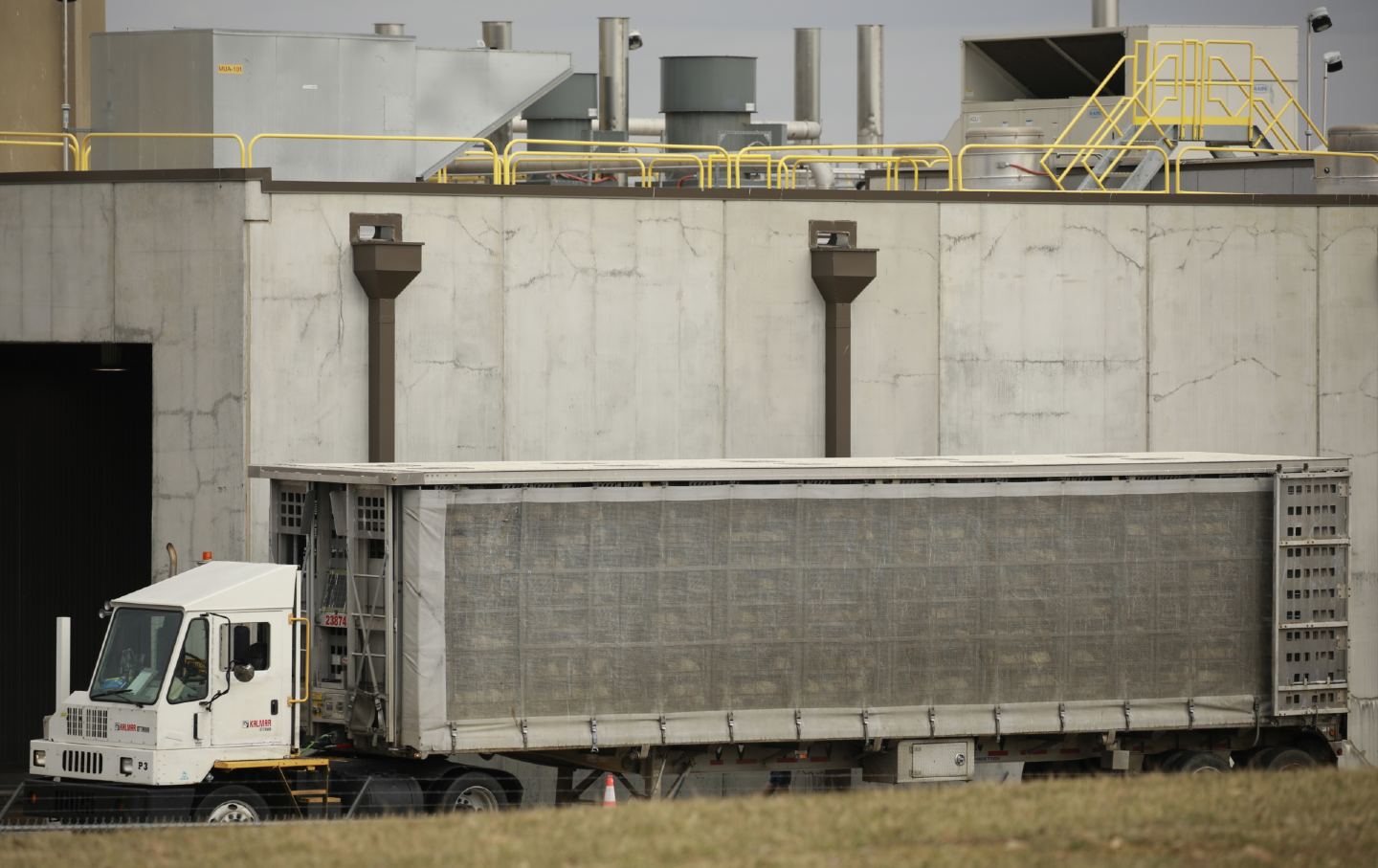
A semi trailer transports chicken to a Tyson Foods plant in Union City, Tennessee, on February 16, 2022.
(Luke Sharrett / Bloomberg via Getty Images)
Tyson Foods is the largest meat producer in the United States and is headquartered in my home state. I grew up in the 1980s in rural Arkansas—the center of the country’s meatpacking industry. The Ozark Mountains are home to a constellation of economically depressed towns like Oark, where I was born. My neighbors grew their own food and tried to make ends meet working odd jobs. Some, like my parents, raised and butchered chickens at home. After my dad and uncle (who lived across the dirt road) chopped off the chickens’ heads, the birds would run around, their nerves briefly alive, as the last flows of life pulsed through their bodies. Other people drove the 45 miles to the chicken processing plant, where they worked and killed 12,000 chickens per day, their hands in perpetual motion, completing a performance both delicate and forceful. One errant movement could get them maimed or killed. In The Jungle, Upton Sinclair’s 1906 novel about the meatpacking industry, he wrote of its workers, “They were willing to work all the time; and when people did their best, ought they not to be able to keep alive?” Over a century later, the question still needs to be asked.
I spent four years, from 2020 to 2024, interviewing dozens of current and former meatpacking workers at Tyson Foods and their family members for my book Life and Death of the American Worker. I began to investigate the meatpacking industry, because I grew up around meatpacking workers and knew their stories. When the pandemic hit in March 2020, I applied for funding from the National Geographic Society to write an article about the impact of Covid-19 on the meatpacking industry. Confronting Tyson Foods, a powerful company worth billions, was daunting, and I never imagined that what began as one article would become a book. But as meatpacking workers began to die of Covid, I kept speaking with their families, hoping that people were ready to listen.
In September 2020, I began driving across Arkansas from one poultry town to the next, speaking to workers at their homes. By spring 2020, workers seemed to be disappearing. At meatpacking plants, managers and supervisors asked: Where is this body or that body? Because they needed more labor.
With the arrival of Covid, I knew the choice the industry faced: follow the Centers for Disease Control’s social-distancing recommendations and reduce Covid infection rates and therefore decrease production or continue as though the pandemic did not exist. Decreasing production would mean less profit, something I knew the industry would never stand for.
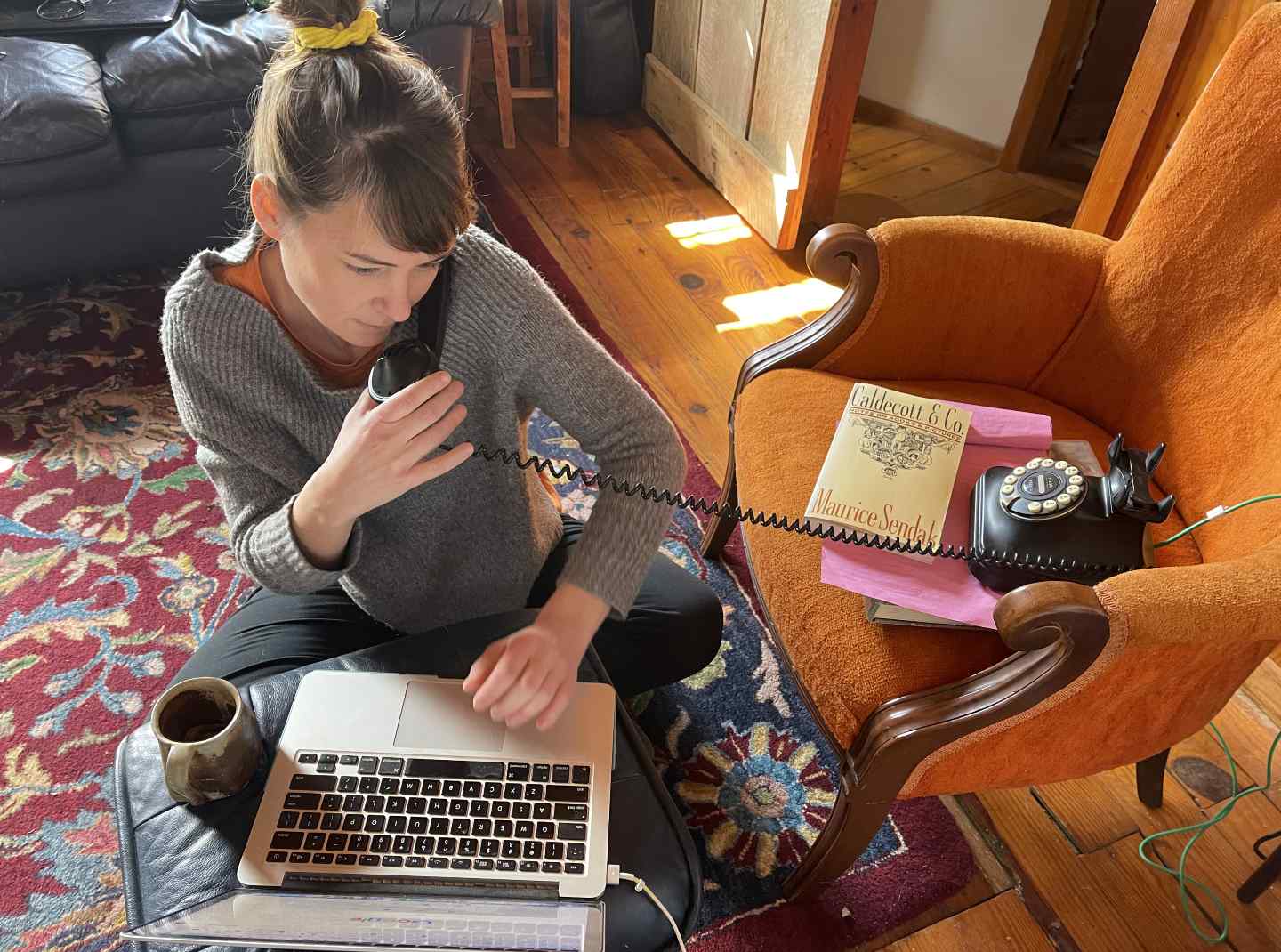
I rented a house down the road from my parents that had been built by my dad’s twin brother. I knew that conducting interviews during Covid would be complicated, and I wanted to ensure that if I became infected, I would not put my parents at risk. There was no cell phone service and poor Internet in the area, so I interviewed meatpacking workers via landline on a black rotary phone, sitting in a chair covered in orange velvet.
I learned that, despite the pandemic, many Tyson plants processed the maximum number of chickens per minute allowed, 140, even with fewer workers. Some plants had obtained permits in 2018 to increase the speed of the lines to 175 birds per minute, which continued during the pandemic. The more chickens processed, the closer the workers were to each other—and many of them worked in temperatures conducive to the spread of the virus. As workers started to go missing, supervisors asked Gloria, a worker from El Salvador, and others to pick up the slack, either by doing the work of two or three people or by managing machinery they hadn’t been trained to operate. Gloria had seen the news about the arrival of coronavirus in the US, but nobody talked about it at work. In early 2020, standing in her kitchen while she formed the dough for pupusas, she said, “We realized a coworker was infected, because they disappeared. We asked Tyson, and they said not even one person was infected.”
“Not even one,” repeated Víctor, Gloria’s husband who had migrated to Arkansas from Mexico. “The lines have half their capacity—many workers are missing,” he noted, adding, “Lately, there have been a lot of accidents because when you’re working more rapidly, you can’t pay attention 100 percent to the dangers you are exposed to. You can fall because the floor is slippery, and you are running faster.” The line where he made chicken nuggets operated at a maximum velocity of 250 revolutions per minute regardless of the number of workers.
During this harrowing time for workers, some of whom would not survive, workers organized to demand safe labor conditions and get justice for family members who had died or become disabled due to labor conditions at Tyson. I followed the work of Venceremos an organization founded in 2019 by 16 immigrant women poultry workers with labor organizer Magaly Licolli. It is a worker-based organization in Arkansas whose mission is to ensure the human rights of poultry workers.
In reporting the book, I traveled with poultry workers from Venceremos to Florida to visit the Coalition of Immokalee Workers (CIW). The CIW has organized workers since 1993, and, like Venceremos, it began as a small group of workers meeting weekly. Licolli believes Venceremos, using the CIW model, can transform the poultry industry in Arkansas. She thinks a worker-to-worker education is an essential tool for organizers in sectors like agriculture and poultry: Workers need to be offered classes in their native language—often at the place they work, since that is where they spend most of their time—and with visual forms of learning since some are illiterate. “It’s more like, let’s have fun and learn together,” Licolli told me.
Licolli began by teaching poultry processing workers about their rights. She used printmaking, papier-mâché, and puppet-making to help workers organize around issues like fair pay, workplace safety, and child labor. She said, “I use theater and art—that is how I engage with and organize workers. Via popular education we all learn from each other, and I like that.” Although she knew there was a lot of work to be done, her first goal was to create a safe space for workers to share their experiences and feel heard.
I found hope in writing about worker-led organizations like the Coalition of Immokalee Workers and Venceremos. Meatpacking workers are immigrants and refugees, some undocumented, but in organizing to ensure safer labor conditions, they create a powerful platform to share their stories. In listening to them, we can honor their work. Even more importantly, we can join forces to demand safe labor conditions for the workers who form the backbone of our food system.
Support independent journalism that does not fall in line
Even before February 28, the reasons for Donald Trump’s imploding approval rating were abundantly clear: untrammeled corruption and personal enrichment to the tune of billions of dollars during an affordability crisis, a foreign policy guided only by his own derelict sense of morality, and the deployment of a murderous campaign of occupation, detention, and deportation on American streets.
Now an undeclared, unauthorized, unpopular, and unconstitutional war of aggression against Iran has spread like wildfire through the region and into Europe. A new “forever war”—with an ever-increasing likelihood of American troops on the ground—may very well be upon us.
As we’ve seen over and over, this administration uses lies, misdirection, and attempts to flood the zone to justify its abuses of power at home and abroad. Just as Trump, Marco Rubio, and Pete Hegseth offer erratic and contradictory rationales for the attacks on Iran, the administration is also spreading the lie that the upcoming midterm elections are under threat from noncitizens on voter rolls. When these lies go unchecked, they become the basis for further authoritarian encroachment and war.
In these dark times, independent journalism is uniquely able to uncover the falsehoods that threaten our republic—and civilians around the world—and shine a bright light on the truth.
The Nation’s experienced team of writers, editors, and fact-checkers understands the scale of what we’re up against and the urgency with which we have to act. That’s why we’re publishing critical reporting and analysis of the war on Iran, ICE violence at home, new forms of voter suppression emerging in the courts, and much more.
But this journalism is possible only with your support.
This March, The Nation needs to raise $50,000 to ensure that we have the resources for reporting and analysis that sets the record straight and empowers people of conscience to organize. Will you donate today?