
Trump’s War on Women Somehow Got Worse
The commander in chief and his allies have deemed women the enemy.
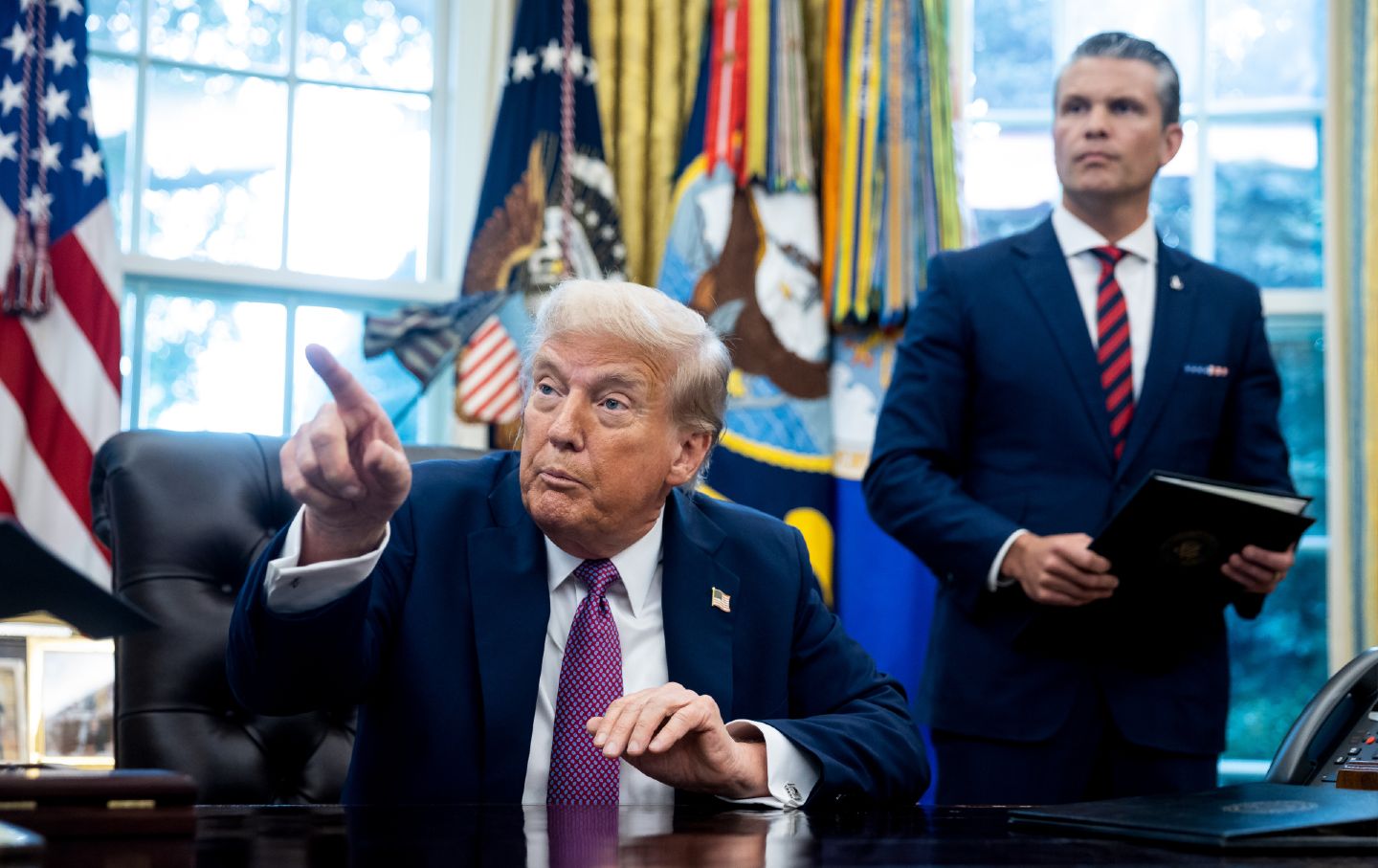
Secretary of War Pete Hegseth and President Donald Trump during an announcement in the Oval Office of the White House in Washington, DC, on Friday, September 5, 2025.
(Francis Chung / Getty Images)This article originally appeared at TomDispatch.com. To stay on top of important articles like these, sign up to receive the latest updates from TomDispatch.com.
“Quiet, Piggy.” The president was intent on silencing Catherine Lucey. The Bloomberg reporter had provoked him with a question about the release of the Epstein files. His insult caught the public’s attention. But Trump’s tongue-lashing lexicon against women has a long history. Other female journalists have been dubbed “obnoxious,” “terrible,” “third-rate” and “ugly.” Vice President Kamala Harris, opposing him in the 2024 presidential election, was labeled “retarded” and former House speaker Nancy Pelosi “crazy as a bedbug.” The list goes on (and on and on). And who knows what was redacted from the Epstein files along those very lines?
Mind you, those Trumpian insults hurled at women (and regularly offered about them) are anything but performative throwaways. They reveal Donald Trump’s deep and abiding contempt for females, an attitude that has taken a giant leap forward (or do I mean backward?) in policy terms in the Trump 2.0 years. Well beyond a simple cascade of insulting words, the commander in chief and his allies have deemed women the enemy. And not surprisingly, under the circumstances, they are now distinctly under attack.
The Purges
From day one of his second term as president, Trump has made his intention to rid the government of women crystal clear—with some window-dressing exceptions. Without mentioning women per se, he nonetheless targeted them on his very first day in office. Executive Order 14151 vowed to end the “forced illegal and immoral discrimination programs” of the Biden era. (On his first day in office, Biden had issued an executive order opening the door for “underserved communities” via a “whole of government equity agenda.”). Trump’s EO, however, decreed an end to DEI (diversity, equity, and inclusion) and to any appointments that were meant to reflect diversity hiring, claiming that such policies “demonstrated immense public waste and shameful discrimination.”
Immediately, women began to be flung from their government perches. Those holding high positions were the first to go. US Archivist Colleen Shogan was removed, as were the three top women at the National Labor Relations Board. Head of the Federal Trade Commission Rebecca Slaughter was promptly fired, a case still under review by the Supreme Court (though it’s hard to expect good news from SCOTUS these days). The Pentagon cleaned house early and fast, removing women from positions of leadership, including the head of the US Naval Academy in Annapolis; the commandant of the Coast Guard, the chief of naval operations, and the only woman flag officer on NATO’s Military Committee. All had been the first females to occupy those posts. Also sent packing was the woman serving as the senior military assistant to the secretary of defense.
Black women in particular found themselves under attack. Early removals of Black women included Carla Hayden, the librarian of Congress; Gwynne Wilcox, the first Black woman to serve on the National Labor Relations Board; and Lisa Cook, the first Black woman to serve on the board of governors of the Federal Reserve Board. Meanwhile, Peggy Carr, the first Black person and the first woman to be commissioner of the National Center for Education Statistics, was cruelly and unexpectedly escorted out of the building in front of her staff.
The circumstances surrounding the ouster of the first female to lead the National Aeronautics and Space Administration (NASA), acting administrator Janet Petro, highlighted the conviction that emptying offices of women occupants took precedence over quality, efficiency, or overall professionalism. Petro was replaced by an interim appointee, Sean Duffy, who continued to serve in the demanding job of secretary of transportation even as he assumed the leadership of NASA. Better, it seems, to overtax a man than allow a woman to lead anything whatsoever.
The Pentagon
The Pentagon took an early lead in the crusade against women. Even before he was confirmed as secretary of defense (now the Department of War), nominee Pete Hegseth signaled the changes to come under his leadership. Obama’s Secretary of Defense Leon Panetta had opened up combat roles to women in 2015. Hegseth promised to change that. “I’m straight up just saying that we should not have women in combat roles,” he told podcaster Shawn Ryan. “It hasn’t made us more effective, hasn’t made us more lethal, has made fighting more complicated.” The Hill summed it up well in late July this way: “All women have now been purged from the military’s top jobs, with no female four-star officers on active duty and none in pending appointments for four- or three-star roles.”
Hegseth’s anti-female campaign focused on substance as well as numbers. Women, he suggested, just didn’t have the skills to conduct business with sufficient lethality. According to him, the Pentagon’s Women, Peace and Security program, signed into law during Trump’s first term in office, only served to weaken the Pentagon. Women would merely distract the department from its “core task—FIGHTING,” he tweeted (as Politico reported). Hegseth summarily ended the program. As a UN spokeswoman suggested, the removal of women’s voices from the realm of peacekeeping would impede the protection of women and children worldwide.
Healthcare
Back at home, removing protections for females has amounted to a full-scale attack, consistent with warfare, on their bodies. A restructuring of the Department of Health and Human Services has crippled reproductive health programs. In April, HuffPost reported that “the majority” of the Centers for Disease Control and Prevention’s (CDC’s) Division of Reproductive Health was laid off and two of the three main programs of the Maternal and Infant Health division were eradicated. While the Trump administration has consistently tried to hide data about such purges and policies, journalists have kept at it, unearthing some of the facts. Citing “piecemeal and crowd-sourced information,” The Guardian, for example, was able to report that “the entire staff of a gold-standard maternal mortality survey…was also put on leave.”
As it happens, the Republican Congress has joined the assault. Trump’s much-ballyhooed Big Beautiful Bill (BBB), which passed in July, included reductions in funding to Medicaid and the Affordable Care Act, programs that are projected to hit adult women the hardest. Of note, the BBB included a prohibition on federal Medicaid payments to Planned Parenthood. Even before the passage of the bill, the administration had withheld Title X funding from 20 states and 144 Planned Parenthood clinics that, since 1970, had received grants for family planning and reproductive health services. Expectations are that more drastic cuts will follow. In May, the Commonwealth Fund summarized the devastating consequences of the president’s first 100 days in office for women’s reproductive health, detailing a drastic decline in access to medical abortions. And if such reproductive issues weren’t enough to alarm us, the Centers for Disease Control and Prevention (CDC) has removed its recommendation for Covid vaccines for pregnant women and children.
The Record
To add insult to injury, the administration has made it clear that it’s not just women’s positions in government or their healthcare that are subject to eradication. The historical record of women and their accomplishments is also under attack. Across government databases, museum displays, and archival holdings, information about women has been systematically deleted. As I wrote in an earlier TomDispatch post, the erasure of information, historical and statistical, has been a signature weapon of this administration. The websites of the Army and Navy have dutifully removed information about the history of women in the military, while Arlington Cemetery took down its webpage on women buried there, including first lady Jacqueline Kennedy. And in a similar fashion, NASA opted to remove any mention of women as part of the DEI purge of its website.
The Deception
No essay on the plight of women in the era of Trump 2.0 would be sufficient without commentary on the seeming contradiction between the multipronged attack on women and the presence of women in a striking number of cabinet roles. Seven of Trump’s cabinet appointments are held by women and his chief of staff, Susie Wiles, is the first woman to hold that cabinet-level post.
And yet, that doesn’t seem to have changed the narrative of Trump 2.0 or the impulse to assault women’s rights nationwide. If anything, it has at times enabled it, only further amplifying the administration’s anti-female screed. At the Department of Justice, for instance, Attorney General Pam Bondi, who a decade earlier had voted against the Violence Against Women Act, has reportedly intervened in a number of asylum cases, banning entry to the United States for women fleeing domestic violence. At the Department of Homeland Security (DHS), under the directorship of Secretary Kristi Noem, the Office for Civil Rights and Civil Liberties has been shuttered, while “at least 25 sexual abuse complaints” have been dismissed. And when it comes to immigration detention, reports of the sexual and physical abuse of women abound. In the words of Human Rights Watch researcher Clara Long, the conditions are “jaw-dropping.” As Long puts it, “Grievous abuses—assaults, sexual abuse, and discriminatory treatment by US agents—are an open secret within DHS.”
In short, the performances of the women in this administration have undermined the cause of women even more. Chosen for their loyalty to Trump rather than their expertise, their incompetence has been laid out for all to see, scoring high marks when it comes to furthering the perception of women as insufficient to the important tasks at hand. Exhibit One is certainly Lindsey Halligan. A former insurance lawyer who had previously been on Trump’s legal team, she was appointed by Attorney General Pam Bondi to serve as the US Attorney for the Eastern District of Virginia. Halligan subsequently headed up the prosecutions of former FBI director James Comey and Attorney General of New York Letitia James, who had been at the helm of lawsuits against the president before he entered office a second time. Both of Halligan’s cases were thrown out after a federal judge ruled her appointment to be an unlawful use of the attorney general’s appointment power. The Department of Justice is appealing both cases.
But even before that judge had a chance to issue his ruling, Halligan had harmed the cause of women. Having never led a prosecution before, she faced the grand jury seeking an indictment of Comey without the presence of her own team at the Justice Department to back her up. (After all, her predecessor, Trump-nominated and Trump-fired Erik Siebert had resigned in part because he had determined that there were insufficient grounds for bringing just such a prosecution.) Due to her lack of expertise, she displayed a profound lack of knowledge about trial procedure and courtroom norms. As former prosecutor Elie Honig reported in New York magazine’s Intelligencer, “the bumbling novice prosecutor” botched many things, including making incorrect statements to the jury and failing to present the final version of the indictment to jury members for their sign-off. Though the case was ultimately thrown out, criticism of Halligan has continued relentlessly.
For those who continue to embrace the exclusion of women from positions of power and consequence, what better proof do they need than Lindsey Halligan—or, for that matter, other women who are being patched into roles they can’t possibly fulfill at a high standard? As French philosopher Simone de Beauvoir long ago commented when it came to women seeking to advance in the world, “Her wings are cut and then she is blamed for not knowing how to fly.”
Popular
“swipe left below to view more authors”Swipe →In sum, women are in trouble in Donald Trump’s second presidency. And yet, there are signs of hope, promising both sustenance and strength for women in the days to come. While the Center for American Women and Politics reports that the number of women in elected office is down overall for 2025, 26 of the 100 senators are now women, the highest percentage ever. (And who knows what the congressional elections in 2026 are likely to bring, given the strong showing of Democrats in elections in 2025?)
Moreover, outside of government, women are far from absent. They currently sit atop the country’s largest philanthropic foundations—Heather Gerken at the Ford Foundation, Amber Miller at the William and Flora Hewlett Foundation, and Louise Richardson at the Carnegie Corporation of New York. They are presidents of some of the country’s most prestigious universities, including Brown, Columbia, New York University, and Yale. At Microsoft, Google, Anthropic, and other tech companies, women are distinctly on the rise, offering expertise, guidance, and leadership, while undoubtedly preparing for a future in which their expertise will be sought.
About-Face?
In recent weeks, inside the Trump administration, there have been signs, however minor, that some of the president’s most devout female allies are starting to dissent. Congressional Representative and Trump loyalist Marjorie Taylor Greene has taken the lead in that female about-face, announcing that she is going to leave Congress before her term is up and going so far as to suggest that she is more in touch with the president’s MAGA base than he is. Like Greene, longtime Trump ally Representative Elise Stefanik has chosen to “call it quits” and leave public office behind. Trump had failed to support her bid to run for governor of New York, just as he had pulled her nomination to the UN earlier in the year. And then there’s chief of staff Susie Wiles who, however much she subsequently reneged on remarks she made over the course of 11 interviews with Vanity Fair’s Chris Whipple, clearly indicated that she had moved away from the president’s stances on Venezuela, the January 6 pardons, and the Epstein files.
Maybe, just maybe, the undermining of decades of progress stands a chance of reversal.
No wonder he’s so afraid of women!
More from The Nation
We Must Raise Our Voices Against the Attacks on Trans Care We Must Raise Our Voices Against the Attacks on Trans Care
The Gender Liberation Movement’s Raquel Willis says trans youth “are our future” and that new HHS rules amount to a national ban on gender-affirming care for young people.

Bruce Springsteen Is Bringing the Cavalry Bruce Springsteen Is Bringing the Cavalry
The Boss’s most political tour yet will go from Minneapolis to Washington.
Trump’s Threats to Free Speech Aren’t New to Black Journalists Trump’s Threats to Free Speech Aren’t New to Black Journalists
Two years after Trump’s infamous invitation to the National Association of Black Journalists’ convention, the organization is adapting and bracing for escalating hostility.
The Scientists Groveling to Trump Are Kidding Themselves The Scientists Groveling to Trump Are Kidding Themselves
The government has pulled back from massive cuts to the NIH, but it’s still destroying scientific research. So why are some groups appeasing the president?
CBS Surrenders to Trump CBS Surrenders to Trump
The network tried to bury an interview critical of Trump. Stephen Colbert made it an indictment of the administration’s assaults on the First Amendment.
Epstein Class Clowns Epstein Class Clowns
One key revelation in the wide correspondence of the late pedophile: The rich and powerful just aren't all that bright.

