
Trump’s New Endowment Tax Is Already Reshaping Higher Education
The “Big, Beautiful Bill” added additional taxes on a small set of universities. Now budget cuts have hit campuses across the Ivy League and elsewhere.
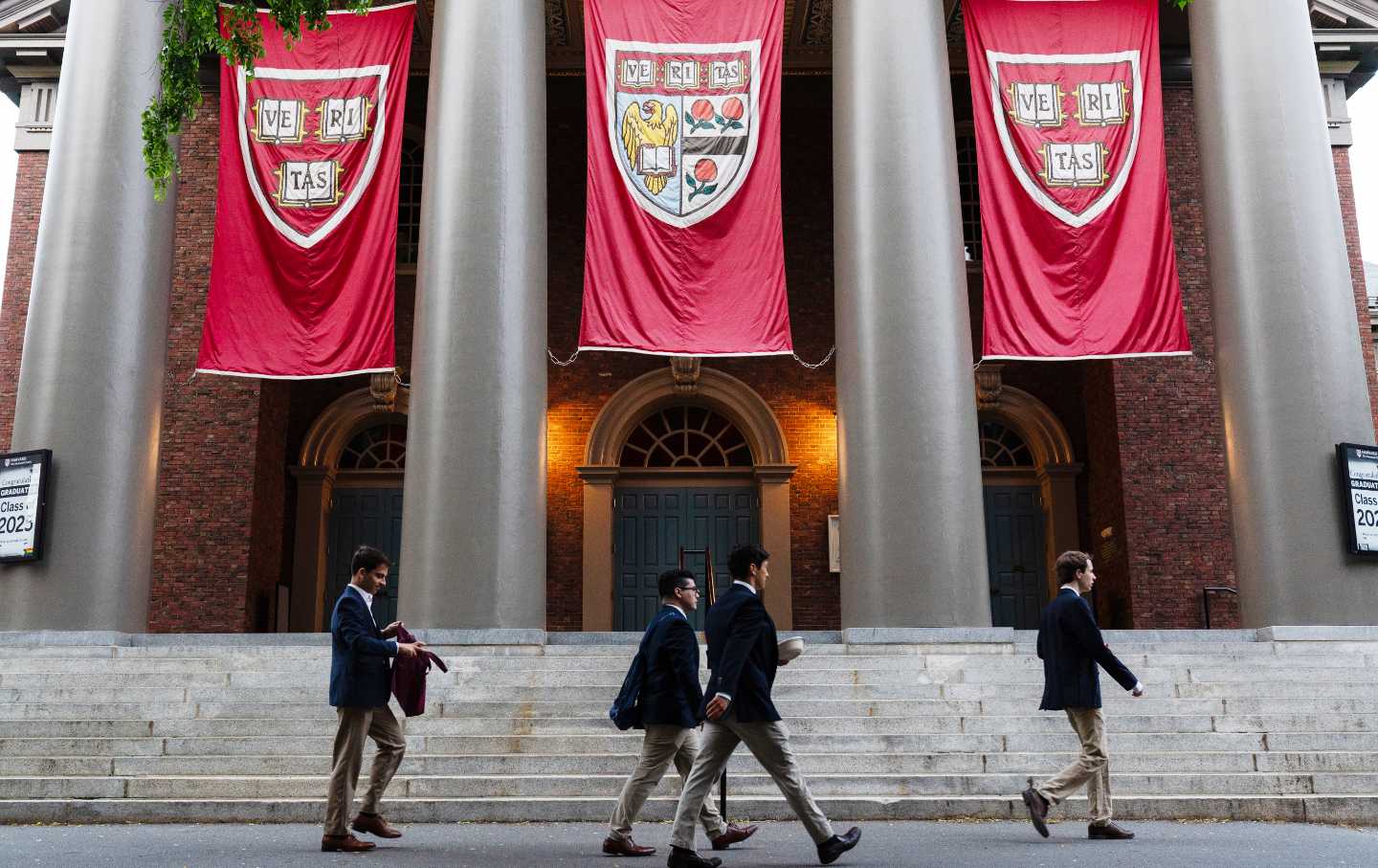
Banners hanging from Memorial Church on the Harvard University campus in Cambridge, Massachusetts.
(Sophie Park / Getty)Over the summer, the Trump administration held an unusual Independence Day celebration at the White House. A live band warmed the crowd with renditions of Chaka Khan’s “Ain’t Nobody” and Pharrell Williams’s “Happy” before the president emerged from the first-floor balcony of the executive residence. Supporters sporting red MAGA caps looked on as he signed the Big Beautiful Bill into law beneath the South Portico’s white columns. He flashed the document, showing his Sharpie signature, fulfilling several campaign promises, including what he called the largest tax cuts in the country’s history: “We’ve delivered no tax on tips, no tax on overtime, and no tax on Social Security for our great seniors.”
But the president never mentioned that the bill would reconfigure the balance sheets of the most elite universities in the United States. And, on New Year’s Day, the universities subject to the Big Beautiful Bill’s higher rates began facing the largest tax hikes in their history.
Ten universities have been hit the hardest, as Princeton, Yale, and MIT brace for an 8 percent endowment tax, and Stanford, Harvard, Notre Dame, Dartmouth, Rice, Vanderbilt, and the University of Richmond face a 4 percent tax, according to an analysis from Forbes.
The selection was determined by endowment size per student: Schools with more than $2 million per full-time tuition-paying student face the 8 percent rate, while those between $750,000 and $2 million per student pay 4 percent. Five other universities—Emory, Duke, Washington University in St. Louis, Penn, and Brown—will continue paying the original 1.4 percent rate. Harvard and Yale each anticipate roughly $300 million in additional annual costs, and, in total, billions will go from elite campuses to Washington every year.
But additional revenue is not quite the point. The Big Beautiful Bill narrowed the endowment tax base, shifting the burden from 56 private universities that paid a 1.4 percent levy under the Tax Cuts and Jobs Act to just 15 institutions facing the new tiered rates.
Rather than broadening the base, the bill concentrated higher taxes on a small set of elite universities that have conducted research leading to some of the most important scientific breakthroughs, including mRNA vaccine technology, MRI machines, pacemakers, and insulin therapy for patients with diabetes.
That reality has led to interpretations that the Big Beautiful Bill’s endowment tax is punitive. Now budget cuts are hitting universities across the Ivy League and elsewhere.
Why target these particular institutions with an increased endowment tax? The schools share several characteristics: enormous endowments (Harvard’s exceeds $50 billion), highly selective admissions processes, perceived ideological homogeneity, and prominence in shaping national elites. But these schools are also among the many universities that the president has spent years attacking as bastions of left-wing thought—even though he, Vice President JD Vance, and Treasury Secretary Scott Bessent, all three attended Ivy League schools.
The choice of targets also reflects political calculation. Unlike state research universities with powerful congressional delegations protecting them, these private institutions have fewer natural political defenders and make symbolically potent targets for a populist agenda.
Princeton, for example, will likely face a tax liability exceeding $223 million this year, according to Wellesley College economist Phillip Levine, a senior fellow at the Brookings Institution. Early last year, Levine issued a warning about university presidents: “They don’t recognize a meteor is about to hit.”
“Princeton has asked its departments to make 5-to-10 percent budget cuts across the board,” according to Charlie Yale, a sophomore from Omaha, Nebraska, studying history at Princeton. But he added that the university has so far done a good job preventing those cuts from directly affecting student life. “There are, for example, fewer events with free food,” he said, “but in the context of cuts to climate research or threats to international students, I don’t think it is as bad as it could be.”
Other departments have been hit harder. Despite recently losing several top faculty, the economics department isn’t hiring this year, according to Owen Zidar, a professor of economics and public affairs at Princeton. “We are also planning to shrink the size of the PhD program from around 23 students to around 19 as a result of budget pressures,” he said, which means “less research, fewer scientists, and less innovation and productivity growth in the United States.”
These cuts are now playing out, in different forms, across the Ivy League.
At Yale, President Maurie McInnis announced a budget adjustment, by imposing a 5 percent reduction in non-salary expenses, which account for roughly one-third of the university’s spending. In Yale College, students noticed the shift in financial aid for undergraduate summers and study abroad. “To compensate for the endowment tax, Yale has been forced to make budget cuts to undergraduate student life,” said Alex William Chen, a sophomore studying history and political science and the speaker of the Yale College Council Senate. The university “has slashed funding and limited the uses of the International Study Award,” said Chen, “which previously enabled more than 50 percent of Yale students—the share of the university receiving financial aid—to participate in life-changing study abroad experiences.”
As one of Yale’s highest-ranking student leaders, Chen has begun organizing the student response. “I decided to stand up for my classmates. Our petition, which nearly one in four Yale students have signed in three weeks, is a push to reject the premise that the necessary fiscal relief for Yale’s endowment tax recalibration must come from denying current and future students on financial aid an array of learning opportunities,” Chen said. The petition, he added, is on its way to becoming the most signed in Yale’s recent history.
“This year, not only are our normal requests being denied by the administration, but so are all of our smaller requests,” said Micah Draper, Yale’s sophomore class president. He criticized the Yale administration for failing to match other Ivy League schools’ student financial aid while attributing the new funding cuts to the Trump administration’s endowment tax. “I know that this is because of the recent increase in the tax on our endowment,” Draper said. “During a normal year, many of our students’ needs could be easily met, but now the tax serves as a barrier for aid to reach those who need it most.”
These taxes didn’t emerge out of nowhere. In 2023, before it was even clear who the next president would be, the Heritage Foundation published “Project 2025,” an agenda for the next Republican in the White House. “Rather than continuing to buttress a higher education establishment captured by woke ‘diversicrats’ and a de facto monopoly enforced by the federal accreditation cartel,” reads a section on the Department of Education, “federal postsecondary education policy should prepare students for jobs in the dynamic economy, nurture institutional diversity, and expose schools to greater market forces.”
In other parts of Project 2025, the plan lays out an agenda where trade schools would be bolstered. Trump has already moved on this: In September, he previewed a $500 million deal on trade schools with Harvard, according to CNN. This aligns with shifting public sentiment: In 2013, 70 percent of adults surveyed by Pew said a college education was “very important.” This year, it was just 35 percent.
At Yale, concerns about the endowment tax extend beyond the cuts themselves. Daniel Martinez HoSang is an American studies and political science professor who serves on the executive committee of the American Association of University Professors at Yale. “I think there is a growing concern among faculty at Yale and other colleges and universities that the problem is not a recognition about the crisis we’re likely to face,” he told Connecticut Public Radio last month. “It’s very, very uneven the ways that faculty, students, staff, and others are allowed to participate in decisions about what the impact and consequences of these budget reductions will be.”
Yale owns roughly $4.3 billion in New Haven real estate. Because it is a nonprofit, the university is tax-exempt, and the city cannot collect property taxes on that land. This is also true of other Ivy League campuses. Yale does, however, provide annual payments in “lieu” of property taxes; the university has a $135 million, multi-year commitment to New Haven.
Popular
“swipe left below to view more authors”Swipe →“It would be fairer for universities like Yale to be taxed by localities like New Haven, which don’t tax them but do provide policing, sanitation, public schools, and so much more,” said Jim Sleeper, a former Yale political science lecturer. “Compared to that uneven tradeoff, the federal government’s taxing of universities’ endowments would be extortion driven by Trump’s ideologically motivated campaign against liberal education.”
Unlike Yale and Princeton, MIT has not tightened its budgets, nor has it framed spending cuts as inevitable—at least not yet.
In a letter sent on November 19, 2025, MIT president Sally Kornbluth identified three levers the university would pull to help close the budget gap created by the new endowment tax: increasing revenue through fundraising; reducing costs by not renewing leases on unused office space and forgoing merit salary increases for employees earning more than $85,000; and “rebalancing,” by urging academic departments to use previously underutilized gifted funds.
Harvard, Yale, Princeton, MIT, and Stanford have each begun responding to the new endowment tax differently. Yet they still share at least one commonality: They are more affordable for the average American family than a typical state school or liberal arts college, and they have made their commitment to financial aid clear.
But what, exactly, the student experience will look like in five years, after as much as $10.5 billion has been transferred to the federal government, is still being worked out by university administrations. “We love our school,” said Draper. “But this isn’t a one-year problem. It will be here long after my classmates and I graduate.”
More from The Nation

What’s It Like Inside a Data Center? What’s It Like Inside a Data Center?
Northern Virginia is laden with structures that house data for Fortune 500 companies. I went inside just one of those monstrosities that bothers its neighbors.

What Trump and Tucker Carlson Have in Common What Trump and Tucker Carlson Have in Common
Carlson has broken with Trump largely over the war in Iran. But on Ukraine and immigration, the two speak very much the same language.

The Jewish Case Against AI The Jewish Case Against AI
Haredi rabbis and the secular left agree: This technology is a threat to the entire social fabric.
The Fight for Educational Equality Is Also a Fight for a Just Supreme Court The Fight for Educational Equality Is Also a Fight for a Just Supreme Court
The court has severely weakened our ability to make an education system that fulfills the promise of Brown.

The Fall of “Scientific American” The Fall of “Scientific American”
When the beloved science publication got too political, its corporate owners stepped in. Now its future is uncertain.

The Bookstore Revolution in Taiwan’s Conservative Heartlands The Bookstore Revolution in Taiwan’s Conservative Heartlands
After Taiwan legalized same-sex marriage, gender-themed bookstores are working to build the social acceptance that the law alone couldn’t deliver.

