What the Hell Do This Week’s Whiplash Tariff Rulings Actually Mean?
While the courts continue to debate the legality of Trump’s sweeping tariffs, the law remains clear: They are unconstitutional.
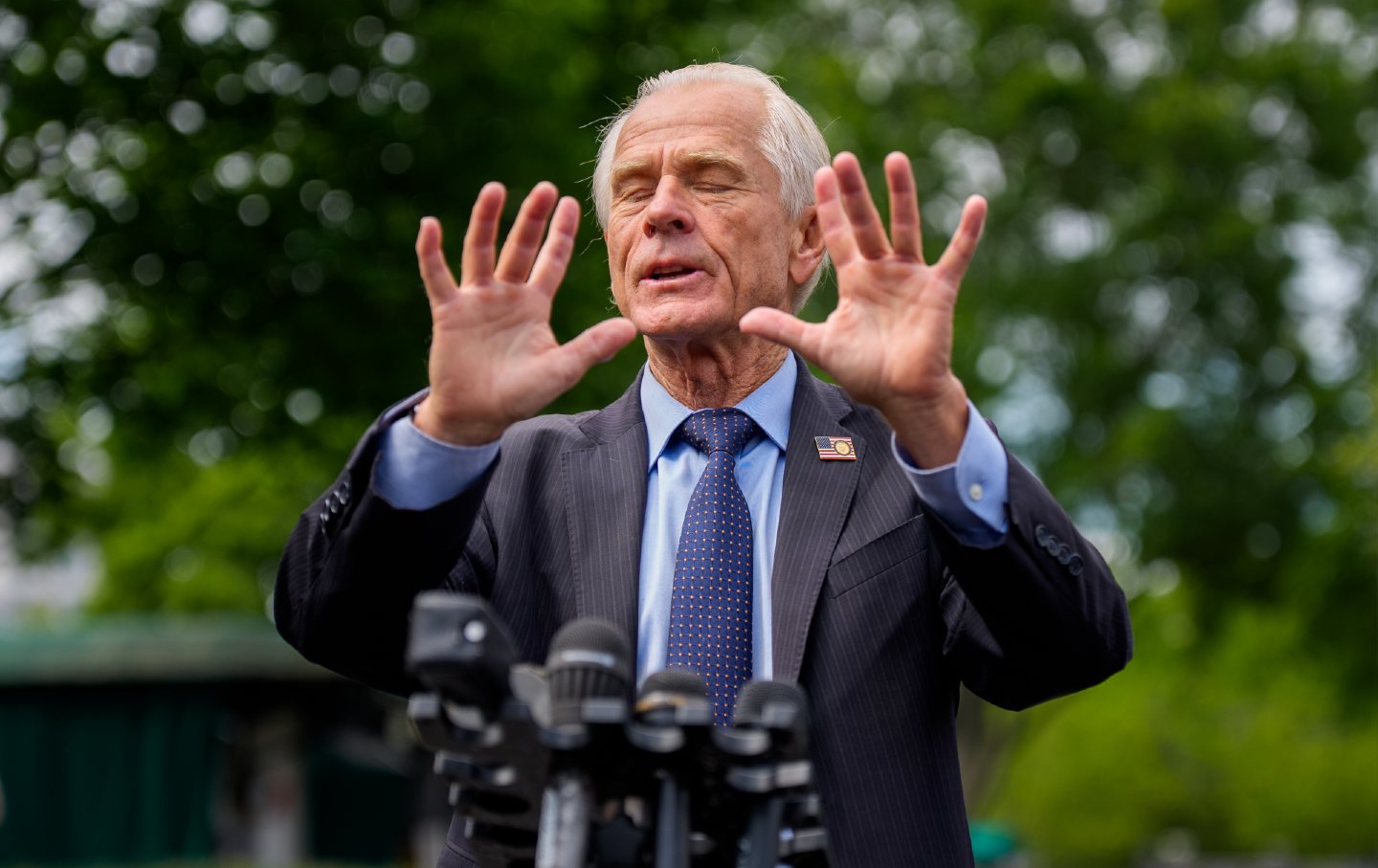
Trade adviser to President Donald Trump Peter Navarro speaks to members of the media after a federal court blocked Trump’s sweeping tariffs using an emergency powers law.
(Andrew Harnik / Getty Images)
Donald Trump’s sweeping, retaliatory tariffs were ruled unconstitutional by a federal appellate court this week. The US Court of International Trade (which is a federal appeals court I periodically forget exists) ruled unanimously that Trump’s tariffs exceeded his authority under the 1977 International Emergency Economic Powers Act. The ruling struck down the so-called “Liberation Day” tariffs Trump imposed, then “TACO’d” back slightly.
That ruling lasted barely a day. The US Court of Appeals for the Federal Circuit (not to be confused with the Court of Appeals for the DC Circuit) stayed the Court of International Trade’s ruling, and directed litigants to prepare to argue the case by June 9.
While it’s always annoying to see a federal court continue to treat Trump like a normal president and give him all the benefits of delay that come from the slow process of appellate review, I still think that Trump will lose his tariff case on appeal to the federal circuit.
That’s because Trump’s actions are flagrantly unconstitutional, and the court will reach that inevitable conclusion whenever it gets around to looking at Trump’s actual arguments. The Constitution gives Congress the power to impose tariffs, not the president, and courts will have to acknowledge that sometime this century.
Like so much else in the Trump era, the tariffs are something Trump could do if he got the Congress, which is controlled by his own party, to pass a bill. Trump’s consistent attempts to do through executive fiat what he could do through legislative acts are one of the reasons he keeps losing in courts. I wish someone in his own party could explain to him how government works in this country, or just read him a high school civics textbook, so the rest of us wouldn’t have to be constantly bombarded by his patently illegal actions.
Of course, the problem for Trump on the tariff issue is that Republicans in his own party are thankful that the courts stepped in to stop this economically disastrous policy. In the movement conservative publication Reason, law professor Ilya Somin writes: “From the very beginning, I have contended that the virtually limitless nature of the authority claimed by Trump is a key reason why courts must strike down the tariffs.… I am glad to see the CIT judges agreed with our argument on this point!”
The opinion from the Court of International Trade (which was unanimously issued by a three-judge panel consisting of a judge appointed by Ronald Reagan, a judge appointed by Barack Obama, and a judge appointed by Trump himself) was smart for at least two reasons that I think will help their ruling hold up on appeal. First, the court argued that if the International Emergency Economic Powers Act actually gave Trump the powers he claims it does, then the act itself is unconstitutional. The legal reasoning behind it is that Congress cannot delegate its authority to impose tariffs to the president in such an open-ended way as Trump says it does. That’s an argument that should appeal to conservative judges, especially Justice Neil Gorsuch, who tends to think that Congress has to be very specific when it gives its powers away.
The court’s other smart move was to invoke another law, the Trade Act of 1974, which governs how presidents can impose tariffs to respond to trade deficits, one of the stated reasons for Trump’s retaliatory tariffs. That act makes it clear that tariffs to address trade deficits have to be lower than 15 percent, and can only last for 150 days.
To pull it all together: the court is saying that Trump can’t use one statute (unless the law itself is unconstitutional) and is using another statute (which he can use) incorrectly.
Again, I expect the Federal Circuit to reach the same conclusion… eventually.
But when the case gets to the Supreme Court (which, at this pace, will be sometime just after Godot finally shows up), Trump can likely expect more support. He’ll start the proceedings with three justices (Clarence Thomas, Samuel Alito, and alleged attempted rapist Brett Kavanaugh) who are already pretty sure that Trump is King of America. Meanwhile, Chief Justice John Roberts seems to think that the words “national security” trigger a kill switch for the Constitution that renders it inoperable.
Whether the tariffs survive could depend on how much money Amy Coney Barrett wants to spend on avocados, and frankly, I don’t even know how much Jesus likes guacamole.
In the meantime, the trade war is still on, for no appreciable reason other than that Trump is a madman and the courts are still debating whether and how to stop him from violating the Constitution. I will now go back to forgetting that the US Court of International Trade exists.
Correction: An earlier version of this article inadvertently mischaracterized the views of Professor Ilya Somin, who does indeed take immigrant rights seriously. We regret the error.
Support independent journalism that does not fall in line
Even before February 28, the reasons for Donald Trump’s imploding approval rating were abundantly clear: untrammeled corruption and personal enrichment to the tune of billions of dollars during an affordability crisis, a foreign policy guided only by his own derelict sense of morality, and the deployment of a murderous campaign of occupation, detention, and deportation on American streets.
Now an undeclared, unauthorized, unpopular, and unconstitutional war of aggression against Iran has spread like wildfire through the region and into Europe. A new “forever war”—with an ever-increasing likelihood of American troops on the ground—may very well be upon us.
As we’ve seen over and over, this administration uses lies, misdirection, and attempts to flood the zone to justify its abuses of power at home and abroad. Just as Trump, Marco Rubio, and Pete Hegseth offer erratic and contradictory rationales for the attacks on Iran, the administration is also spreading the lie that the upcoming midterm elections are under threat from noncitizens on voter rolls. When these lies go unchecked, they become the basis for further authoritarian encroachment and war.
In these dark times, independent journalism is uniquely able to uncover the falsehoods that threaten our republic—and civilians around the world—and shine a bright light on the truth.
The Nation’s experienced team of writers, editors, and fact-checkers understands the scale of what we’re up against and the urgency with which we have to act. That’s why we’re publishing critical reporting and analysis of the war on Iran, ICE violence at home, new forms of voter suppression emerging in the courts, and much more.
But this journalism is possible only with your support.
This March, The Nation needs to raise $50,000 to ensure that we have the resources for reporting and analysis that sets the record straight and empowers people of conscience to organize. Will you donate today?