Trump Is Outdoing Himself
In the malignity of his intent and the scale of his graft, the second term is significantly worse. But it’s also his last.
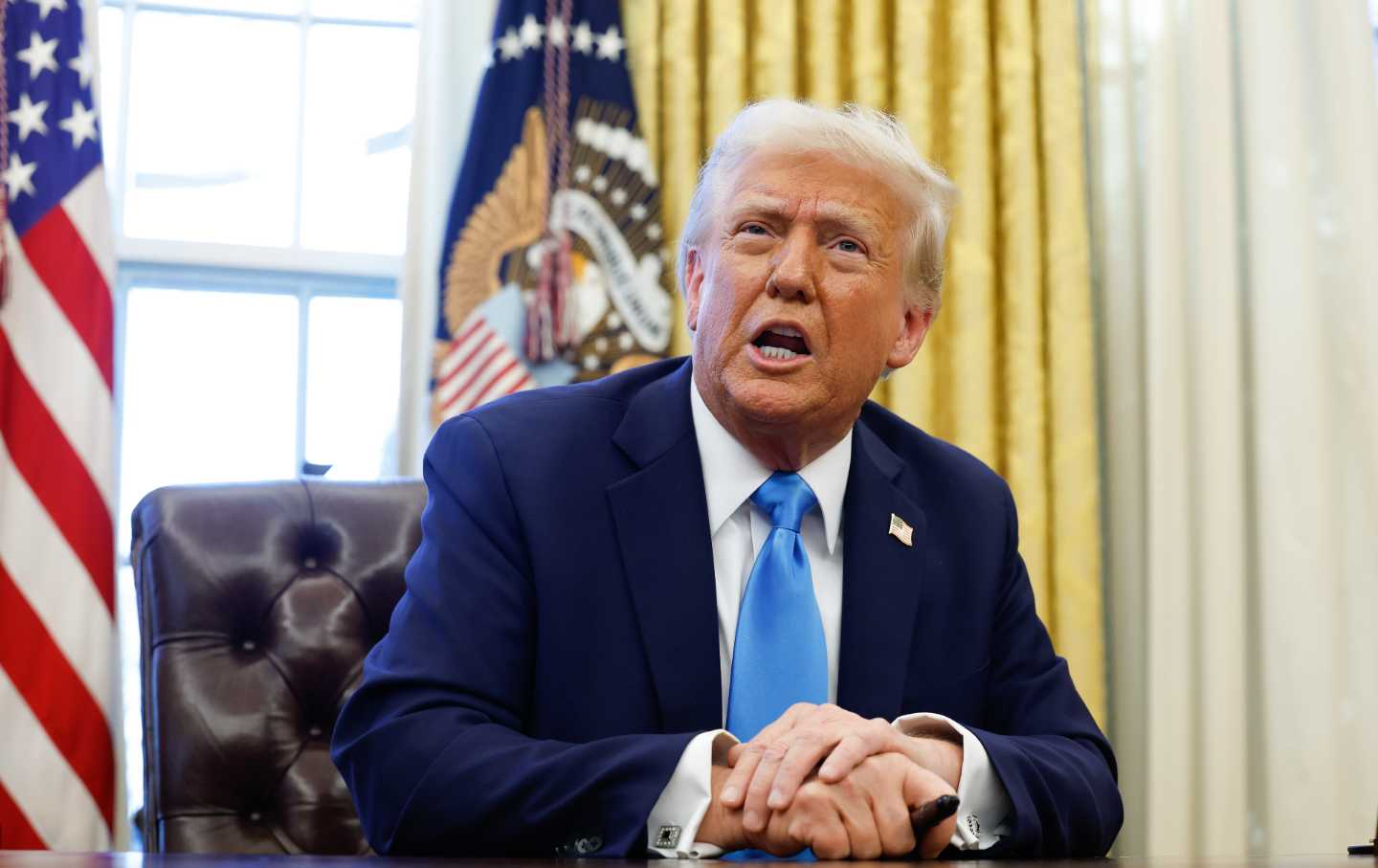
With all due respect to Karl Marx, Hegel never actually said that history repeats itself—and the claim that events occur first as tragedy and then again as farce, while a pretty turn of phrase, is about as far as you can get from an iron law of history. Donald Trump’s second term, for example, though it will doubtless contain its lighter moments, seems likely to outpace his previous outing in both the malignity of its aims and the scale of its corruption. In 2017, a domestic oligarch or foreign potentate who wanted to curry favor with the White House had to book an overpriced suite in a Trump hotel—or perhaps promise to throw some business at his son-in-law. This time around, anyone can participate, with the range of opportunities for lining the pockets of America’s first family stretching all the way from gilded Bibles (and matching footwear) to memecoins ($Trump for the gentleman, $Melania for the lady).
At this point in his first term, the pace of Trump’s “barrage of outrageous and offensive comments, his waves of unqualified or conflict-ridden nominees, and his daily assault on the most vulnerable among us,” as I described it at the time, seemed more like a tactic designed to discombobulate the opposition than a program to remake the federal government. Trump’s weapons of mass distraction are as effective as ever, with the Democrats in familiar disarray and the mainstream media normalizing like there’s no yesterday. But thanks to Project 2025, we know that Trump and his minions really do mean to shred the social safety net and burn down the administrative state.
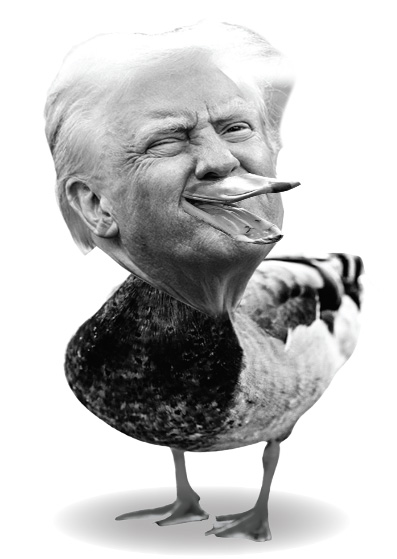
Not since Franklin Roosevelt’s first inaugural has an incoming administration so dominated the political agenda. And yet underneath all the executive orders and shock-and-awe assaults on the powerless, the most fundamental fact about our cowardly new world is that Trump is and will remain a lame-duck president. Which lends a certain brittle quality even to his current triumphs—and ought to give his opponents some courage.
Not that the Democratic Party appears to have noticed. Rejecting Representative Alexandria Ocasio-Cortez’s bid to head the House Oversight Committee in favor of the senescent—and on current evidence barely sentient—Gerry Connolly was a sign that whatever game House Democrats may be playing, they’re still just playing. As for the party’s Senate leadership, even some Democratic governors—no one’s idea of a militant vanguard—recently expressed their frustration with Chuck Schumer’s ineffective opposition.
Over on MAGA Square, claimants to the mantle are already marshaling their forces. Whether Steve Bannon’s preemptive strike on Elon Musk will prove as effective as their joint purge of Vivek Ramaswamy remains to be seen. Likewise whether JD Vance, as titular heir apparent, will outlast or outmaneuver the already evident political ambitions of Trump’s heirs of the body. But the marriage of convenience between the workerist/social conservative wing, represented by Bannon and Vance, and the tech-lord oligarchs (and their fan base) on Team Musk is on the rocks—and could be sped toward divorce by an opposition capable of walking and chewing gum at the same time.
Here at The Nation, we’re not just sitting on our hands waiting for that to happen—or shouting from the sidelines. Instead, we’ve got Elie Mystal on why, at least where the courts are concerned, things could get much, much worse; Lily Geismer on the roots of the Democratic Party’s paralysis; Waleed Shahid on what a fighting (and thriving) left looks like; and Joshua Leifer on Israeli settlers and the Trump approach to Gaza’s future (“waterfront property,” “prime location”).
Plus Hasan Ali on Sufi devotional music, John Banville on the adventures of Henri Bergson, Alyssa Battistoni on a translation of Marx’s Capital fit for the 21st century, Jorge Cotte taking the measure of The Pitt, J. Hoberman on Mike Leigh’s Hard Truths, and Rachel Hunter Himes on the art of Kara Walker.
Not to mention the debut of columnist John Ganz, our house blend of eloquent editorials and commentary, and dispatches from California burning.
If you like what you read here, please tell your friends.
D.D. Guttenplan
Editor