The US Is Now in the Human-Trafficking Business
The Trump administration spent $6 million to knowingly disappear hundreds of people into a foreign prison where they are being made to work, without pay, in torturous conditions.
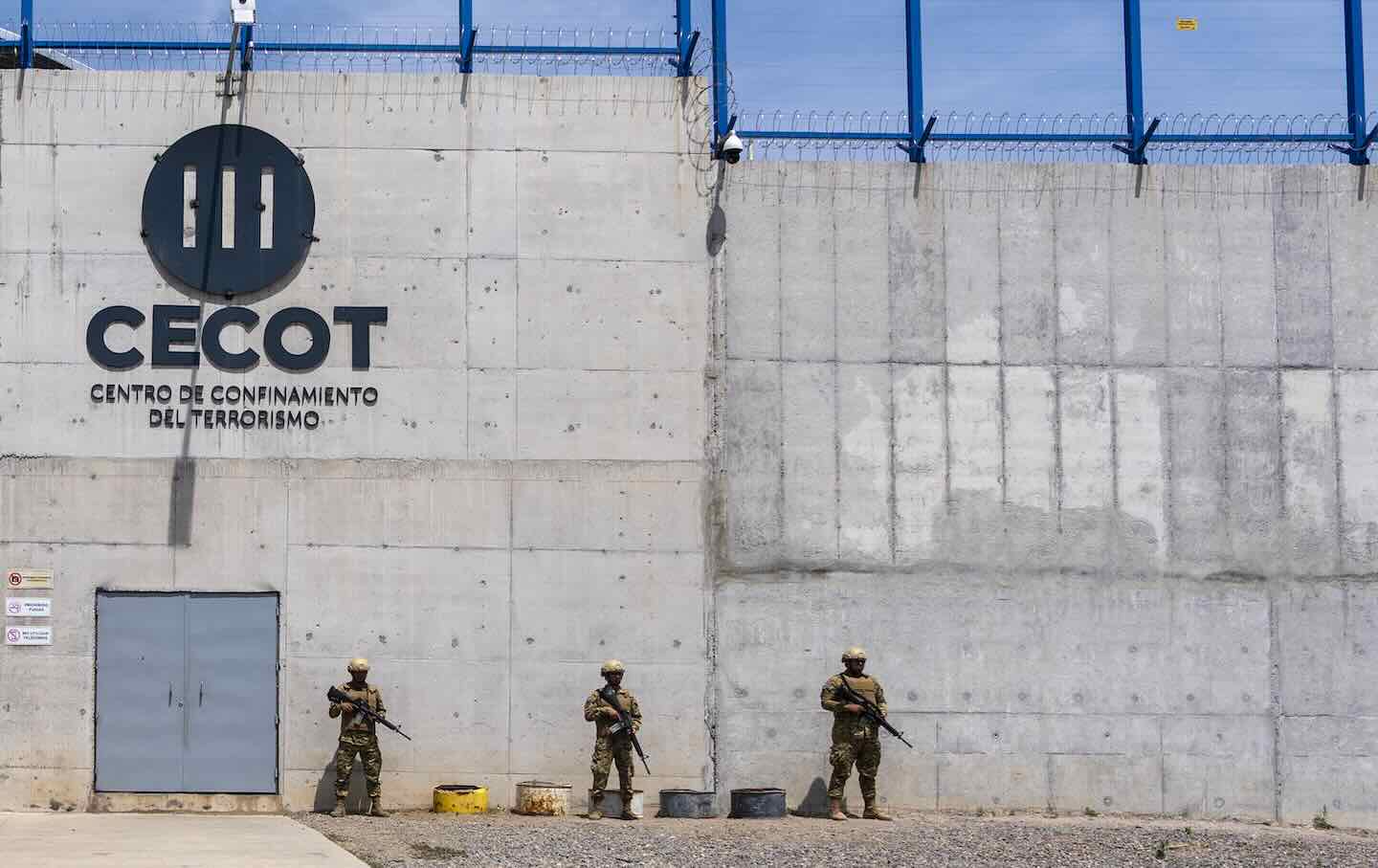
The exterior of the Terrorist Confinement Center as Homeland Security Secretary Kristi Noem arrives, in Tecoluca, El Salvador, Wednesday, March 26, 2025.
(Alex Brandon / AP Photo)
After deporting 238 Venezuelan immigrants to a notorious mega-prison in El Salvador—likely in violation of court orders—the Trump administration has triggered an unprecedented showdown with the judicial branch to defend its ability to deport immigrants without presenting any evidence in court. Invoking the state secrets privilege—which allows the government to withhold evidence to protect national security interests—DOJ lawyers have refused to reveal deportation flight departure times and also tried to appeal Judge James Boasberg’s temporary restraining order (TRO).
This deportation effort constitutes a clear assault on civil liberties and due process rights. It also represents an arguably darker milestone: The US government is now in the business of trafficking migrants on the global market.
On March 15, the Trump administration struck a $6 million agreement with Salvadoran President Nayib Bukele in which the government traded 238 people to be warehoused for a year in the Centro de Confinamiento del Terrorismo—CECOT—the “crown jewel” of Bukele’s deeply antidemocratic domestic security platform and where prison sentences are reportedly indefinite, with no possibility of release. Despite ongoing legal intervention, the administration has since doubled down. On March 26, as DOJ lawyers sought a federal appeals court ruling that will allow them to resume deportations to El Salvador, Secretary of Homeland Security Kristi Noem visited the country to tour CECOT and deepen the administration’s relationship with Bukele. And in another overnight operation this past weekend, the US deported 17 more people to El Salvador, using a different legal mechanism to get around Judge Boasberg’s TRO.
The country’s partnership with El Salvador is designed to score cheap political points and marginal financial gains, at the enormous moral cost of reducing people to tradable commodities on the global market. Even after conceding that they illegally deported one Maryland father who had already been granted protected status by an immigration judge, the Trump administration has said it cannot bring him home because he is now in foreign custody—meaning the executive branch is prioritizing its trade relationship with El Salvador over compliance with American law.
Bukele, Trump, and Secretary of State Marco Rubio each have shared horrifying videos of men being led from American airplanes with chains binding their ankles and wrists, some hunched over as armed guards press down on each of their necks. Upon their arrival at CECOT, their heads were shaved and they were forced into white prison garb. For now, they spend 23.5 hours a day in overcrowded cages that number around 80 to 100 people, where they sleep on metal bunks with no mattresses. They will soon be enlisted in El Salvador’s euphemistic “Zero Idleness” program, an obscure labor regime that requires more than 40,000 incarcerated people to build infrastructure, manufacture commercial goods, and harvest agricultural products.
There’s a familiar word for forced prison labor: slavery. The Trump administration has spent millions of taxpayer dollars to knowingly disappear hundreds of people—many of whom have no criminal record and likely no gang affiliation—into a foreign prison where they are being made to work, without pay, in torturous conditions for the explicit economic benefit of a self-professed dictator. Bukele recently boasted that the deal will help make his country’s famously brutal prison system “self-sustainable,” acknowledging that he sees these new arrivals as little more than able bodies in his vast carceral machinery.
By effectively subsidizing and populating a modern penal colony, Trump has reignited the international slave trade. The United States will profit from this deal, too. It costs the US approximately $60,000 to incarcerate one person in a domestic immigrant detention center for a year but far less at CECOT, where the price tag comes out to around $25,000 per person. Overall, the federal government is projected to save $8.3 million with this deal, with the added bonus of geographically isolating people from the critical legal protections that have stymied Trump’s deportation operation on domestic soil. And by leasing carceral infrastructure from a foreign country, Trump can supersede the physical limitations of America’s detention capacity. As Noem declared on her visit to CECOT, “This facility is one of the tools in our toolkit that we will use if you commit crimes against the American people,” signaling a clear desire to pursue similar human -trafficking arrangements.
To sustain its rapid expansion under this new authoritarian regime, the American carceral state has now metastasized beyond the borders of the state itself.
This is the culmination of a long and shameful history, in which the American criminal legal system has always been a site of state-sanctioned economic exploitation and capitalist profiteering. We don’t need to look any further than the rise of the private-equity-backed, for-profit prison industry. This encompasses everything from private prison operators (who now primarily run immigration detention centers) to the more than 4,000 companies that use prison slave labor in their supply chain or contract with carceral facilities to profit off their captive market, including selling new, wearable monitoring and surveillance technologies to track biometric and location data.
The United States already exports its carceral logic—culturally and materially—across the world, ranging from militarized policing tactics to the extremely profitable $230 billion weapons trade. But this exchange with El Salvador introduces a new market sector in the globalized carceral economy: the trade of incarcerated migrants.
It’s hard not to read the deal with El Salvador as part of a larger agenda to use state violence to convert free workers, mainly immigrants, into market commodities. Trump’s mass deportation plans already threaten to disrupt the US economy by targeting immigrants who largely work low-paying jobs that form the backbone of the construction, agriculture, and hospitality sectors. Forced out of the free labor market by ICE arrests, immigrants are instead incarcerated in privately run detention centers—and, now, in a Salvadoran prison—to fulfill their new economic role: as incarcerated laborers for corporate profit, or as criminalized bodies who can be detained and deported for financial gain. And as industries—including American-born workers—feel the consequences of this deportation regime, corporations are likely to fill labor shortages with forced prison labor.
Incarcerated people are already compelled to fill existing labor gaps in dangerous conditions, including fighting wildfires and managing hurricanes and other natural disasters; during the Covid-19 pandemic, this extended to manufacturing PPE and digging mass graves. The incarceration of criminalized populations, including immigrants, is a multibillion-dollar industry—Trump’s mass deportations simply introduces a new, much darker chapter in the story of American carceral capitalism.
Even as Trump attempts to torch the global economy by levying tariffs and relinquishing foreign aid to poor and war-torn nations, he has allowed for a human exception to his international trade policy.
Popular
“swipe left below to view more authors”Swipe →It remains to be seen whether other countries will be incentivized to follow suit by offering their own carceral facilities to house victims of the Trump deportation regime—although it is worrying that Bukele’s mass criminalization program has already influenced other Latin American leaders. And we are still waiting for the final word from the courts on whether these men will be brought back home.
But here’s what we do know right now: Two weeks ago, the United States government sold 238 Venezuelan immigrants into penal slavery. On Sunday, 17 more immigrants joined them, deported under unsubstantiated allegations—including a lead plaintiff in an existing lawsuit against the Department of Homeland Security. These men are fathers. Some are factory workers or recreational soccer players. One is a gay asylum seeker and a makeup artist. Another, a barber. And one is even a professional goalkeeper. Their families cannot understand why they were taken and are calling desperately for their return.
Trump and Bukele want to disappear these men from our public consciousness and reduce them to criminals, commodities, slaves. But we have an obligation to recognize their humanity, and to demand their return and their freedom. Because if we don’t, then who else will they come for next?
Become a Sustaining Donor This September
Between the reemergence of right-wing red-baiting and Donald Trump’s use of the chilling National Security Presidential Memorandum–7 to criminalize left political organizing, we’re seeing McCarthyism reborn before our eyes.
This assault on democracy cannot be ignored or wished away. Resisting it requires bravery in the face of threats and repression, a steadfast commitment to the truth, and the unwavering belief that we can—and will—overcome this darkness.
We must have an independent media that sets the record straight, unearths corruption and abuses of power, and advances a politics of justice and dignity for all if we’re to win this fight.
That’s why I’m writing to you today. This September, The Nation needs to add 100 monthly donors to sustain our progressive journalism. Your contribution makes the next investigative report, the next truth-speaking column, and the next pathbreaking essay all possible.
I hope you’ll support our work with a recurring donation today. If you donate $10 or more a month, we’ll send you a brand new “Hands Off the Free Press!” sticker to recognise your commitment to our cause. Please, donate today.
Onward,
Katrina vanden Heuvel
Editor and Publisher, The Nation