Our Trans Protections Aren’t Strong Enough for the Trump Era
Many states have passed so-called “shield laws” to protect trans people. But they weren’t designed for a presidency like Donald Trump’s.
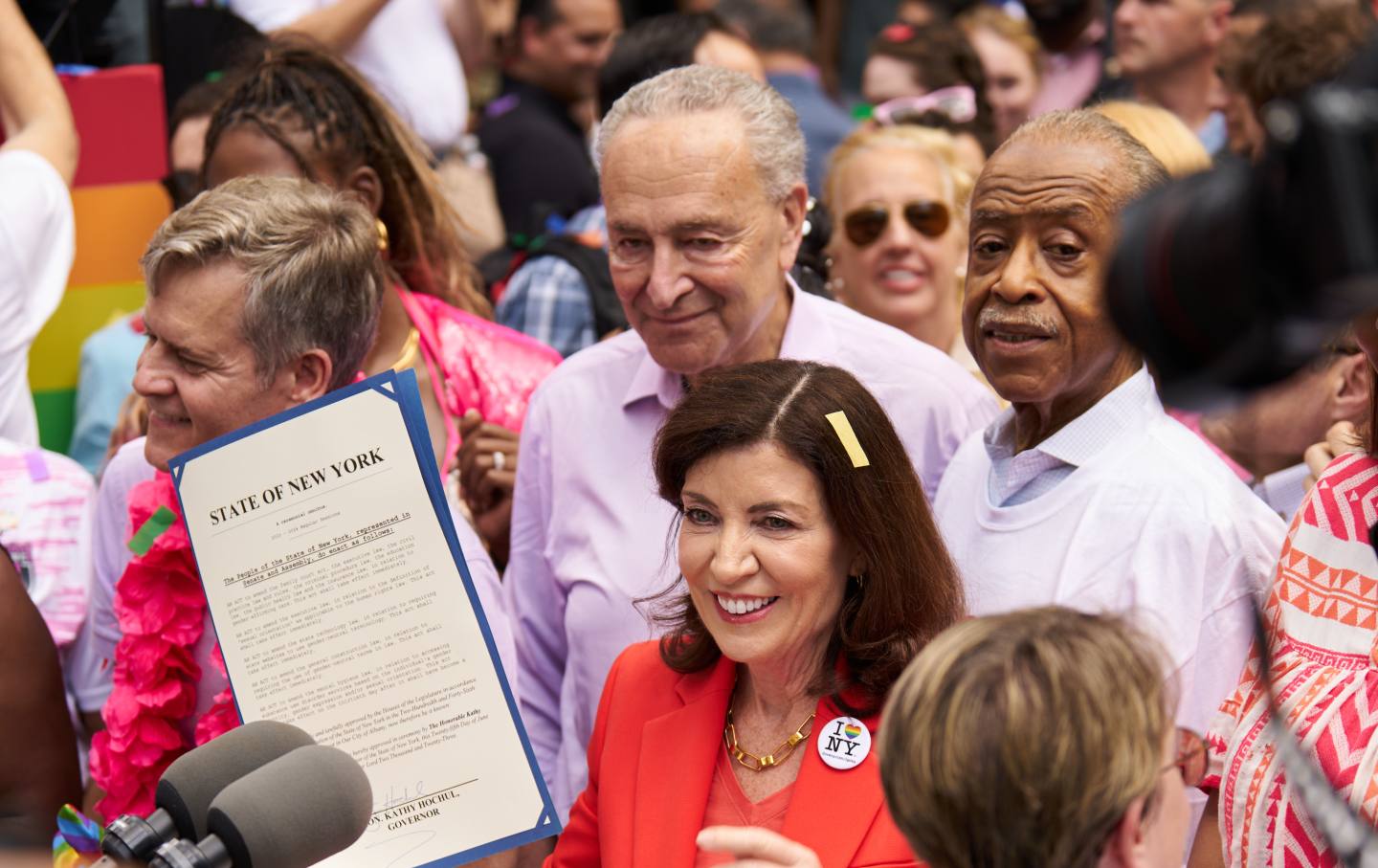
New York Governor Kathy Hochul displays signed legislation designating New York State as a safe haven for trans youth and physicians before the NYC Pride March on Sunday, June 25, 2023.
(Bing Guan / Bloomberg via Getty Images)New York’s new shield law would “enshrine our state as a beacon of hope, a safe haven for trans youth and their families,” Governor Kathy Hochul announced during Pride Month in 2023. The “march of bigotry and hate stops at Minnesota’s borders,” Governor Tim Walz said when he signed another shield law the same year. “We must fight for our youth and their parents,” California Governor Gavin Newsom announced in 2023 as he signed a similar bill, even as he vetoed another that would have protected trans kids in custody battles.
But as the Trump administration’s assault on trans people accelerates, it’s becoming more and more obvious that these and other so-called “safe haven” laws enshrined across the country are no match for the might of the federal government. States are unlikely to be able to fully protect their trans residents from White House attacks, but rather than do what they can, their leaders—once eager for LGBT-friendly soundbites—are rolling over in the face of the federal anti-trans campaign.
Trump hard-launched his second administration with a slew of executive orders targeting trans people, including one threatening to end gender-affirming care for people under the age of 19. In New York, Colorado, Virginia, Washington, DC, Illinois, Arizona, Wisconsin, and California, hospitals announced restrictions and shutdowns of gender-affirming care. Trans youth who had fled their home states for more welcoming ones discovered that long-awaited appointments had been canceled with no warning at all.
That executive order is on hold pending legal challenges. With their funding more secure, some hospitals have begun to provide care again. But the reprieve is temporary.
This is where state-level laws could kick in. But, passed at a time when few envisioned a second Trump presidency, the laws aimed to respond to legal threats from other states rather than from an openly hostile federal government, said Alejandra Caraballo, a civil rights expert at Harvard Law School.
In the aftermath of the Dobbs Supreme Court decision, Democratic states passed legislation intended to protect their abortion providers from aggressive red-state attorneys general. Around the same time, as conservative states started banning gender-affirming care for minors and restricting it for adults, activists began to recognize that “the two provisions of care are inextricably linked,” as Arli Christian, a senior policy counsel for the ACLU, told The Nation.
A dozen states passed laws, mostly in 2022 and 2023, declaring themselves refuges for trans people and their families. The objective was the same as with abortion shield laws: to make it safe for people refuse to cooperate with legal persecution from other states. Providers sued for providing medical care could sue right back, and authorities could ignore subpoenas and protect confidential medical information.
“The spirit of these laws is almost equally important,” Christian said, because they show providers fearful of legal and professional consequences that the governments of their home states are prepared to defend their right to provide lifesaving, best-practice medical care.
The focus on other states wasn’t universal—Massachusetts, for example, also prohibited state law enforcement from assisting federal investigations into abortion and gender-affirming care. But broadly speaking, these laws were designed for an era that has passed. They were meant to protect against civil and criminal litigation from other governments—in other words. They were not crafted for a world in which the federal government threatens to slash funds and otherwise punish states not over any specific legal case but simply because they refuse to discriminate against trans people. It isn’t a particularly constitutional strategy, but with Elon Musk and his goons lurking in the Treasury, the promise of relief through the courts rings increasingly hollow.
Popular
“swipe left below to view more authors”Swipe →“If you’re bankrupt before you can even file a lawsuit,” Caraballo said, “it doesn’t matter if what they’re doing is unlawful.” Some nonprofits, including ones focused on sexual abuse and LGBTQ health, have already scrubbed their sites of any mention of gender-affirming care and transgender identity in response to another executive order prohibiting the promulgation of “gender ideology.”
“Absent state law that says, ‘No, you have to continue providing care,’ then the legal risk calculus is all against us,” Reed said. Forcing organizations to go to war with the Trump administration is risky. “That being said,” she added, “hospitals are much better equipped to fight for their transgender patients in court than the patients themselves are.”
Antidiscrimination statutes protecting trans people can offer states a modicum of leverage. In Michigan, for example, a hospital lifted a pause on new hormone therapy treatments for trans youth after the state’s attorney general warned that the decision could violate state antidiscrimination laws. New York’s attorney general has also warned hospitals that refusing care to trans patients on the basis of their identity “is discrimination under New York law,” and on February 18 the state Department of Health reminded hospitals of their obligation to provide “equitable continuity of care” for all patients, regardless of gender.
But trans people still remain under threat.
When New York first expanded its civil rights law to cover gender identity in 2019, “we almost thought we’d won this battle,” New York State Senator Brad Hoylman-Sigal told The Nation. At the time, he said, no one thought that the federal government would “run roughshod over the legislative prerogative of states.”
Hoylman-Sigal sponsored New York’s shield law in 2023, and now hopes to expand it to protect other providers, like social workers and pharmacists, as well as physicians. In the Assembly, Linda Rosenthal recently introduced a bill that would require Medicaid to cover gender-affirming care regardless of federal funding. State organizations continue to advocate for other legislation that would expand funding for LGBTQ health and housing. Hochul, meanwhile, has generally remained silent.
Newsom has been the opposite of silent. Besides using his new podcast to rail against trans athletes, he has discouraged lawmakers from introducing trans rights legislation. The state LGBTQ Caucus ignored him, introducing bills to expand “refuge” protections—limiting access to prescription histories, medical records, and court records, for example. But even if those bills pass, Newsom could veto them, and the California legislature hasn’t overridden a gubernatorial veto since 1979.
Some protection is still better than nothing, said Alejandra Caraballo. “Don’t do the devil’s work for him.” But the Trump administration isn’t just threatening trans people, she said. It’s also threatening the federalist order: the 10th Amendment principle that reserves a degree of autonomy to the states. “I don’t see how a better-worded statute or policy can protect against the breakdown of the rule of law,” she said.
Three states, she pointed out, have protections for gender identity in their constitutions. Others have laws prohibiting discrimination on the basis of gender identity. “It’s going to come to a head,” Caraballo said.
As the Trump administration launched its campaign to punish Maine for its refusal to kick two girls off their sports teams, its governor issued a statement asserting that Trump couldn’t force the state to violate its own nondiscrimination law. Since then, as the feds have begun slashing state funding, the governor has declined to comment, ProPublica has reported. Meanwhile, the state of Iowa has preempted the issue entirely by passing a bill that removes gender identity protections from the state civil rights code.
Things will become more clear—for better or worse—when the Supreme Court announces its decision in United States v. Skrmetti. That case could establish that trans people are entitled no special legal protections whatsoever, meaning that the government would need only the barest excuse to discriminate on the basis of trans identity. “If Skrmetti goes that way,” Caraballo warned, “there is no bottom of the barrel to how far they can go to effectively eradicate trans people from public life.”
“The level of government overstep into our lives is unbelievable, and the level of government harm on a very specific population just because of who we are is horrible to see,” said Arli Christian of the ACLU. “It’s a moment where we really hope our legal institutions hold up.”
Become a Sustaining Donor This September
Between the reemergence of right-wing red-baiting and Donald Trump’s use of the chilling National Security Presidential Memorandum–7 to criminalize left political organizing, we’re seeing McCarthyism reborn before our eyes.
This assault on democracy cannot be ignored or wished away. Resisting it requires bravery in the face of threats and repression, a steadfast commitment to the truth, and the unwavering belief that we can—and will—overcome this darkness.
We must have an independent media that sets the record straight, unearths corruption and abuses of power, and advances a politics of justice and dignity for all if we’re to win this fight.
That’s why I’m writing to you today. This September, The Nation needs to add 100 monthly donors to sustain our progressive journalism. Your contribution makes the next investigative report, the next truth-speaking column, and the next pathbreaking essay all possible.
I hope you’ll support our work with a recurring donation today. If you donate $10 or more a month, we’ll send you a brand new “Hands Off the Free Press!” sticker to recognise your commitment to our cause. Please, donate today.
Onward,
Katrina vanden Heuvel
Editor and Publisher, The Nation