
Trans Medicine’s “Merchants of Doubt”
There is plenty of uncertainty involved in gender-affirming care—as in most aspects of medicine. But the groups behind the Tennessee ban aren’t driven by science—or patient care.
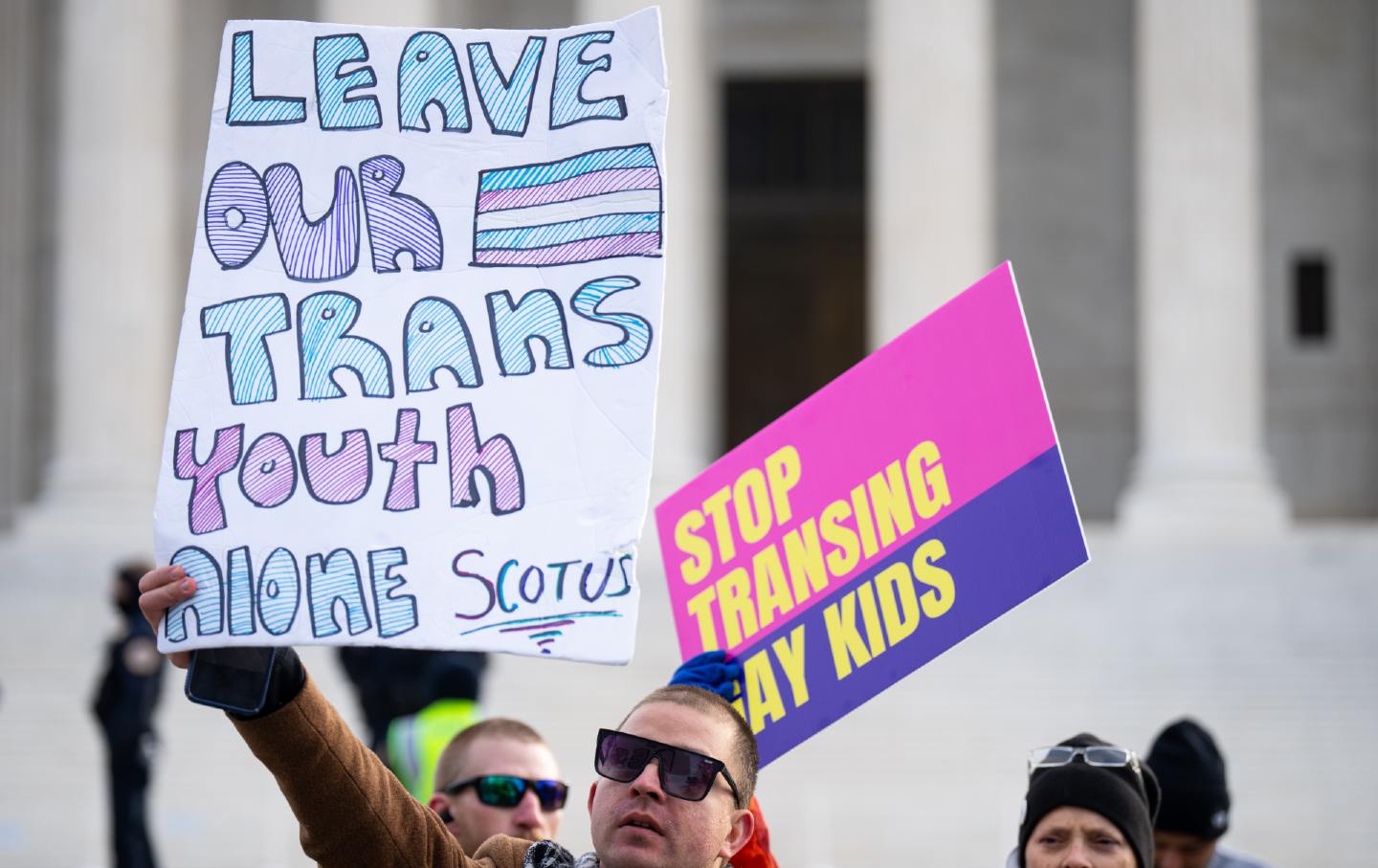
Gender-affirming care is based on dangerously uncertain science. So say lawmakers in the 26 states that have banned medical interventions for minors ranging from puberty-suppressing and hormonal replacement medications to surgical procedures.
Today, the Supreme Court will hear a case, United States v. Skrmetti, deciding whether to uphold these regulations of what trans medicine’s critics have unduly called “experimental” healthcare. To the contrary, leading medical associations, including the American Academy of Pediatrics and World Professional Association for Transgender Health (WPATH) firmly support gender-affirming care for minors as “medically necessary” and potentially lifesaving. So, if the medical establishment isn’t driving this narrative of dangerous uncertainty, who is?
For the past several years, conservative political leaders and fringe medical voices have waged an often covert campaign against gender-affirming care. Borrowing from fossil fuel, tobacco, and Covid-19 science denial strategies, these agents of scientific uncertainty have cast doubt on trans medicine’s safety and efficacy. Just like those “merchants of doubt” who spread untruths about humanity’s impact on the climate and the dangers of secondhand smoke, extraordinarily well-funded groups have spread the idea that gender-affirming care’s evidence base is perilously uncertain.
Just look at the strategists who drafted the ban language that many states have copy-and-pasted into their laws. Do No Harm, for instance, has promoted its JUSTice for Adolescent and Child Transitioners Act as a model for anti-trans legislators. While its name borrows from the physicians’ Hippocratic Oath, many of Do No Harm’s senior fellows are political operatives working for the American Enterprise Institute and the Heritage Foundation and not medical experts. Do No Harm’s board chair Stanley Goldfarb is admittedly a physician, albeit one who specializes in kidney disease.
Those defending bans in court also sow uncertainty. The Alliance Defending Freedom, which has benefited from dark-money foundations including the Charles Koch Institute, has worked extensively to support bans. Leaked emails show that the organization courted the American College of Pediatricians—a fringe group that broke away from the American Academy of Pediatrics over its support for gay and lesbian second-parent adoption rights—to “refute” WPATH’s renowned standards of care for trans patients and to file pro-ban legal briefs.
In the media, the libertarian Manhattan Institute’s City Journal has published skeptical takes on trans medicine alongside criticisms of Covid-19 vaccination policies. Senior fellow Christopher Rufo of “critical race theory” panic fame has joined his Manhattan Institute colleagues in conjuring fears of “castration machines” and other “Frankenstein” medical interventions that he attributes to a mix of trans studies scholars in the humanities and pharmaceutical industry billionaires. My own co-authored study on this anti-trans political network was immediately attacked in the pages of City Journal by Do No Harm’s Ian Kingsbury, an education policy researcher who works for a school choice think tank, who embraced “doubt as a badge of honor.”
One powerful way that these groups promote uncertainty is by citing the work of an older generation of clinicians. The first gender-identity clinics in the 1960s focused primarily on preserving a child’s assigned gender identity, coaxing effeminate boys to adopt masculine mannerisms. Experts at Johns Hopkins University’s pioneering gender identity clinic were committed to preserving a sex binary at a time when rigid gender norms prevailed. In fact, that clinic’s work was a natural extension of its previous work in unethically “correcting” intersex patients’ anatomies.
Today, ban proponents invoke older studies and commentaries by those like psychologist Kenneth Zucker, former director of the Gender Identity Clinic at the Centre for Addiction and Mental Health in Toronto. Zucker has been criticized for decades for his practices that some claim are akin to discredited conversion therapies. Others like Case Western Reserve University School of Medicine gender identity clinic founder Stephen Levine have testified in favor of bans, arguing that trans identity is perhaps rooted in a pathological narcissism.
Though many of these ideas have been relegated to the fringe, they have been put to use by new medical associations formed to oppose gender-affirming care. According to a Yale School of Medicine report, groups like the Society for Evidence–based Gender Medicine (SEGM) and Genspect have disseminated “biased and unscientific content” despite often having no “apparent ties to mainstream scientific or professional organizations.” SEGM’s leadership includes psychoanalyst Lisa Marchiano, who promotes untested “gender exploratory” therapies, and Avi Ring, a Scandinavian expert in “countermeasures to chemical warfare.” Genspect’s leadership includes Stephen Levine along with Abigail Shrier, author of Irreversible Damage: The Transgender Craze Seducing Our Daughters, and physician Lisa Littman, most famous for her highly criticized study on the concept of “rapid-onset gender dysphoria.”
To further heighten fears about transition regret, ban supporters often publicize the experiences of prominent detransitioners. Contrary to its most common usage, the term “detransition” refers broadly to halting gender-affirming care for any reason and is not synonymous with regret. As gender identity clinician and researcher Dr. Jack Turban has shown, detransition frequently results from family pressure, social stigma, and difficulty in attaining or maintaining employment. That has not stopped Do No Harm and its patient advocate, detransitioner Chloe Cole, from promoting the narrative that gender clinicians rush to affirm distressed patients, ultimately resulting in an epidemic of detransition.
Part of what makes these claims so powerful is that there actually is plenty of uncertainty involved in gender-affirming care—just as there is in most aspects of medicine. While puberty suppression therapy is prescribed “off-label” because the Food and Drug Administration has not approved its specific use in trans medicine, the off-label prescription of drugs is extremely common, especially for children and adolescents given the financial and ethical barriers to pediatric pharmaceutical trials. And yet, there is no wave of legislation banning other off-label prescriptions.
This trans exceptionalist way of viewing the medical record has also characterized the Cass Review, a recent UK National Health Service–sponsored series of studies that found “weak evidence” for many gender-affirming care practices. In their reports, pediatrician Hilary Cass’s team repeatedly framed detransition as a serious risk—despite finding fewer than 10 examples of detransition in well over 3,000 patient records. And while Cass correctly observed that many gender-affirming treatments have not been subject to randomized-controlled trials (RCTs), evidence-based medicine’s supposed gold standard, bioethicists have questioned whether RCTs should be afforded that distinction given its denigration of clinical experience, observational studies, and other indispensable forms of medical knowledge. In the context of gender-affirming care, withholding hormonal treatments from some patients (as is necessary for RCTs) is especially unethical and methodologically fraught. The physical effects of testosterone therapies, for instance, would be easily distinguished from a placebo. For those and many other reasons, a Yale Law School–led team of prominent gender-affirming care experts recently published a critique of the Cass Review’s deficiencies.
Despite their enormous medical flaws and their relationships to powerful conservative interests, the influence of these agents of scientific uncertainty is palpable and growing. Just as disingenuous climate change “skeptics” have stalled efforts to mitigate the human toll of weather catastrophes, so too do bans unduly restrict access to much-needed care. While more research is always better—for patients and the planet—we should not be deluded into thinking that gender-affirming care’s critics are engaged in a good-faith debate over the science.
Support independent journalism that does not fall in line
Even before February 28, the reasons for Donald Trump’s imploding approval rating were abundantly clear: untrammeled corruption and personal enrichment to the tune of billions of dollars during an affordability crisis, a foreign policy guided only by his own derelict sense of morality, and the deployment of a murderous campaign of occupation, detention, and deportation on American streets.
Now an undeclared, unauthorized, unpopular, and unconstitutional war of aggression against Iran has spread like wildfire through the region and into Europe. A new “forever war”—with an ever-increasing likelihood of American troops on the ground—may very well be upon us.
As we’ve seen over and over, this administration uses lies, misdirection, and attempts to flood the zone to justify its abuses of power at home and abroad. Just as Trump, Marco Rubio, and Pete Hegseth offer erratic and contradictory rationales for the attacks on Iran, the administration is also spreading the lie that the upcoming midterm elections are under threat from noncitizens on voter rolls. When these lies go unchecked, they become the basis for further authoritarian encroachment and war.
In these dark times, independent journalism is uniquely able to uncover the falsehoods that threaten our republic—and civilians around the world—and shine a bright light on the truth.
The Nation’s experienced team of writers, editors, and fact-checkers understands the scale of what we’re up against and the urgency with which we have to act. That’s why we’re publishing critical reporting and analysis of the war on Iran, ICE violence at home, new forms of voter suppression emerging in the courts, and much more.
But this journalism is possible only with your support.
This March, The Nation needs to raise $50,000 to ensure that we have the resources for reporting and analysis that sets the record straight and empowers people of conscience to organize. Will you donate today?
More from The Nation

The Real Reason Americans Love Guns The Real Reason Americans Love Guns
With a weak social safety net, a gun offers a false sense of personal power and security.

The Endless Hypocrisy of Bari Weiss The Endless Hypocrisy of Bari Weiss
She claims to be a free speech champion. But as her actions at CBS News keep showing, she seems to think free speech should run only in a rightward direction.
What Will Be Left After the University of Texas Destroys Itself? What Will Be Left After the University of Texas Destroys Itself?
UT-Austin has collapsed its race, ethnic, and gender studies into a single program while a new policy asks faculty to avoid “controversial” topics. But the attacks won’t end there...

The Corporate Media Is Head Over Heels for the Iran War The Corporate Media Is Head Over Heels for the Iran War
Donald Trump’s attack may be surreal, unjustified, and illegal. But that’s not stopping the press from turning the propaganda dial way up.

The Disturbing History of ICE’s “Death Cards” The Disturbing History of ICE’s “Death Cards”
The Vietnam-era practice is yet another example of ICE agents thrilling to the brutality they have been encouraged to cultivate.

The American Universities Programming Israel’s Killer Drones The American Universities Programming Israel’s Killer Drones
Industry partnerships in higher education are pushing STEM graduates into the business of weapons manufacturing and genocide profiteering.

