
The Supreme Court Once Again Endorses Trump’s Racism
The court took a look at Trump’s obviously bigoted handling of the Temporary Protected Status program and said, “Nothing to see here.”
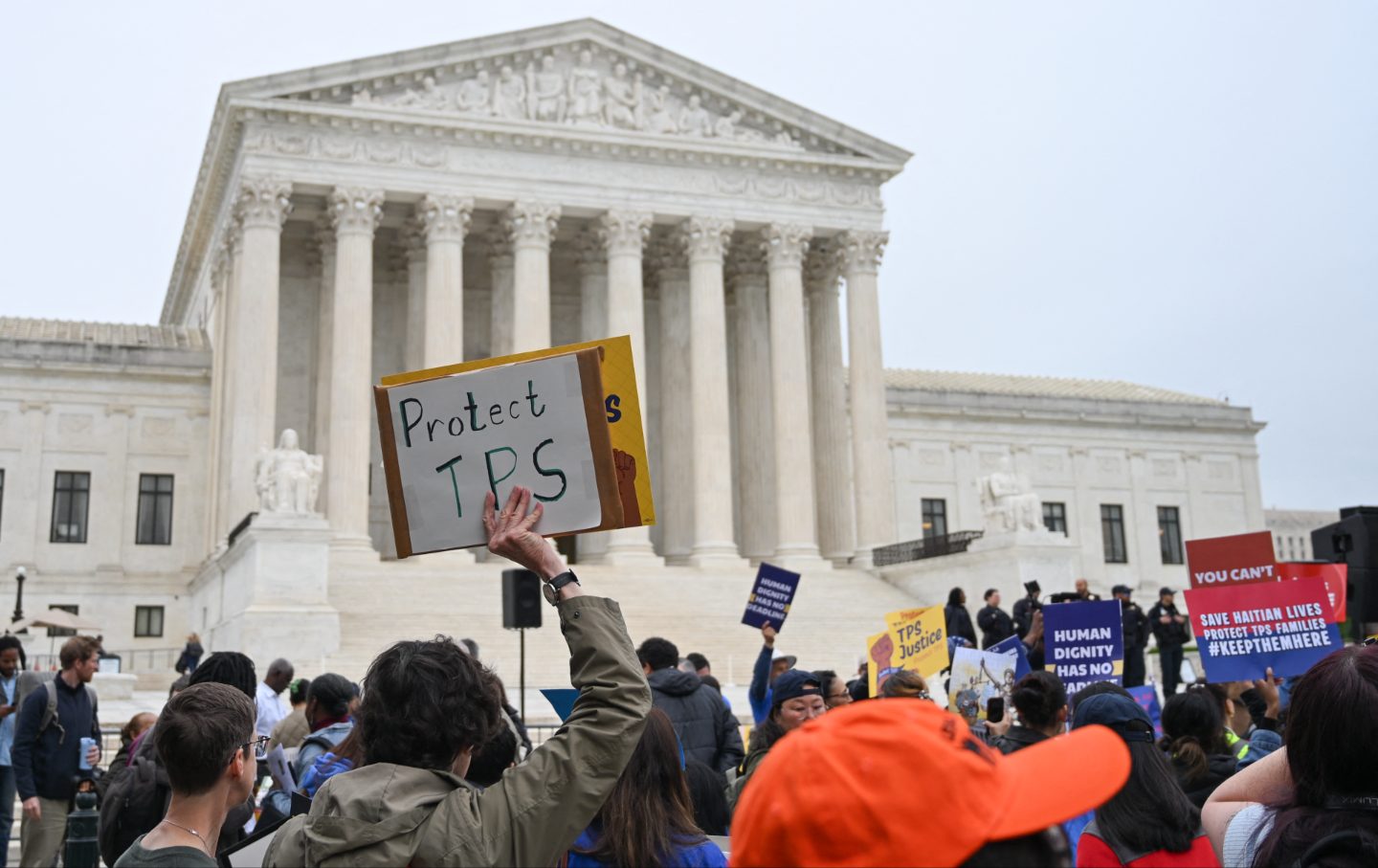
Members of the National TPS Alliance rally at the US Supreme Court in Washington, DC, on April 29, 2026.
(Alex Wroblewski / AFP via Getty Images)On Thursday, the Supreme Court ruled by a vote of 6–3 that the Trump administration can revoke Temporary Protected Status (TPS) for Haitian and Syrian immigrants. The case is called Mullin v. Doe. Justice Samuel Alito, writing for the majority, determined that the decision by former Secretary of Homeland Security Kristi Noem to revoke TPS was “unreviewable” by the court. Further, Alito argued that the affected immigrants were “unlikely to succeed” on their constitutional claim that the administration violated their rights under the Equal Protection Clause. Alito then said that the administration can begin mass deportation immediately, refusing to allow people to stay here while their litigation is pending.
In so ruling, Alito and the other Republicans on the Supreme Court have given constitutional protection to the openly racist and white supremacist policies of the Trump administration. When it comes down to it, the thousands of words Alito wrote could have been tossed out in favor of just 10: “Haitians have no rights white men are bound to respect.”
Every Republican you know, whether they’re wearing a wife-beater or Elon Musk underoos, will respond to these objections with some version of “but temporary protected status is supposed to be temporary.” Which, duh, congratulations for successfully googling the definition of “temporary”; your Republican mother must be very proud. The disagreement comes because there is supposed to be a process for ending TPS, and that is a process the Trump administration refused to follow.
The Haitian TPS program was first implemented in 2010 following a massive earthquake in their country. Before revoking TPS status, the US government is supposed to assess whether the country is “safe” for people to return to.
Have you checked in on Haiti recently? The country functionally has no government. It is run by several rival gangs. Things are so unsafe that the Haitian national soccer team, which amazingly made the World Cup this year, literally cannot play soccer matches in Haiti. Somehow, the Trump administration has decided that none of this matters—that a country where you can’t even watch a sports game is nevertheless safe enough to deport people to. And now, Alito says that the Supreme Court isn’t even allowed to review that stance. But he is wrong, because the court can review the Trump administration’s process for making that wild determination. Or, more accurately, its lack of a process, given that there is no evidence that the administration conducted any investigation at all into the conditions in Haiti. (It’s not even clear that these people read a newspaper.) Instead, Trump just remembered that Haitians are Black and decided to send them back.
And that leads to the second problem with this ruling. No matter what you think about TPS, it is flatly unconstitutional for the US government to make its decisions based on racial animus. Or at least it was unconstitutional until Trump took office. There is a mountain of evidence that racism was behind Trump’s TPS decisions. But according to Alito, Trump’s obvious bigotry is not something you can prove. Instead, he writes:
None of the cited statements by either the President or the Secretary was overtly racial, and in substance all expressed policy views that could rest on race-neutral justifications.… And a person without racial bias can provide a harshly unfavorable description of living conditions in some of the countries with TPS designations. The criteria for TPS designations guarantee that many, if not most, designated countries have such characteristics.
Alito is essentially saying you can say racist things about a people and their country, without being racist. I’m reminded of a Chris Rock joke about Seinfeld actor Michael Richards. Richards infamously shouted the N-word in a crowded theater multiple times, but there were still people defending him as “not racist… in his heart.” Rock opined, “What does he have to do to be racist, shoot Medgar Evers?”
The idea that one can say racist things but not be a racist person is one for (white) philosophers to debate. The idea that the Trump administration was motivated by unconstitutional racial animus is something Haitian immigrants should be allowed to argue in court. Alito’s formulation gives the Trump administration carte blanche to be racist, however defined, without ever being held to the standard of equal protection as laid out in the Constitution.
And there’s another problem with Alito’s formulation. The astute reader will note that Alito is speaking in hypotheticals. The TPS decision “could” rest on race-neutral grounds. A person “can provide…unfavorable descriptions” without being held to account for their racism. Alito is talking around what Trump has said about Haitian immigrants, without engaging with what Trump has actually said.
In dissent, Justice Elena Kagan puts it into the record. She writes:
The evidence [Haitian plaintiffs] have offered includes statements by the President so repellent and racially inflected that the majority declines to put them in print.… So here are some of those statements. Haitians are “eating the dogs.… They’re eating the cats. They’re eating—they’re eating the pets of the people that live [in Springfield, Ohio].”…And: Haitians are also eating “other things too that they’re not supposed to be.”…And: Haitians in the United States “probably have AIDS.”…And: Haiti is a “shithole country,” which is “filthy, dirty, [and] disgusting.”…And: Haitian immigration is “like a death wish for our country.”…And: Haitians, along with some others, are “poisoning the blood” of our country.… And: “Why is it we only take people from shithole countries” like “Haiti [and] Somalia”? “Why cannot we have some people from Norway [and] Sweden?”
The majority briefly replies that those remarks are not “overtly racial,”… but it is hard to know what that means. Haitians are Black. (Norwegians and Swedes not so much.) The references—of filth, disease, and primitiveness—are shot through with racial stereotypes and tropes. It is hard to imagine the statements being made today of any White community.… The statements fairly shout, in their racial undertones and overtones alike, that race entered into the President’s resolve to remove Haitians from this country.
I’m just saying, if you don’t want to reprint the comments from the guy you’re claiming is so not-racist, that guy might be a racist.
Alito finishes up by saying that the Trump administration is not racist toward Haitians, or Syrians (another group affected by this ruling), because the Trump administration rejects TPS for all groups of people. Alito claims this shows that Trump just doesn’t agree with TPS.
Popular
“swipe left below to view more authors”Swipe →First of all, rejecting all non-white immigrants here on TPS doesn’t prove you are race-neutral; it just illustrates that TPS is usually extended to people from non-white countries. This isn’t a card game of hearts. “Shooting the moon” on racism doesn’t help you get away with it.
But there’s also the very obvious point that the government is not opposed to all claims from immigrants who say their country is unsafe. Trump, famously, is solicitous to one immigrant group above all others: white South Africans.
Make of that what you will.
I’ve written about this before, but this decision fits in line with how this Supreme Court usually handles the Trump administration: It pretends Donald Trump does not exist. Trump can say any filthy, disgusting, bigoted thing he likes, and his cronies on the court will pretend he didn’t say it—and if he did say it, they’ll just pretend it doesn’t matter. This has been happening since at least Trump v. Hawaii—the Muslim ban case in Trump’s first term—where the court pretended that what the president actually said about his policies didn’t matter when it came to reviewing those policies. It is all part of the Republicans’ judicial commitment to keep their collective heads planted in a mound of white sand.
The decision to ignore Trump’s racism means that the Republicans on the Supreme Court are racist. I don’t claim to know what’s in their hearts, but more to the point, I don’t care. I can see their racist actions. And their actions affirm, time and again, Trump’s own overt racial biases. It has been clear for a long time that that affirmation must be interpreted as an endorsement.
Become a Sustaining Donor This September
Between the reemergence of right-wing red-baiting and Donald Trump’s use of the chilling National Security Presidential Memorandum–7 to criminalize left political organizing, we’re seeing McCarthyism reborn before our eyes.
This assault on democracy cannot be ignored or wished away. Resisting it requires bravery in the face of threats and repression, a steadfast commitment to the truth, and the unwavering belief that we can—and will—overcome this darkness.
We must have an independent media that sets the record straight, unearths corruption and abuses of power, and advances a politics of justice and dignity for all if we’re to win this fight.
That’s why I’m writing to you today. This September, The Nation needs to add 100 monthly donors to sustain our progressive journalism. Your contribution makes the next investigative report, the next truth-speaking column, and the next pathbreaking essay all possible.
I hope you’ll support our work with a recurring donation today. If you donate $10 or more a month, we’ll send you a brand new “Hands Off the Free Press!” sticker to recognise your commitment to our cause. Please, donate today.
Onward,
Katrina vanden Heuvel
Editor and Publisher, The Nation
More from The Nation
What’s the Matter With Effective Altruism? What’s the Matter With Effective Altruism?
President Trump has decried the techbro creed for indulging in AI doomerism, but its excesses are far worse than that.
As Morale Sags, More Military Service Members Are Having a Crisis of Conscience As Morale Sags, More Military Service Members Are Having a Crisis of Conscience
According to multiple GI rights organizations, service members are inquiring in unprecedented numbers about seeking conscientious objector status.
What Remains of Riis? What Remains of Riis?
A new members’ club has revived Riis Park’s long-vacant bathhouse, reopening old questions about whom the People’s Beach is really for.

When Texas Sex Ed Falls Short, Gen Z Women Turn to Social Media When Texas Sex Ed Falls Short, Gen Z Women Turn to Social Media
A 2025 study found that 70 percent of adolescents sought reproductive health information through social media platforms.
Justice for Macklemore Justice for Macklemore
The rapper has been dumped from Ed Sheeran’s tour for saying “free Palestine.” That’s a disgrace.
We Are Living Under Roy Cohnian Logic We Are Living Under Roy Cohnian Logic
The political fixer created a career for himself as a self-promoting, ubiquitous hustler. Like Trump, he got away with it by having the right friends.

