Root for Spain for Their Play and Their Politics
A World Cup victory will not just feel like a soccer triumph but a national triumph. For that reason, fans should support Pedro Sánchez’s Spain over Javier Milei’s Argentina.
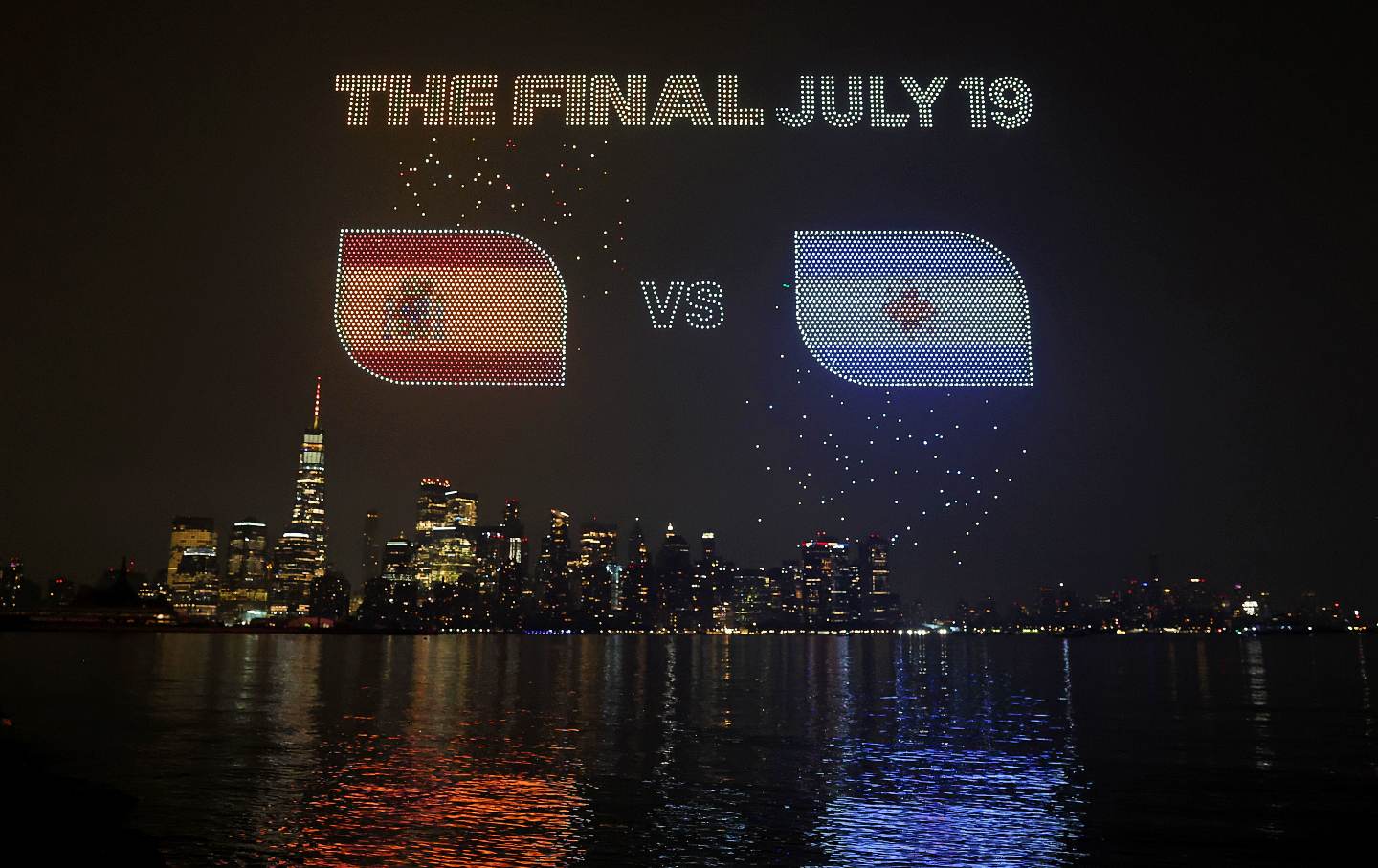
The flags of Spain and Argentina are displayed against the Manhattan skyline during the FIFA drone show on July 15, 2026, in Jersey City, New Jersey.
(Carl Recine / Getty Images)The World Cup is politics by other means. Not even Olympic competition imbues a game with politics quite like the World Cup. This is not only because—to state the obvious—that it’s a tournament that pits country against country and where tensions and hostilities play themselves out on the pitch. It’s that the whole world is watching. In an age of polyculture, when our focus is divided into a million pieces, each piece competing for slivers of our time, nothing unites the world’s eyeballs like the World Cup. This makes it political. Every nation—and every world leader—knows that victory will feel not only like a soccer triumph but a national triumph. Winning the World Cup gooses the political commodity in the shortest supply in 2026: hope.
Even by World Cup standards, this year’s final is especially fraught with politics. We have the defending champion, Argentina, led by Lionel Messi, perhaps the greatest player to ever take the pitch. And we have a team from Spain that plays a more beautiful game—a team approach consisting of quick passes, impenetrable defense, and blinding speed. They are opposites. Everything Argentina does is aimed at freeing up, creating space, and physically protecting the 39-year-old Messi. Everything Spain does is about involving all 11 players, its whole greater than the sum of its parts
This style of play bluntly mirrors the leaders of the two countries—and this matters because, as stated above, the country’s leader that claims the win will also get a boost. In Argentina, that means President Javier Milei. The bombastic Milei should be very familiar to us in the United States and not only because he is so openly corrupt. Milei is an oligarch committed to severe austerity, retrograde social policies, and an “enhanced” security state to quell internal dissent. He also maintains close ties to the rest of the international authoritarian right. He is a favorite of Israel’s war-criminal in chief Benjamin Netanyahu. When Netanyahu was asked on a recent podcast if he was rooting for Messi, he said, “No, before Messi—Milei. He’s a superstar.” Milei is also, suffice it to say, a dear ally of our own emotionally erratic despot, Donald Trump. The thought of them joining together on the field and raising the FIFA championship trophy together is nauseating.
If Spain’s prime minister, Pedro Sánchez, takes the pitch after a Sunday victory, there is still a chance that Trump would join him. Trump despises Sánchez, who is also the secretary-general of the Spanish Socialist Workers’ Party. There are many reasons for his enmity, but recently Trump’s rage escalated dramatically when Sánchez refused to let the United States use Spain’s military bases to launch attacks against Iran. Now Trump, ever the fascist fantasist, is threatening to cut off trade with Spain. But Iran is only the latest reason for a Trump tantrum. Sánchez, unlike Milei, opposes US military aid to Israel, has called Israeli military operations in Gaza “the greatest genocide this century has witnessed,” and restricts fuel and military trade to Israel. Sánchez also believes in investing in renewable energy, the importance of immigration, and state spending. This is not to say that Sánchez is perfect. His family and party are facing corruption allegations, and perhaps he should be pressing harder, especially against an ascendant far right. But Milei and Sánchez, certainly in the eyes of our own regime, could not be more different, and the political benefits of their country winning the World Cup will have far different real-life implications.
If there is one political reality that both Sánchez and Milei share, it is that neither enjoys firm majority approval in their countries. Both are considered polarizing, and both face sizable opposition. Given the facts, rooting interests should be obvious. Support Spain because their collective style of play—instead of gearing everything they do around one, singular player—is better for the sport. Fans should also support Spain because Milei will swallow his tongue if Argentina loses and Trump’s mottled face will fume. Trump may even stay away from the award ceremony, his petulance outweighing his ego. The political benefits would flow away from Milei and his already weak regime. And Sánchez—and everything he represents, even with all its imperfections—will get some wind at his back. This is all worth rooting for on Sunday. I wish the world was not like this. I wish a soccer game would not buttress a fascist agenda or give wings to a social democratic one, but this is where we are, and we should cheer accordingly.