In Princeton, a Housing Plan Sparks a Neighborhood War
What a battle over a mixed-use development in a historic town reveals about liberal America.
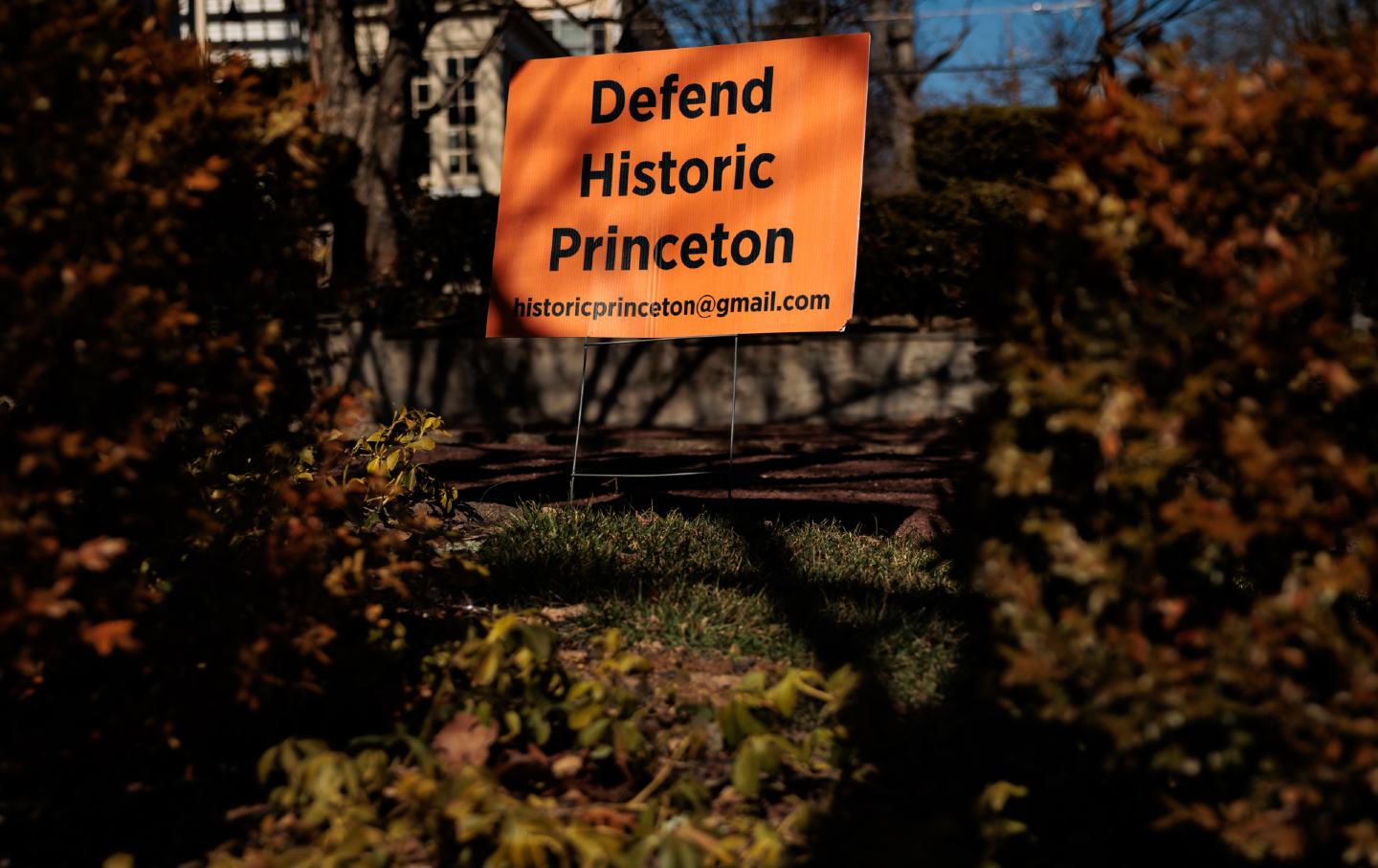
Signage reading “Defend Historic Princeton” across the street from Albert Einstein’s House in Princeton, New Jersey, on March 9, 2026.
(Hannah Beier / The Washington Post via Getty Images)Princeton, New Jersey—At a community forum in 2023, Jim Kyle, a municipal planner, approached the dais and spoke about focusing “more density in town and near public transit.” Kyle was working with the city to redevelop of land in the town’s Western Section, a wealthy, tree-lined neighborhood of Tudor and Colonial homes near downtown.
The municipality hadn’t yet settled on its final proposal to build 238 apartment units, 48 of which would be designated affordable, on that 4.8-acre tract, but the resistance to it was already mounting.
Over the course of that morning, homeowners overwhelmingly balked at the prospect of increased density—what one town consultant would call the “the D-word.” One resident of Princeton’s Western Section told the room, “Those of us who own historic homes are subsidizing the community”—and was met with applause. Another pointed out that when it comes to historic preservation—i.e., maintaining the homes they own and live in—the “weight is borne by individuals in this community.” Then a resident took the mic to “take on the role of the Lorax and speak for the trees.” (The project’s lead architect, Dean Marchetto, says the plan would prioritize maintaining trees along the streets.)
In the three years since, the conflict has grown fiercer. Locals make the dispute sound like the Second Battle of Princeton. The housing proposal has pit pro-preservation residents against their pro-housing neighbors. It’s prompted a lawn-sign war, public insults, private threats, and at least one assault. And in this way, experts say, Princeton is like a lot of other towns. In upper-class suburbs, a group of organized residents will almost always fight to maintain the single-family status quo.
Matt Mleczko earned his PhD from Princeton in 2024 and founded Princeton Grows, a local housing advocacy group. He’s now a political science professor at Marquette University, and he told me, “If you replicate this same scenario thousands of times over in all the other places like Princeton that have a lot of resistance to building multi-family housing, I would imagine it starts to become a little bit clearer why we’re in such a housing crisis.”
Neighbors campaigning against the development point to the illustrious parts of town history: Einstein’s house, Revolutionary War sites, and Nassau Hall, which served as the US Capitol for four months in 1783. But they usually leave out Princeton’s less glorious history of discrimination.
In 1696, Princeton’s first known Black residents arrived: seven enslaved people belonging to Declaration of Independence signatory Richard Stockton. “The enslaved Stocktons not only worked the land but also cleared and built the Stocktons’ stately home, as well as their own slave quarters in the back,” Kathryn Watterson writes in I Hear My People Singing, a book on Princeton’s African American history.
The address of the proposed housing is 108 Stockton Street—part of Stockton’s initial 400-acre tract.
What affordable housing Princeton did have was rendered that way by segregation, according to the Princeton Affordable Housing Project. Beginning in the late 1800s, 12 concentrated blocks were home to most of the town’s Black population. A fence separated that area from higher-income housing to the west. Black entrepreneurs opened businesses, including grocery stores, beauty salons, and the state’s only Black-run newspaper. Businesses along Princeton’s main drag largely did not allow Black clientele, so the neighborhood’s residents created an affordable micro-economy, with the Black YMCA as its social hub.
Then, in 1929, a rich Princeton alum bankrolled the construction of what would become the town’s economic center. To make way for these plans “to enhance the student experience,” those 12 blocks were demolished and the Black residents displaced.
Now anti-development signs have sprouted up across town, demanding “Defend Historic Princeton.” The eponymous group behind the signs says its organizers “oppose town-wide overdevelopment at the expense of Princeton’s multifaceted historic character.”
Adam Gordon, the executive director of Fair Share Housing, a statewide advocacy group that has settled housing-related cases with more than 340 towns across New Jersey, looks to the rhetoric of safeguarding Princeton’s history and sees an echo with another movement. “Defend historic Princeton.… it’s Make America Great Again,” he told me. “It’s this romantic vision of a past that didn’t really exist.”
Because of its long history of discrimination, Princeton’s metro area is the sixth-most-segregated in the country, according to a 2023 study out of Berkeley. And lacking affordable housing, many poor and working-class residents have been pushed out. In 2024, Princeton’s household median income was $192,079, nearly twice the statewide median income of $103,556 and close to four times that of neighboring Trenton.
In a paid advertisement printed last April in Princeton Packet, a group of prominent academics—including liberal historian Sean Wilentz and topped by filmmaker Ken Burns, who does not live in Princeton but is a friend of Wilentz’s—wrote, “Few if any American towns are as distinguished as Princeton.” They call the proposed development “aggressive high-density urbanism.”
“This is not just any town, any municipality, just like this is not just any university,” Wilentz told Princeton University’s student newspaper last fall.
His organization, Defend Historic Princeton, and another, Princeton Coalition for Responsible Development, separately filed legal challenges against the town to halt the development plans from becoming part of the planned affordable housing stock. Those lawsuits have so far been dismissed. In February, the US Supreme Court sided with the state of New Jersey in upholding towns’ obligation to implement affordable housing—a requirement that several of the state’s wealthiest municipalities were trying to shirk.
New Jersey has mandated affordable housing since the 1970s, when an influx of wealthy white families to the South Jersey suburb of Mount Laurel priced out longtime Black residents. A lawsuit between the township and the local chapter of the NAACP resulted in the Mount Laurel doctrine in 1975, which banned exclusionary zoning and stipulated that towns had to offer their “fair share” of affordable housing. In the following decades, updates to the legislation and the formation of the Council on Affordable Housing strengthened state oversight and enforcement capacity.
Still, for decades, towns did not build affordable units at scale. Regional Contribution Agreements allowed wealthier towns to offload their fair-share obligations onto poorer towns with compensation until 2008 when the state eliminated these deals. And in 2015, the New Jersey Supreme Court ruled that compliance with Mount Laurel was within the judicial system’s purview, making it possible for the courts to compel towns to follow the law. Since then, Fair Share Housing has settled cases with hundreds of towns—including Princeton. In the past 11 years, some 25,000 designated affordable homes have been built statewide—a testament to “how successful and influential the Mount Laurel framework has been,” Jag Davies, Fair Share Housing’s director of communications, told me. Several other states enacted housing laws similar to New Jersey’s. Still, it hasn’t been enough: New Jersey has a 150,000-unit shortage of low- and moderate-income homes.
Critics of the proposed housing have downplayed the affordable housing in the project and lambasted it as “a massive luxury apartment development,” not in keeping with neighborhood architecture and character. “It’s as lopsided to its context as the Trump White House ballroom is,” Wilentz told me.
Mleczko, the Marquette professor, pointed out that the housing deficit exists across class brackets, with affordability meaning different things to different people. “If everything that’s new is luxury, the term starts to not mean much of anything.”
The 48 designated affordable units would be split into three income-restricted tiers, the lowest being for families making 30 percent or less of area median income. Building these units requires funding. “Affordable housing cannot pay for itself,” Patrick McAnaney, a DC-area housing developer, wrote. “Government subsidies exist, but they can rarely finance entirely affordable developments. Developers often account for the funding shortfall by “utilizing market-rate housing to cross-subsidize affordable units.”
Responding to the initial ad signed by Wilentz, Burns, and four other historians, Councilman Leighton Newlin published a letter in Town Topics titled: “‘Defending’ Historic Princeton? From Whom, and From What?” Newlin extols the possibility of inclusionary multi-family affordable units in town, and describes anxieties related to traffic, aesthetics, and stormwater as “a plantation mentality in progressive clothing.”
In his response to the response, Wilentz decried Newlin’s “predictably” pro-forma portrayal of the housing opponents “as elite racists out to exclude Blacks and Hispanics from Princeton.” Wilentz stands by his claim that the development only replicates the town’s racial inequities.
Some of the houses in Princeton are centuries old, but the town has also seen hyper-modern mansions get built without raising any alarms. A 2017 Princeton Magazine feature called “Evolving Neighborhood” describes how a gabled, Cape cottage–style home in the Western Section was “deconstructed” to make room for “a modernist’s dream.” The magazine says such residents have risen “to the challenge of modern living in an historic neighborhood.” In 2012, an effort to designate this same area historic—and limit teardowns—caused some inhabitants to express feeling “disenfranchised” by losing property rights. One resident described the historic designation as “a creeping cancer.”
The much-debated housing proposal is for a vacant, previously developed site and wouldn’t involve any further demolition. (In 2022, three historic Princeton Theological Seminary buildings were leveled on the property, to neighbors’ chagrin.)
For Jessica Vieira, the historical significance of Western Section drew her to the neighborhood, even if it comes with an added price. Vieira lives down the street from the proposed development, which she described as “a massive structure in what is a colonial village.” She worried that the construction would tower over the Barracks, a 17th-century estate where James Madison and Alexander Hamilton slept during the 1783 Continental Congress. “We feel like we’re sitting here in our little historic homes, and they’re basically building huge developments around us,” Vieira told me. “I recognize that we need to be able to build housing, but this is insane.”
Some neighbors argue the area is better simply better suited to single-family homes. One new family next door is more “in keeping” than dozens. It boils down to “the idea that some element of the big city is coming to take a place in their town,” said TAPInto Princeton editor Richard Rein. “And people find that very frightening.”
At the end of one community forum in March, Rein, 78, was shoved and cursed at. “Fortunately, I had myself braced in such a way that I didn’t go down,” said Rein. “What was more shocking to me was the dropping of an F-bomb from two different women of retirement age living in the Western Section of Princeton.” Rein’s coverage leans in favor of the proposed development.
Rein is not the only one feeling the heat of social tensions. “We have experienced constant animosity, threats that are personal, political and professional,” said Councilwoman Mia Sacks, chair of the Affordable Housing Committee.
The attention blitz has also bred a kind of meme-ification. After the orange “Defend Historic Princeton” signs cropped up, blue ones imploring “Princeton for All” started populating dissenting yards. The sign skirmish was waged by university neuroscientists Jonathan Pillow and Sam Wang, who told me they thought the orange ones sent an “unwelcoming message, keeping people out to preserve the town as it is.”
Popular
“swipe left below to view more authors”Swipe →Then suddenly there were lime-green signs too, stating simply, “Princeton.” An e-mail address at the bottom reads [email protected]. Someone calling themself “Princeton Yard Sign Syndicate” said via e-mail: “We can neither confirm nor deny that our sign is our official entry into the ongoing battle of the yard signs.” And at local pub trivia, graduate students studying housing policy have competed under the name “Destroy Historic Princeton.”
Sacks grew up in Princeton and returned in 2008 after more than 20 years away. Arriving “felt like I was moving to a stage set of a town that had been frozen in time,” Sacks said. “It felt like the town was basically preserved in formaldehyde, and that it was not evolving.”
Mleczko sees the development question as part of a social contract, in which housing is both a need and a right. He said these debates require us to ask ourselves: “Are we going to provide for neighbors? Are we going to provide for the people who want to be our neighbors but can’t because there’s not enough housing to go around?” As for balancing housing and environmental priorities, Mleczko takes issue with the heady philosophizing: “It’d be one thing if this were a debate in a vacuum [about] what’s more important, housing affordability or historic preservation. But we’re not in a vacuum. We’re in the backdrop of an unrelenting housing crisis.”
Princeton is not alone among blue towns in having a chasm between its purported values and real-time stance. This is especially true at municipal meetings, which disproportionately draw people opposed to housing proposals. A study by Data for Progress analyzing Massachusetts voters’ attitudes toward affordable housing found respondents much more likely to support hypothetical affordable housing than actual projects in their neighborhoods. Fifty-six percent of voters supported affordable housing abstractly in a ballot referendum, but 63 percent of municipal meeting attendees opposed development projects.
By the time later community forums rolled around in Princeton, housing advocates were showing up in larger numbers, diluting the density panic and showing that a smattering of housing-apprehensive voices had been disproportionately loud.
“There’s general agreement that affordable housing serves an important role in the community,” Liz Lempert, Princeton’s mayor from 2013 to 2020, told me. “The debate is more on where it should be, and oftentimes it’s, ‘not here, it should be there.’”
Princeton has a reputation as a liberal, intellectual bastion—but like many towns, its progressivism, for many residents, crumbles at the prospect of lower property values or a changing view across the street.