Assassination Nation
The Nation magazine was founded in the startled wake of Abraham Lincoln’s murder—the first presidential assassination in the country. It wouldn’t be the last.
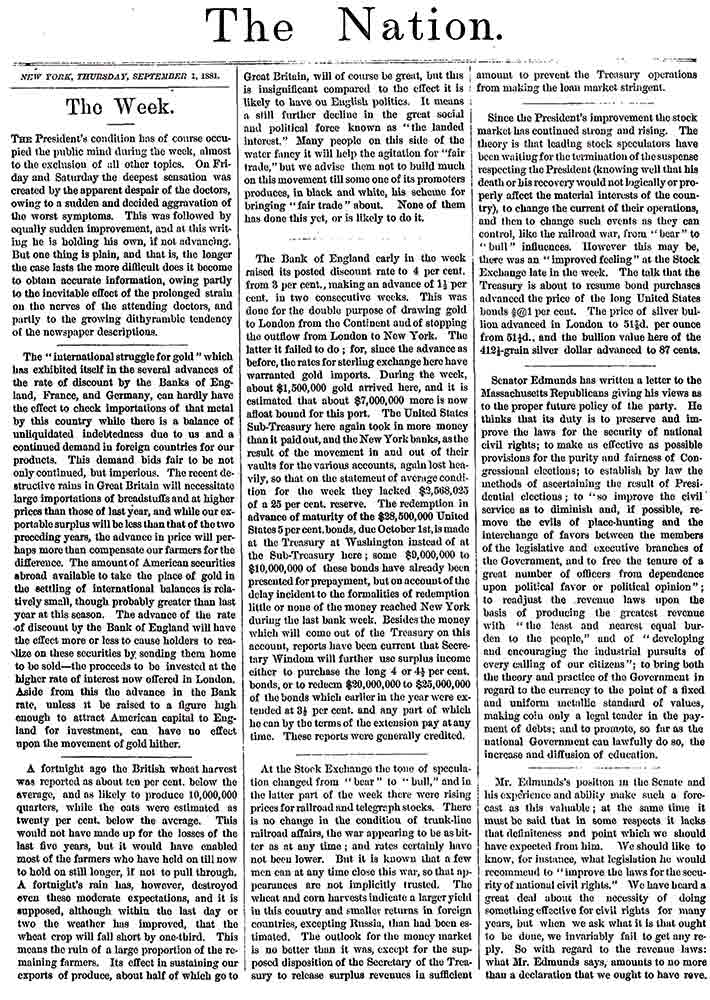
When the first issue of The Nation rolled off the presses in 1865, Abraham Lincoln’s body had been laid in the ground only weeks earlier. For years, the country remained in the grim shadow cast by the president’s assassination. And then it happened again—and again.
In 1881, James Garfield became the second president to be killed in office, shot by a jilted job-seeker who ambushed him at a Washington train station. The Nation noted an important contrast: Whereas the bullet fired at Lincoln’s head was “the last shot of the civil war,” coming as “men’s pulses were still throbbing with the hates and fears and hopes and sorrows of the struggle through which the country had just passed,” Garfield’s senseless slaying in a time of peace brought only “sympathy and sorrow,” with “no taste of bitterness or discord.” Indeed, as the attack was deplored by all parties and politicians, it “brought about a better understanding between the North and the South.” The universal condemnation proved, The Nation suggested, that there was no constituency for undermining the American form of government.
Four decades later, in 1912, a former saloonkeeper shot Theodore Roosevelt at a campaign rally in Milwaukee. The ex-president, who had ascended to the office when William McKinley was assassinated by an anarchist in 1901, was running for a third term on the Progressive Party ticket. The wounded Roosevelt drew accolades even from political foes for intervening in the chaotic moments after the shooting to prevent his assailant from being lynched; then, with the bullet lodged in his chest, he calmly finished his speech.
“There can be but one feeling in regard to the attempt to assassinate Mr. Roosevelt—a feeling of deep joy that he escaped with apparently slight injury,” The Nation reflected in its next issue. “Americans have reason to congratulate each other that their country has been spared another causeless murder of a public man…. We all felt a sort of patriotic humiliation when Garfield and McKinley were shot, and it is a profound satisfaction not to have to go through that again.” The editors—no fans of Roosevelt—praised his “characteristic coolness and pluck in danger” but took issue with those who argued “that the way to prevent such shocking and lamentable crimes is to forbid severe criticism of public men.”
“Free discussion is the very breath of our political life,” the editors wrote. “It is obvious that we cannot order or alter our whole plan of government by public discussion, merely because cranks and lunatics can get hold of deadly weapons and commit crimes that startle the world.”
Support independent journalism that does not fall in line
Even before February 28, the reasons for Donald Trump’s imploding approval rating were abundantly clear: untrammeled corruption and personal enrichment to the tune of billions of dollars during an affordability crisis, a foreign policy guided only by his own derelict sense of morality, and the deployment of a murderous campaign of occupation, detention, and deportation on American streets.
Now an undeclared, unauthorized, unpopular, and unconstitutional war of aggression against Iran has spread like wildfire through the region and into Europe. A new “forever war”—with an ever-increasing likelihood of American troops on the ground—may very well be upon us.
As we’ve seen over and over, this administration uses lies, misdirection, and attempts to flood the zone to justify its abuses of power at home and abroad. Just as Trump, Marco Rubio, and Pete Hegseth offer erratic and contradictory rationales for the attacks on Iran, the administration is also spreading the lie that the upcoming midterm elections are under threat from noncitizens on voter rolls. When these lies go unchecked, they become the basis for further authoritarian encroachment and war.
In these dark times, independent journalism is uniquely able to uncover the falsehoods that threaten our republic—and civilians around the world—and shine a bright light on the truth.
The Nation’s experienced team of writers, editors, and fact-checkers understands the scale of what we’re up against and the urgency with which we have to act. That’s why we’re publishing critical reporting and analysis of the war on Iran, ICE violence at home, new forms of voter suppression emerging in the courts, and much more.
But this journalism is possible only with your support.
This March, The Nation needs to raise $50,000 to ensure that we have the resources for reporting and analysis that sets the record straight and empowers people of conscience to organize. Will you donate today?