
The Supreme Court Just Took Its First Swipe at Marriage Equality
Last week, the conservative justices buried a soft repudiation of Obergefell in an immigration case, likely laying the ground for more attacks.
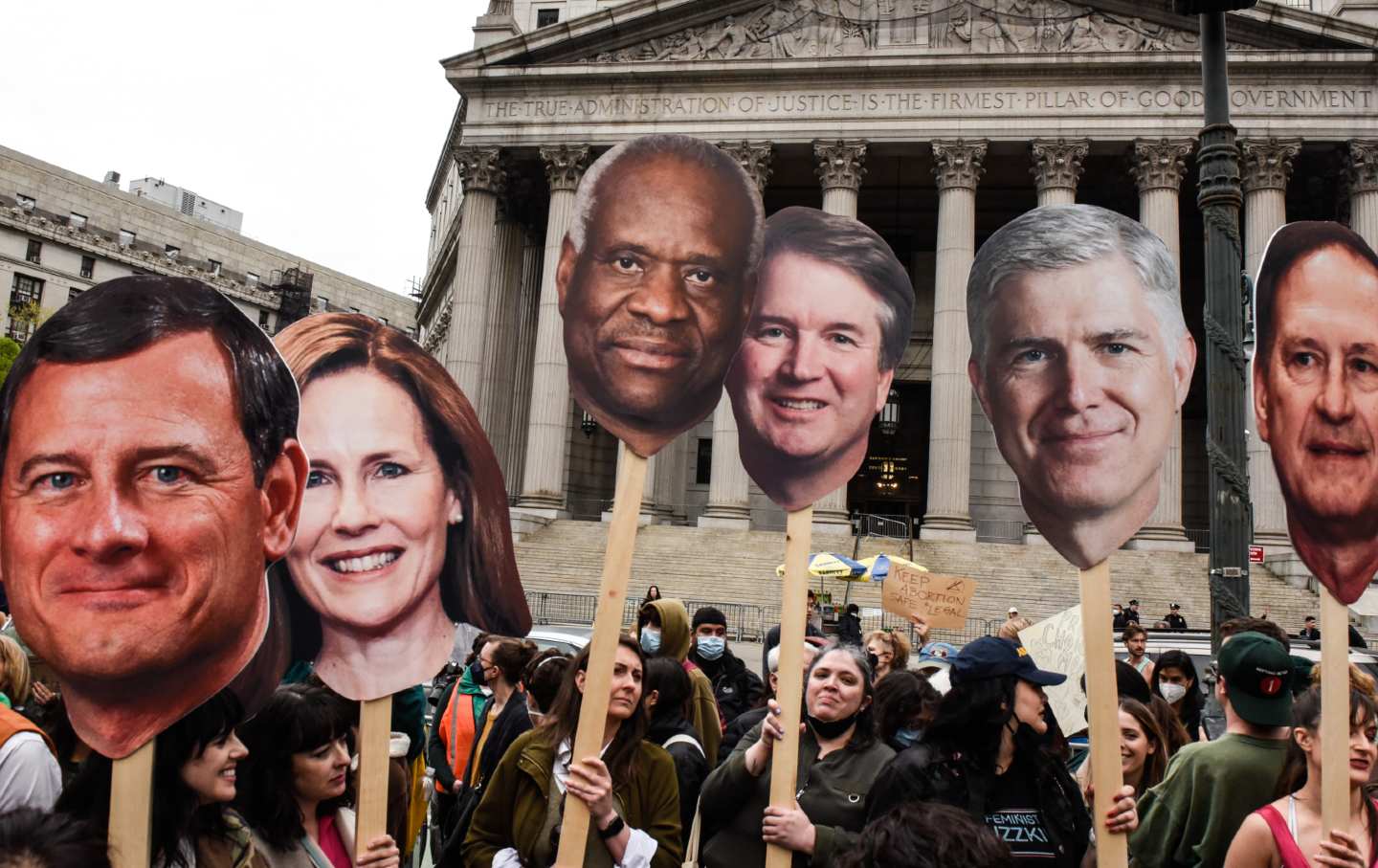
Demonstrators hold signs bearing the faces of the six conservative Supreme Court justices during a protest in New York in 2022.
(Stephanie Keith / Bloomberg via Getty Images)
Every year, there is at least one Supreme Court case that I wasn’t paying attention to, or didn’t think was that important, that absolutely floors me for its cruelty and misapplication of American law. This year, that case is Department of State v. Muñoz, an immigration case that the justices ruled on last week. While I had fully expected the court to use the case to continue its long-standing tradition of racist rulings against brown immigrants, I had not anticipated that it would also turn out to be a frontal attack by Republican justices on the right to marry, aimed squarely at gay and lesbian couples. Muñoz will be a case the conservatives cite in future opinions limiting same-sex marriages whenever they get around to taking away the rights recognized in Obergefell v. Hodges.
The case involves an American citizen, Sandra Muñoz, who has been trying to get a permanent residency card (more commonly known as a green card) for her husband, Luis Asencio-Cordero. Many people know that a noncitizen can obtain legal status in this country if they marry an American citizen (see Trump, Melania), but many white people don’t know that the process is not automatic. The government reserves the right to deny entry to spouses, and non-white people face that reality all the time.
Asencio-Cordero came to this country without documentation in 2008. In 2010, he married Muñoz. They were married for five years and had a child together, and decided to make his status “legal” by applying for a green card. Due to our Byzantine immigration laws, this required Asencio-Cordero to get a waiver from the Department of Homeland Security absolving him of his past undocumented entry (which he obtained), and then go back to his country of origin (El Salvador) and apply for a visa at the consulate there (which he did).
But in El Salvador, the US Consulate (a division of the Department of State) denied his application. The consulate didn’t even give him a reason for why he was denied; he was just denied. Muñoz and Asencio-Cordero guessed that the reason might be that the consular suspected he was a member of the transnational MS-13 gang, based on some of his tattoos. It is critical to note that Asencio-Cordero had no criminal record, either in the United States or El Salvador, and had literally never been arrested. But he did have tattoos.
Based on this guess (because again, the State Department never told him why he was denied entry), Asencio-Cordero “renounced any affiliation” with MS-13. Muñoz is actually a well-known workers’ rights attorney, and she was able to get a sitting US representative, Judy Chu, to send a letter to the State Department on Asencio-Cordero’s behalf. Still, the State Department denied his application, again, without giving a reason. (This all happened under the Barack Obama administration by the way, proving once again that cruelty towards immigrants is a bipartisan position, it’s just that the Democrats tend to avoid using racial slurs when carrying out the same racist policies).
Muñoz sued. As the American citizen in this case, she argued that her fundamental right to marry was being infringed on by the government’s denial of basic due process rights to her spouse.
In a 6-3 ruling that broke along partisan lines, Justice Amy Coney Barrett upheld the State Department’s decision, defended its failure to uphold due process rights, and left Asencio-Cordero to rot in El Salvador for all she cared. Barrett wrote that the right to marry is a fundamental right, but the right to live with one’s spouse is not. Here is Barrett’s tortured parsing of the rights at issue:
Muñoz invokes the “fundamental right of marriage,” but the State Department does not deny that Muñoz (who is already married) has a fundamental right to marriage. Muñoz claims something distinct: the right to reside with her noncitizen spouse in the United States. That involves more than marriage and more than spousal cohabitation—it includes the right to have her noncitizen husband enter (and remain in) the United States.
Separating out the right to marry from the right to live with your spouse (a spouse you have literal children with) is trash on its face, but it’s also dripping with hypocrisy coming from Barrett. I doubt that she would apply her own logic to her own family. Barrett, famously, has adopted children from other parts of the world (and renamed them). I somehow don’t think she would recognize a right to adopt as “distinct” from a right to live with the children she’s adopted.
The right to cohabitate with one’s spouse is not inviolable, of course. The government may have a compelling reason to prevent spouses from living together, as is the case when one partner is incarcerated, for instance. Similarly, parents can lose the right to live with their children when they are abusive or neglectful of those children. But those situations involve some application, however flawed in practice, of due process. Before the right to cohabitation is taken away, there is a hearing, or a trial,where the government has to explain why it is taking away the right, and people subject to those government proceedings have a right to appeal.
None of those normal due process protections were provided to Asencio-Cordero and Muñoz. The random consular official in El Salvador didn’t even give the couple a reason—much less a hearing during which they could submit evidence—to explain why their family was being ripped apart.
What’s really important about the Muñoz decision is that it was needlessly sweeping. Justice Neil Gorsuch wrote a concurrence in which he agreed with the judgment but pointed out that the case should have been moot. Muñoz had wanted a reason for the denial of her husband’s green card and, over the course of this long litigation, the government had provided one. The couple’s guess was right: The Obama State Department had decided that the tattoos looked like MS-13 markings (an outside expert has since confirmed they were not) and were sufficient reason to separate their family. The court could have ruled that Muñoz got her reason and therefore had to go away, without making this declaration against the right to live with one’s spouse.
While this would have been cold comfort, Muñoz and Asencio-Cordero could still have gone back to the State Department with the new information revealed during the litigation to lobby it (and the media, and the Congress, and the people) to reverse its ridiculous ruling. The political process of changing racist immigration laws could play out, without further court intervention.
But the Supreme Court opted not to go with the narrow ruling.
To understand why Barrett and the conservatives (including Gorsuch) signed on to this expansive and extremist decision, you have to understand the antipathy they all hold toward gay and lesbian marriages. Decoupling the right to marry from the right to cohabitate is how the conservatives are going to vitiate same-sex unions.
This was the crux of the dissent written by Justice Sonia Sotomayor (which was joined by Elena Kagan and Ketanji Brown Jackson). She warned that the Muñoz ruling will disproportionately impact same-sex couples. She notes that while Muñoz and Asencio-Cordero can, at least, live together with their child in El Salvador, many same-sex couples do not have that freedom because many countries do not recognize marriage equality. So they might not be able to relocate after a noncitizen spouse is denied entry into this one.
Sotomayor wrote: “Obergefell rejected what the majority does today as ‘inconsistent with the approach this Court has used in discussing [the] fundamental rights’ of ‘marriage and intimacy.’” Sotomayor goes on to point out that Muñoz’s claim should directly follow from Obergegell, writing: “Muñoz does not argue that her marriage gives her the right to immigrate her husband. She instead advances the reasonable position that blocking her from living with her husband in the United States burdens her right ‘to marry, establish a home and bring up children’ with him.”
The Muñoz ruling is a soft repudiation of Obergefell that the conservatives buried in an immigration case, hoping none of the voters or activists notice. Sotomayor called out the conservatives and referred to their opinion two years ago in Dobbs v. Jackson Women’s Health Organization, the case that overturned Roe v. Wade. But it now seems evident that (shocker) the conservatives have no intention of keeping their word. Sotomayor wrote: “Despite the majority’s assurance two Terms ago that its eradication of the right to abortion ‘does not undermine…in any way’ other entrenched substantive due process rights such as ‘the right to marry,’ ‘the right to reside with relatives,’ and ‘the right to make decisions about the education of one’s children,’ the Court fails at the first pass.”
Popular
“swipe left below to view more authors”Swipe →She, correctly in my view, sees Muñoz for what it is, the first step at unraveling same-sex marriage rights.
Like Justice Sotomayor, I do not think the implication of the Muñoz ruling will stop at immigration proceedings. However, in addition to overturning Obergefell outright, I also think this case allows the court to eviscerate marriage equality without doing that. If the right to cohabit can be so easily severed from the right to marry, any number of legal marital benefits can be taken away from the legal recognition of marriage. The right to be at your spouses’ side while they die (which was the factual issue in Obergefell, by the way) could be taken away. The right to live with your same-sex spouse in, say, Trump Tower, could also be taken away.
Instead of accepting same-sex marriage and getting over herself, Barrett has effectively laid out another option for conservatives: construct a society where some marriages mean more than others.
Bigots in red states will likely pick up the license Barrett has given them. Muñoz might not seem like the most consequential ruling right now, but over the next 10 years, as the conservatives on the court chip away at LGBTQ rights, they’ll be referring to this case again and again. Muñoz is a poisoned dart to same-sex marriage: It doesn’t hurt as much as a shotgun to the chest, but it will kill you just the same.
Support independent journalism that does not fall in line
Even before February 28, the reasons for Donald Trump’s imploding approval rating were abundantly clear: untrammeled corruption and personal enrichment to the tune of billions of dollars during an affordability crisis, a foreign policy guided only by his own derelict sense of morality, and the deployment of a murderous campaign of occupation, detention, and deportation on American streets.
Now an undeclared, unauthorized, unpopular, and unconstitutional war of aggression against Iran has spread like wildfire through the region and into Europe. A new “forever war”—with an ever-increasing likelihood of American troops on the ground—may very well be upon us.
As we’ve seen over and over, this administration uses lies, misdirection, and attempts to flood the zone to justify its abuses of power at home and abroad. Just as Trump, Marco Rubio, and Pete Hegseth offer erratic and contradictory rationales for the attacks on Iran, the administration is also spreading the lie that the upcoming midterm elections are under threat from noncitizens on voter rolls. When these lies go unchecked, they become the basis for further authoritarian encroachment and war.
In these dark times, independent journalism is uniquely able to uncover the falsehoods that threaten our republic—and civilians around the world—and shine a bright light on the truth.
The Nation’s experienced team of writers, editors, and fact-checkers understands the scale of what we’re up against and the urgency with which we have to act. That’s why we’re publishing critical reporting and analysis of the war on Iran, ICE violence at home, new forms of voter suppression emerging in the courts, and much more.
But this journalism is possible only with your support.
This March, The Nation needs to raise $50,000 to ensure that we have the resources for reporting and analysis that sets the record straight and empowers people of conscience to organize. Will you donate today?
More from The Nation

The Real Reason Americans Love Guns The Real Reason Americans Love Guns
With a weak social safety net, a gun offers a false sense of personal power and security.

The Endless Hypocrisy of Bari Weiss The Endless Hypocrisy of Bari Weiss
She claims to be a free speech champion. But as her actions at CBS News keep showing, she seems to think free speech should run only in a rightward direction.
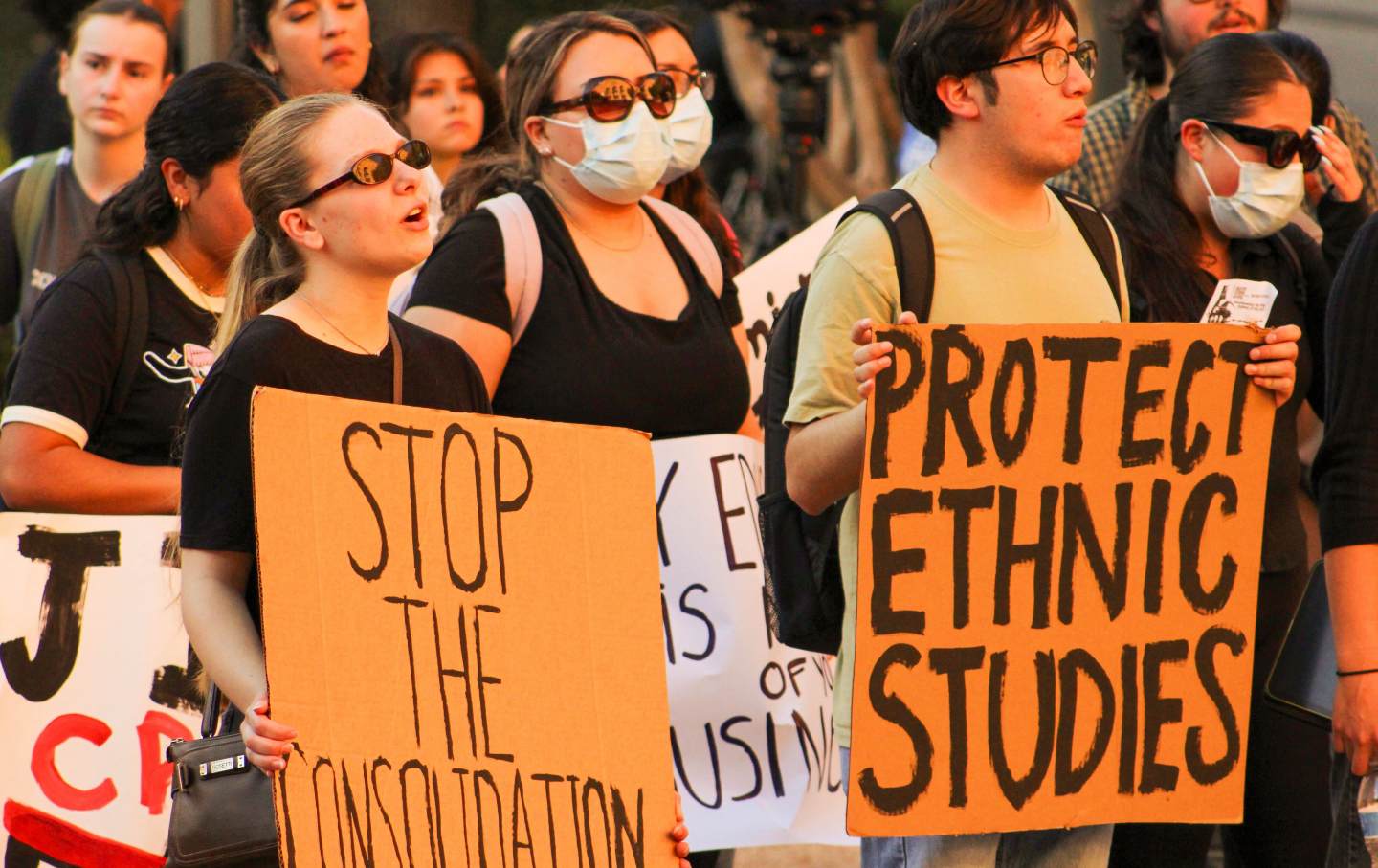
What Will Be Left After the University of Texas Destroys Itself? What Will Be Left After the University of Texas Destroys Itself?
UT-Austin has collapsed its race, ethnic, and gender studies into a single program while a new policy asks faculty to avoid “controversial” topics. But the attacks won’t end there...

The Corporate Media Is Head Over Heels for the Iran War The Corporate Media Is Head Over Heels for the Iran War
Donald Trump’s attack may be surreal, unjustified, and illegal. But that’s not stopping the press from turning the propaganda dial way up.

The Disturbing History of ICE’s “Death Cards” The Disturbing History of ICE’s “Death Cards”
The Vietnam-era practice is yet another example of ICE agents thrilling to the brutality they have been encouraged to cultivate.
The American Universities Programming Israel’s Killer Drones The American Universities Programming Israel’s Killer Drones
Industry partnerships in higher education are pushing STEM graduates into the business of weapons manufacturing and genocide profiteering.

