This Is What Government by Electronic Plebiscite Looks Like
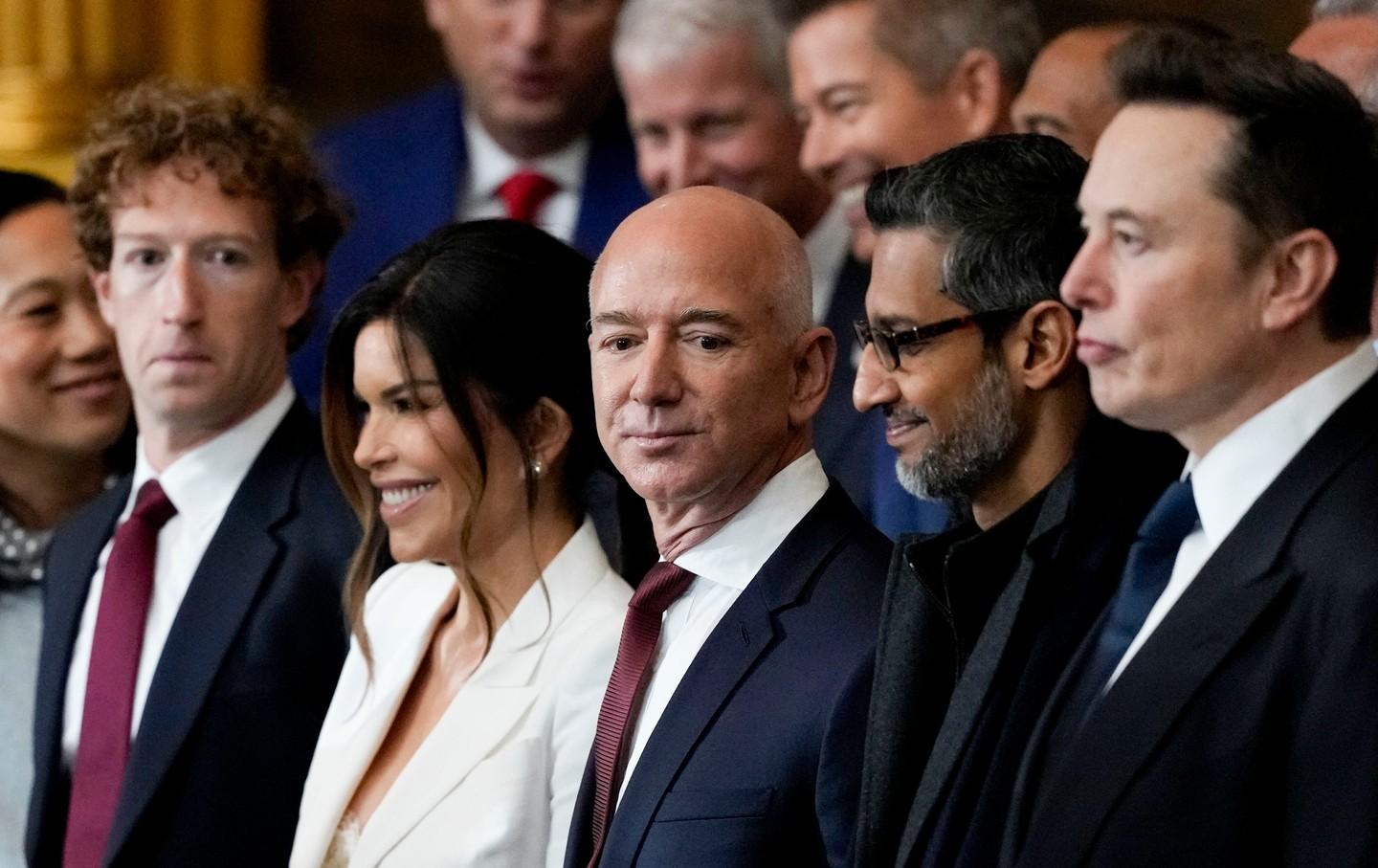
Today’s tech oligarchs want the appearance of public acclaim for their deeply elitist vision of society—while maintaining a docile and cooperative public.
In exchange for being permitted by my indulgent editor to call this column “The Last Days of Discourse,” I agreed to explain the joke—and to prove that it was not mere wordplay for its own sake. As many of you may have already picked up, the name comes from Whit Stillman’s 1998 movie The Last Days of Disco, a charming film about a group of young people in the early 1980s, when that dance craze was going out of style. But as with Stillman’s other films, it also has deeper concerns: about what it means to live at the end of an era, and what we may hope for under decadent conditions.
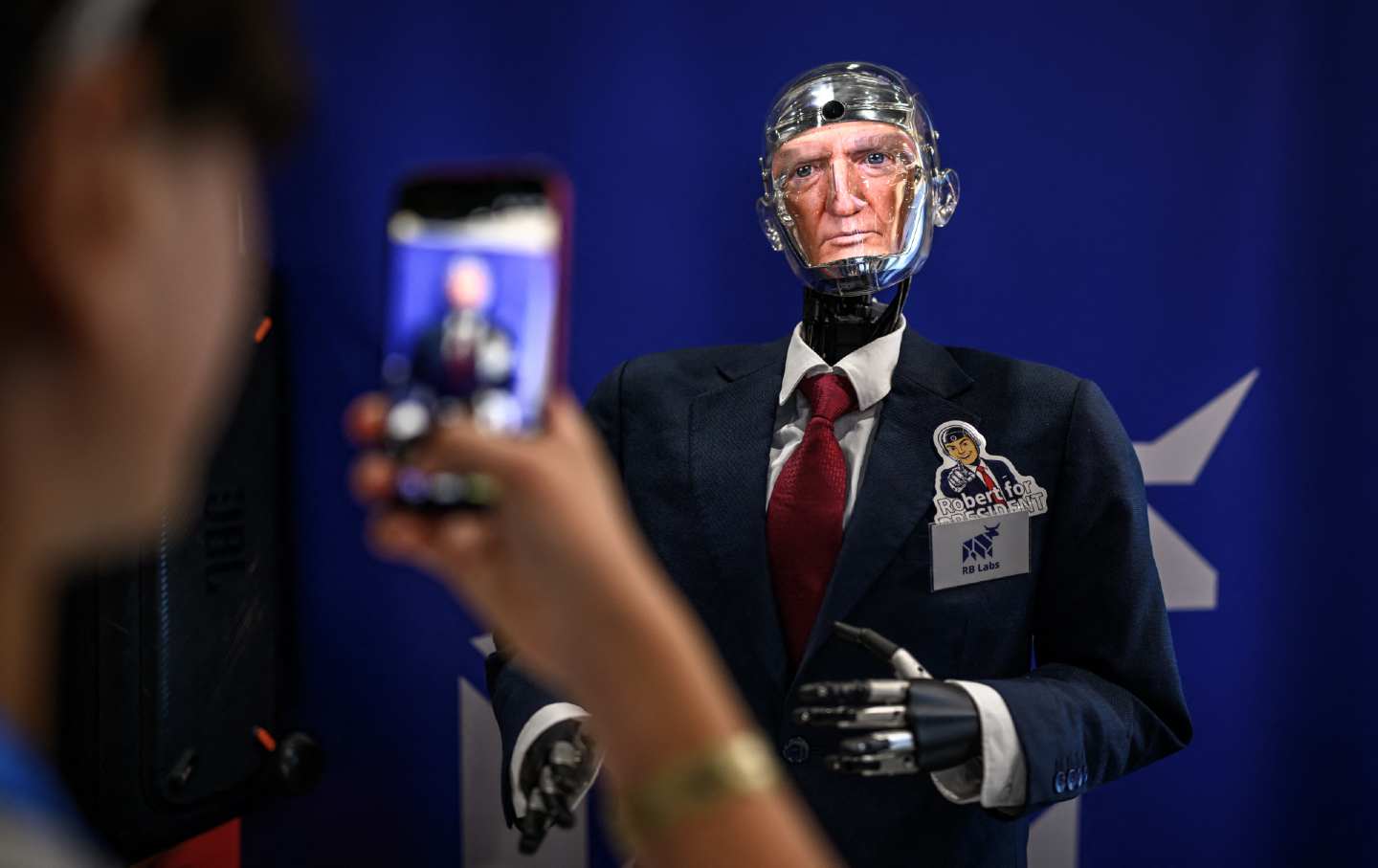
The current media landscape appears at a distance to be multifarious, but on closer inspection reveals itself as desolate: We are confronted with a constant barrage of hysterical cable news anchors, decontextualized video snippets, speculative manias, streaming content that feeds an insatiable thirst for “drama,” and social media mobs. Instead of a pluralism of voices, we have a cacophony that eventually gives way to monotony, an unbearable din that dulls the mind and the senses. Those in charge deliberately broadcast noise and emotional electric shocks. The “platforms” are controlled by an oligarchy of tech billionaires who speak in Orwellian fashion about “free speech” but are actually interested only in profits, power, and control. While it appears that it has never been easier for anyone to freely share their opinions with the world, the apparatus that shapes the public’s thoughts and sentiments has never been in the hands of fewer men. (And yes, they are all men.) The possibilities for reasoned and at least relatively enlightened public discussion—the purpose of magazines like the one you’re reading now—seem to be shrinking by the day. How are we to continue to have a democracy (which relies, at least in theory, on informed public opinion) given such an etiolated public sphere—one that seems to have been deliberately poisoned? These will be among the concerns and questions of “The Last Days of Discourse.”
Cynics will say, and with some good reason, “Same as it ever was.” The problem of the manipulation and deformation of opinion is indeed not new. One hundred years ago, the American journalist and political commentator Walter Lippmann published The Phantom Public, in which he argued that the issues of governance in modern society were just too complicated for most folks and so should be left to the experts. To Lippmann, the proper role of public opinion was merely to say “yea” or “nay” to the proposals of the competent classes. “The public must be put in its place…so that each of us may live free of the trampling and the roar of a bewildered herd,” he wrote. Certainly, that might be one way to avoid the problems arising from the online mob. But it is not so different from the pseudo-populism of today’s tech oligarchs, who want the appearance of public acclaim for their deeply elitist vision of society while maintaining a docile and cooperative public. They, too, hope to use “the trampling and the roar” of the “bewildered herd” to keep the public “in its place.” Although Lippmann may sound like a defender of democratic pluralism, the practical upshot of what he advocated was essentially the same as the republic through electronic plebiscite that our tech masters desire. It’s not for nothing that the first meeting of the “neoliberals” in 1938 called itself the Walter Lippmann Colloquium.
What alternatives do we have, then? Lippmann’s great opponent, the American philosopher and educational reformer John Dewey, proposed a participatory alternative based on the notion of an increasingly informed and educated public. That sounds very attractive, but how are we to conduct the Deweyan experiment when the mechanisms of information and education are precisely the problem? The German philosopher Jürgen Habermas believes in the emancipatory potential of a spirited public sphere, but even at his most sanguine, Habermas has had to admit that the contemporary environment of compulsive consumerism, mass media manipulation, and bureaucratic control makes for a very different world from the one inhabited by the literate bourgeoisie of the 18th century. The writer and theorist Hannah Arendt thought that opinions should be formed by imaginatively inhabiting the point of view of others until one came to view the facts from a disinterested perspective—but she still required that there be facts to interpret. The conditions that made all these ideals even theoretically possible are in today’s world under considerable strain from the very technology that was supposed to make them a universal endowment.
But here at “The Last Days of Discourse,” we will not be wallowing in despair and gloom; there’s more than enough of that already. Instead, I plan to keep these models of genuinely enlightened public deliberation in mind as I write this column, which will direct a critical eye to the ills afflicting democracy—while trying to practice democracy itself. It will, I hope, be omnivorous in scope, adventurous in spirit, and experimental in practice. If I had to pick one of the great theorists of public opinion as my guide, I would choose Arendt, who wrote that “in matters of opinion…our thinking is truly discursive, running, as it were, from place to place, from one part of the world to another, through all kinds of conflicting views, until it finally ascends from these particularities to some impartial generality.” One writer and one short column cannot accomplish that universal task alone, but I will try to do my part.
Become a Sustaining Donor This September
Between the reemergence of right-wing red-baiting and Donald Trump’s use of the chilling National Security Presidential Memorandum–7 to criminalize left political organizing, we’re seeing McCarthyism reborn before our eyes.
This assault on democracy cannot be ignored or wished away. Resisting it requires bravery in the face of threats and repression, a steadfast commitment to the truth, and the unwavering belief that we can—and will—overcome this darkness.
We must have an independent media that sets the record straight, unearths corruption and abuses of power, and advances a politics of justice and dignity for all if we’re to win this fight.
That’s why I’m writing to you today. This September, The Nation needs to add 100 monthly donors to sustain our progressive journalism. Your contribution makes the next investigative report, the next truth-speaking column, and the next pathbreaking essay all possible.
I hope you’ll support our work with a recurring donation today. If you donate $10 or more a month, we’ll send you a brand new “Hands Off the Free Press!” sticker to recognise your commitment to our cause. Please, donate today.
Onward,
Katrina vanden Heuvel
Editor and Publisher, The Nation