The Many Lives of Joshua Clover (1962–2025)
How the militant, poet, political theorist, organizer, and giver of gifts refused to die.
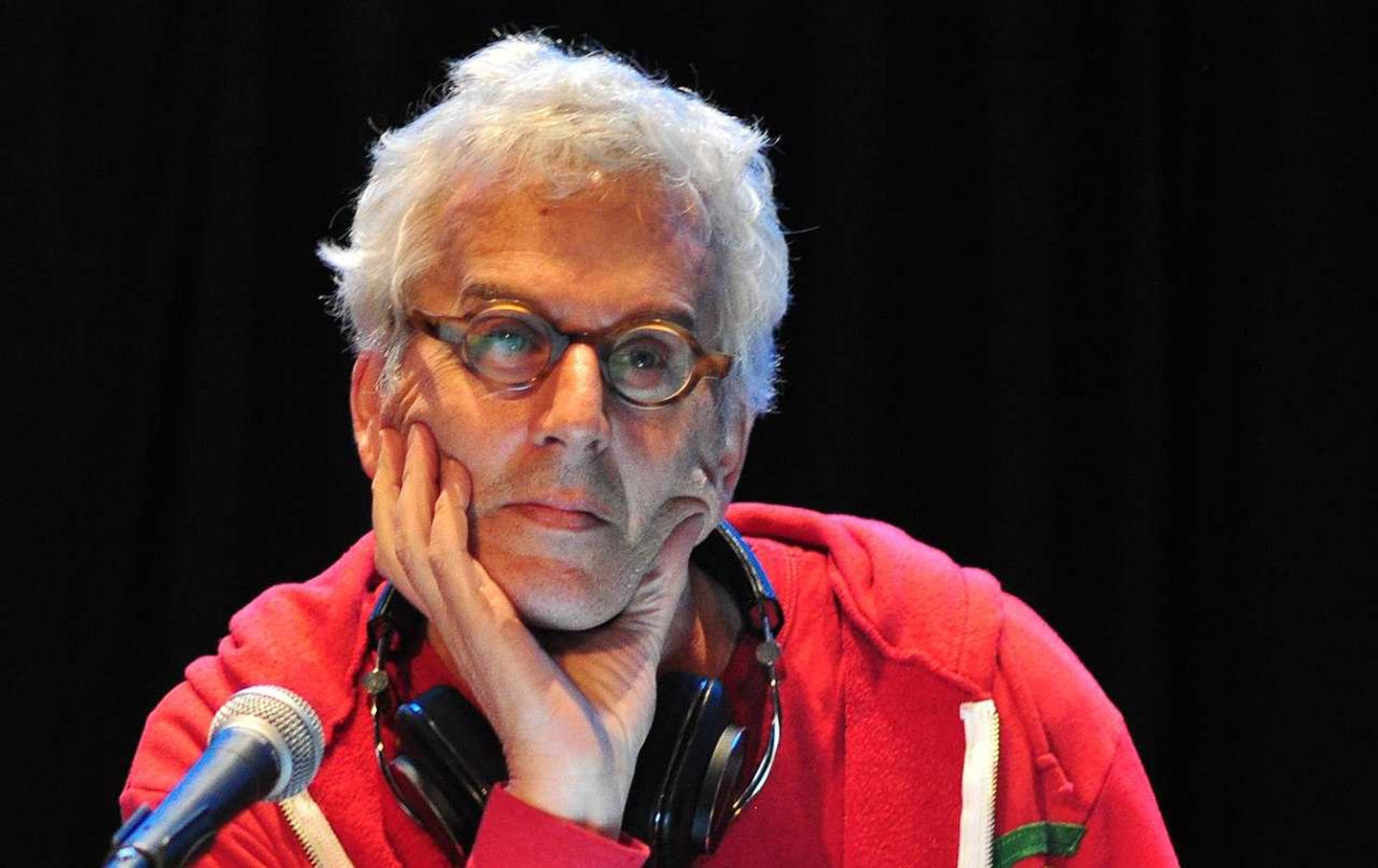
In early April, Joshua Clover removed some transphobic signs from a Turning Point USA event at UC Davis. The video circulated on Twitter: There he is in all-black, camera slung over his shoulder, hiking pole in hand, crossing a lawn with that new, unsteady gait that had worried me for months. He looks old, frail, yet simultaneously proud and content. When the woman with the camera rushes up demanding her signs back, he simply refuses. “No, no, it’s good,” he tells her. “I was cleaning up the trash that people are leaving out here.”
My first thought watching this footage, consumed with concern for his health: Why is he doing that? And then it struck me—oh, there he is, refusing to die.
When he died a few weeks later, social media overflowed with tributes: He bailed me out of jail on May Day once; without knowing me, he contributed thousands of dollars to help cover my bail; I e-mailed him out of the blue and he edited my first book of poems.
I have my own stories. I remember him during that unsuccessful Occupy Oakland–ish action to potentially occupy the Kaiser Center, motioning me and my son down an alley and away from the line of police eagerly loading their tear gas rifles. I remember answering a call from him during a May Day protest. He happened to be in a building overlooking downtown Oakland, meeting with lawyers about another friend arrested earlier that day. From his bird’s-eye vantage point, he spotted me—and the officers approaching around the corner. “Run,” he said simply. And I did.
This was Joshua the Militant. And yet there were so many Joshuas, often contradicting yet frequently overlapping. There was Joshua the Political Theorist, perhaps best known for Riot Strike Riot, where he defined political eras by their tendency toward riots or strikes. Yet while Joshua the Political Theorist was on the side of riots and remained hesitant around strikes, when Oakland Teachers embarked on their bitter, prolonged strike, he called me: “Meet me outside Sankofa United Elementary School at 8 am.” We showed up every morning until the strike ended. There was Joshua the Scholar, writing unusually generous and optimistic readings of popular music and film, whether his focus was Jonathan Richman and the Modern Lovers’ 1972 “Roadrunner” or Lil Nas X’s 2018 “Old Town Road” or The Matrix. Joshua the Organizer of Summer Camps, from the 95 Cent School to the recent Summer Seminars of the Marxist Institute for Research. Joshua the Conference Organizer, as in Revolution and/or Poetry. Joshua the Publisher of Commune Editions and Editor of Commune Magazine. Joshua the Tweeter, lover of barbs and jabs, the shit-talker, the contrarian, and also author of “How I Quit Spin.” Joshua the Marxist who proclaimed and educated about the value-form across numerous arenas. Joshua the Organizer of Long Bike Rides. Joshua the Academic who taught at UC Davis for many years, who defended its public funding by shutting down an on-campus branch of US Bank in 2011 with 11 students, who emotionally supported its students when UCD police pepper-sprayed them. Joshua the Connoisseur of Gummy Candies.
And then there was Joshua the Poet. He knew how to turn a phrase, build optimism, and remind us to love each other not just within occupied buildings but also within the short, limited lines of verse. He published his first book—Madonna Anno Domini—in 1987. His last—Red Epic—in 2015. He was never a poet for poet’s sake. Joshua the Militant always maintained a certain hesitancy around poetry’s often exaggerated revolutionary potential and loved to claim he had left poetry behind. That was something of a ruse. His final poem—“Poem (Sept 26, 2023)”—appeared in Protean Magazine in July. He wrote: “The revolution / in Palestine is not over. It is twelve years since the Port of Oakland / which is not over. It is eight years since Standing Rock / which is not over. It is three years since the George Floyd Uprising / which is not over.”Finally, Joshua the Lover of Animals, Particularly Cats. The last few times I saw him outside of the hospital, we drove around looking for the herd of sheep whose job it was to eat the understory. He was particularly fond of the sheepdog, Pedro, who watched over them. “It was true that the more I hated people the more I loved cats,” one of his most quoted poems begins. And then continues, “Then people started to surprise me. / Often this involved fire or coca-cola / bottles with petrol which amounts to the same thing.” Those who surprised him, he held so tight. Being friends with him was like entering a magic circle. Those who saw only his outside may not know this, but he was a giver of all sorts of gifts, not just intellectual and also material as in small trinkets, warm jackets, special candies, amusing notebooks, bottles of wine. It was not just that he made those in his circle feel special; if his writing is any one single thing, it is an invitation to join him in refusing to die. Those who want to pay homage might donate to their local bail fund, or I am sure many of you can imagine some ways to refuse to die that would have surprised him if he was still here.
Become a Sustaining Donor This September
Between the reemergence of right-wing red-baiting and Donald Trump’s use of the chilling National Security Presidential Memorandum–7 to criminalize left political organizing, we’re seeing McCarthyism reborn before our eyes.
This assault on democracy cannot be ignored or wished away. Resisting it requires bravery in the face of threats and repression, a steadfast commitment to the truth, and the unwavering belief that we can—and will—overcome this darkness.
We must have an independent media that sets the record straight, unearths corruption and abuses of power, and advances a politics of justice and dignity for all if we’re to win this fight.
That’s why I’m writing to you today. This September, The Nation needs to add 100 monthly donors to sustain our progressive journalism. Your contribution makes the next investigative report, the next truth-speaking column, and the next pathbreaking essay all possible.
I hope you’ll support our work with a recurring donation today. If you donate $10 or more a month, we’ll send you a brand new “Hands Off the Free Press!” sticker to recognise your commitment to our cause. Please, donate today.
Onward,
Katrina vanden Heuvel
Editor and Publisher, The Nation