
History’s Lessons for the Second Committee for the First Amendment
Jane Fonda is reviving the Hollywood advocacy group to meet the high-stakes challenges to free expression in the Trump era.
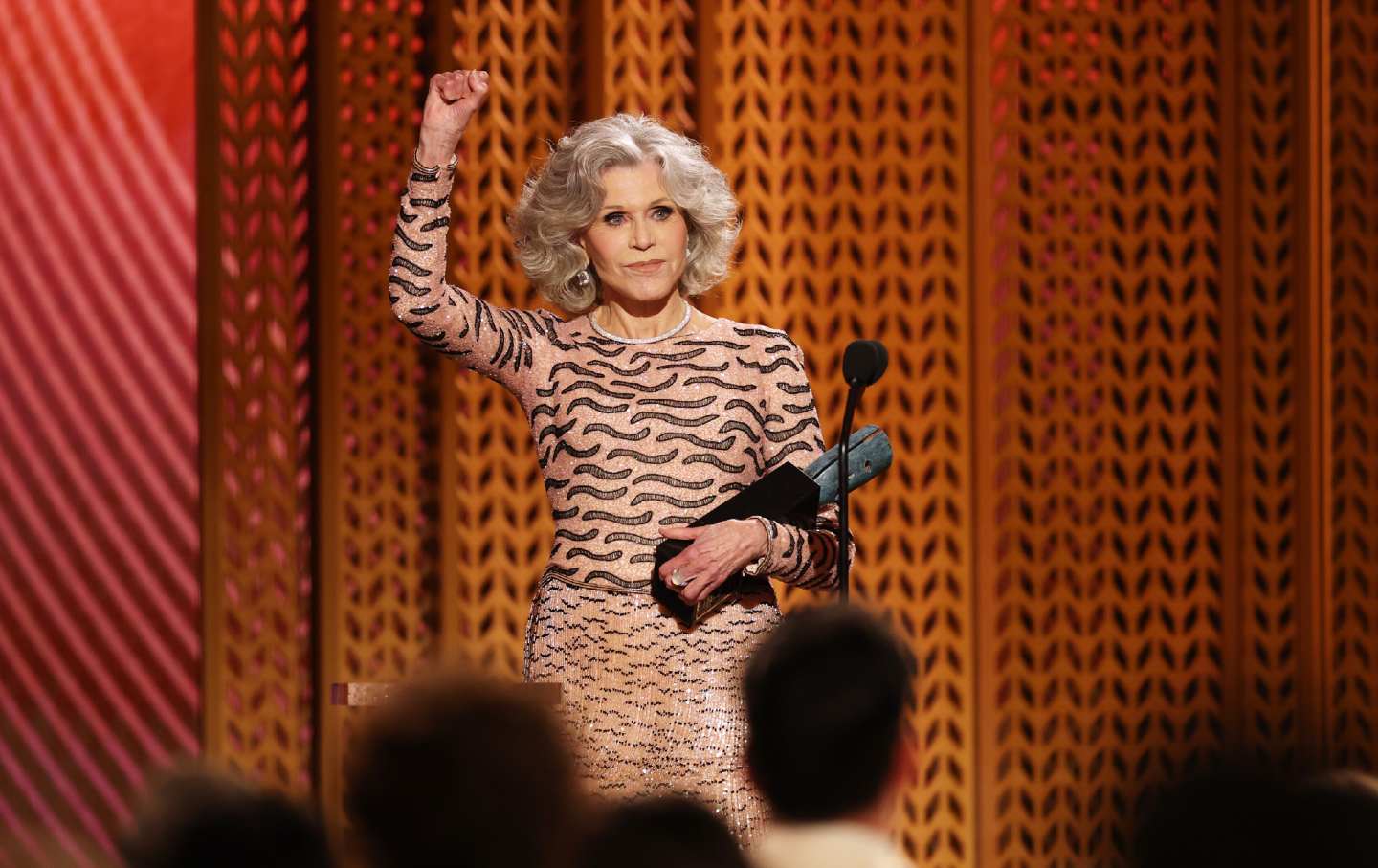
Jane Fonda accepts her Lifetime Achievement Award at last winter’s Screen Actors’ Guild ceremony.
(Matt Winkelmeyer/Getty Images)Earlier this month, actor and activist Jane Fonda announced the reformation of the Committee for the First Amendment (CFA), the organization her father, Henry Fonda, joined in 1947 as Hollywood’s initial answer to the House Un-American Activities Committee (HUAC). Its revival is an inspiring bid to galvanize the principled resistance to the anticommunist inquisitions of the McCarthy era in our current collapsing democracy—but the original CFA is also a cautionary tale in the long history of the entertainment industry’s tolerance for dissent.
We saw the inspiring side last February, when Fonda accepted a Lifetime Achievement Award from the Screen Actors Guild (SAG). In her acceptance speech, she threw down a challenge to her fellow actors. “Have any of you ever watched a documentary of one of the great social movements—apartheid or civil rights or Stonewall—and asked yourself, would you have been brave enough to walk the bridge? We don’t have to wonder anymore. We are in our documentary moment. This is it, and it’s not a rehearsal!”
As you might expect, Fonda did not wait around for her moment. Her revival of the CFA is her answer to it—a recognition of how the second Trump White House is dismantling the basic civil liberties of Americans. In cities and states across the country, citizens are passing their documentary-moment tests by taking to the streets to oppose ICE and the Trump administration’s federalization of law enforcement.
Unfortunately, the institutional responses to Trump’s power grab and shakedown attempts have been anemic-to-subservient compared to the actions of so many everyday Americans. When the Trump administration threatened to cut off funding to universities unless they change curriculums and silence protesters, most failed that test. Harvard fought back, but it hasn’t had much company—although some universities are finally showing some backbone in refusing the administration’s “social compact,” which secures their political fealty via threatened federal funding cuts. ABC and Viacom/CBS caved to Trump’s meritless lawsuits alleging slanderous coverage. The bosses at both networks gave in to Trump for purely financial reasons—in Viacom’s case, a pending merger with Skydance—and paid out $30 million in legal settlements. In our national documentary moment, the platforms airing documentaries have mostly failed.
One recent such failure, though, sparked a potent and promising free-speech backlash. Last month, ABC suspended Jimmy Kimmel for ridiculing Trump’s empathy-challenged attempts to look bereft the week an assassin killed Charlie Kirk. When FCC chief Brendan Carr signaled to the companies that own dozens of ABC affiliates that Jimmy Kimmel was unfit to air, they did his bidding, and preempted his show. ABC then suspended Kimmel “indefinitely.”
The national outrage over this censorship and bullying caused more than 1.7 million people to cancel their Disney+ subscriptions. Hundreds of artists in the entertainment industry signed a petition to bring Kimmel back. This was another documentary moment, and many people stepped up. Some, like showrunner Damon Lindelof, who created ABC’s Lost and HBO’s Watchmen, let it be known he would refuse to work with Disney again if ABC canceled Kimmel. The show of solidarity from viewers and industry insiders worked. With that kind of blowback, “indefinitely” lasted only six days.
The Kimmel episode harked back to the CFA’s original mission. While Fonda has yet to spell out what the new CFA will do, she gave a hint in a recent interview with Democracy Now! host Amy Goodman as they discussed the Kimmel suspension. She called such moments “CNN—creative nonviolent noncompliance,” arguing that the CFA could “model that for the rest of the country.”
Fonda has been an activist for more than half a century. That’s a good thing for the new CFA, because the original group was led by idealistic artists with little political experience. In 1947, The Hollywood Reporter began attacking writers, directors, and actors it considered communists. That attracted the attention of HUAC, which subpoenaed many of those named to testify.
In response, directors John Huston and William Wyler, together with writer Philip Dunne, founded the Committee for the First Amendment. It quickly attracted a stellar list of cosigners from the studio era’s golden age, including Humphrey Bogart, Lauren Bacall, Judy Garland, Lucille Ball, William Holden, William Wyler, and Groucho Marx. Broadway recruits included Ira Gershwin, George S. Kaufman, and Richard Rodgers. They were not joined officially by their unions or any studio executives.
CFA leaders joined forces with the subpoenaed to oppose the committee’s threat to the First Amendment. Communists or not, they understood that to allow HUAC to go unchallenged meant that sooner or later they would be next—because HUAC wasn’t investigating “communist” films; it was investigating liberal films made by mainstream Democrats. Many in the CFA were assured that the film workers subpoenaed by HUAC had been vetted, and that none were communists. They wanted to appear as patriotic Americans supporting the rights of everyone to speak freely, and not give the committee political ammunition to call the CFA a communist front or a group of clueless liberals duped by communists.
This was especially important to Humphrey Bogart. He had been through this once before when the Dies Committee (the first incarnation of HUAC) held closed-door hearings in August 1940 in Los Angeles. Democratic Texas Representative Martin Dies had come west to investigate communism in the film industry and, many felt, get himself some celebrity-generated headlines from stars like Bogart and James Cagney. Dies cleared Bogart and Cagney, and in 1947 Bogart insisted that the CFA be vetted for communists. He was assured that there were none.
First, the CFA did what its members did best. It put on a show. To state their goals on their own terms before arriving in DC, CFA members staged two radio broadcasts on ABC to make their case, Hollywood Fights Back. Dozens of the CFA’s members appeared in cameos to defend free speech, cite HUAC’s critics, and expose its odious allies. “Before every free conscience in America is subpoenaed,” Judy Garland said of HUAC’s chairman, J. Parnell Thomas, “Tell them how much you resent the way Mr. Thomas is kicking the living daylights out of the Bill of Rights.”
HUAC’s supporters in media answered with a mini–Red Scare timed to hit the subpoenaed and their CFA sponsors as they testified on Capitol Hill. Syndicated entertainment columnist Hedda Hopper, a die-hard right-winger, devoted the first of several columns to red-baiting quotes about the CFA solicited from her like-minded readers. A telegram from Ms. Gertrude Smith of Milwaukee, Wisconsin, read: “Until we are sure that Katie Hepburn [one of our favorites] and all others involved in any way in—to us, seriously menacing-ways of communism, we cannot and will not attend a movie in which these people play or write.… Why are they protesting so emphatically against this investigation into un-American activities if they are not involved in it? Why? What have they to fear?”
On the other side of the country, DC gossip columnist George Dixon outed John Howard Lawson and Sterling Hayden as Communist Party members (Hayden said he had quit the party by 1946), but also falsely lumped Bogart and Bacall in with them. According to Dixon, Hayden allegedly hit on DC socialite Mary Benton Gore—a distant cousin of Vice President Al Gore—at a dinner party with the unpromising pickup line of asking why she was not a communist. “The Communist way is the only way of life,” Hayden reportedly said, before pulling some pamphlets from his pocket, and saying, “I would like you to read some literature on the subject.” Miss Gore, whose family owned the Fairfax Hotel and its elite Jockey Club, proved an unwilling recruit. “I was shocked,” she supposedly said later. “They contained the most vicious Communist propaganda I have ever seen.”
With public pressure mounting, the HUAC hearing grew rancorous. Ten of the subpoenaed witnesses got into loud, defiant exchanges with committee members over their right to believe whatever they wanted—and their right to refuse to answer. Several actually were communists—which, of course, they had every right to be. It was a brutal lesson in Washington politics for the fledgling CFA; its members had staked out the moral high ground; they were absolutely right in what they said, but the combative party members who had concealed their affiliation were a PR disaster.
Afterward, they heard from a livid Bogart: “You fuckers sold me out!” “We didn’t realize until much later that we were being used to some degree by the Unfriendly 10,” Lauren Bacall said. After the hearing, HUAC had all the political ammunition it needed to label the CFA dupes and communists, and so it did.
The growing divisions in their own ranks and the hardball tactics of HUAC made the well-meaning members of the CFA seem like they were in over their heads. After HUAC issued contempt-of-Congress citations for the Hollywood 10, the studios went into aggressive damage-control mode, and issued what became known as the Waldorf statement—a pledge to purge communists from the film industry. Ten of the HUAC witnesses would get prison time for contempt, and would become known as “the Hollywood 10” in histories of the McCarthy era.
Popular
“swipe left below to view more authors”Swipe →The Writers Guild of America, the Directors Guild of America, and the Screen Actors Guild soon fell in line behind the Waldorf statement and abandoned their members. The comparatively small group of the CFA’s writers, artists, and directors stood on their own. “We oughta fold,” Billy Wilder said, and pretty soon they did. To save his career, Hayden testified before HUAC and named names in 1951. In 1952, John Huston moved to Ireland and became a citizen.
Fortunately, 2025 is not 1947. The entertainment industry isn’t limited to a handful of studios; most Hollywood guilds have already protested Kimmel’s suspension, and the members of the new CFA should already have a good idea of what’s ahead as the Trump administration crackdowns continue. The group’s website indicates a familiarity with history. “The formation of this Committee is not a warning shot,” it says. “This is the beginning of a sustained fight.” The site also pledges to document the capitulations of other industry players: “To those who profit from our work while threatening the livelihoods of everyday working people, bowing to government censorship, and cowering to brute intimidation: we see you and history will not forget. This will not be the last you hear from us.”
That, too, is good news. It was the decision of the studio heads to fold before HUAC’s demands that doomed the original CFA and elevated HUAC as de facto arbiters of content and talent in Hollywood movies until the blacklist was finally broken more than a decade later. It’s what the FCC just tried with Kimmel. And what we learned is that collective action from the artists who create content for studios, combined with an outraged groundswell of resistance from the audience who purchases it, can break the stranglehold of Trump-authored bribery and intimidation. The challenge for Fonda and the new CFA is to continue building on that precedent—and keeping their backers on message and united.
More from The Nation
Monstrous Merger Monstrous Merger
Allowing Paramount to buy Warner Bros. is a capitulation to corporate power and a threat to press freedom.
How Congress Is Cashing In on the AI Boom How Congress Is Cashing In on the AI Boom
Roughly one in five members of Congress has household investments in the industry.
Rebecca Solnit's (Mis)Adventures in the Manosphere Rebecca Solnit's (Mis)Adventures in the Manosphere
Rebecca Solnit explores an America where the right has turned hatred of women into an ever-expanding, multi-platform Internet grift.
Wendell Berry’s Unrelenting Vision Wendell Berry’s Unrelenting Vision
The poet wrote for The Nation for decades, always demonstrating conscience and prescience.

The Architecture of Campus Assault The Architecture of Campus Assault
College sexual assault is predictable. Here's how to change that.
New Mexico’s Grand Experiment New Mexico’s Grand Experiment
Last November, the state made childcare free for children of all ages, for all families. The impact has already been profound. “I feel like I can breathe," one mother said.

