
An Essential Intervention on Behalf of Embattled Palestinian Journalists
The Committee to Protect Journalists has just committed $300,000 to an emergency fund to aid journalists working in Gaza.
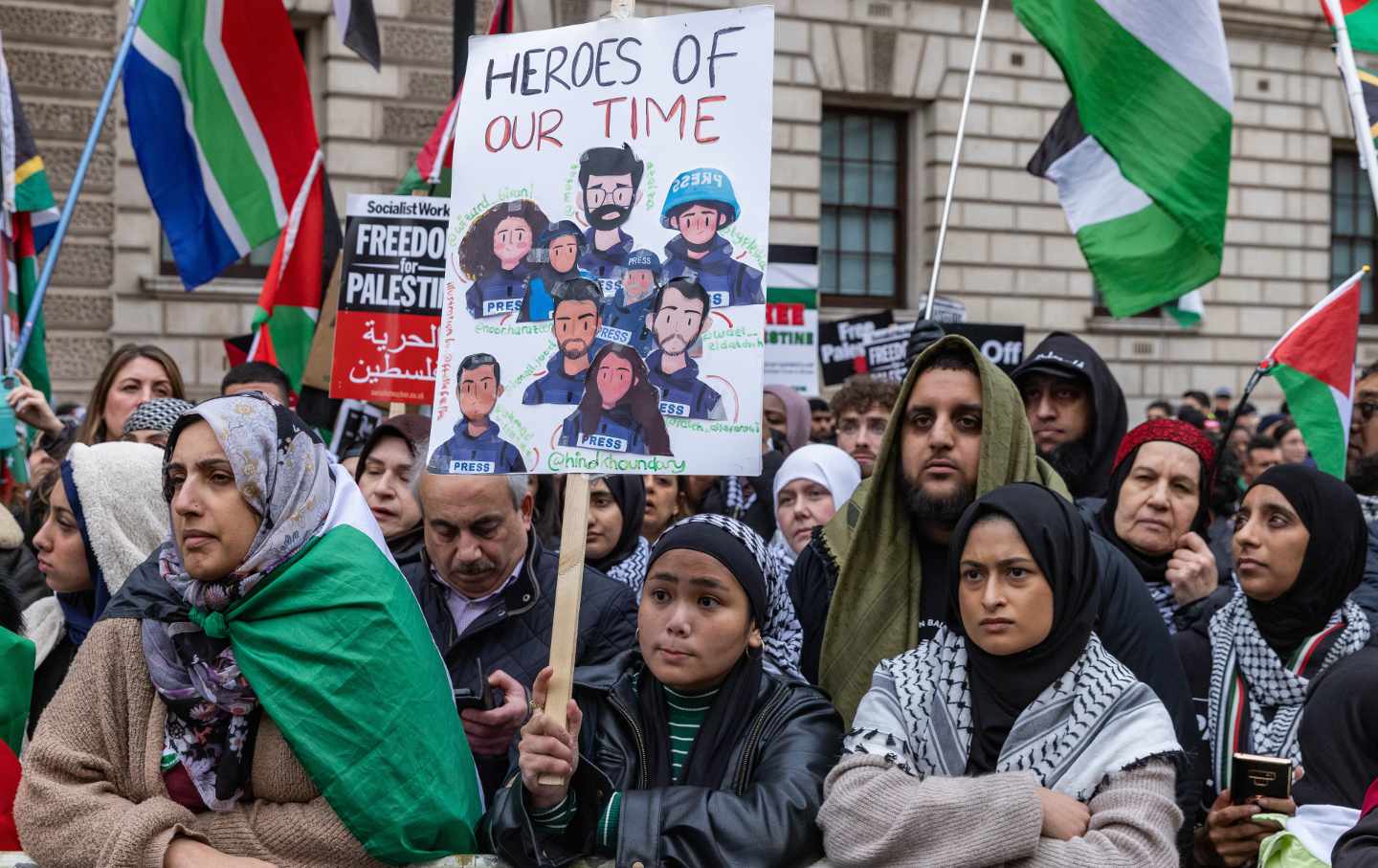
A pro-Palestinian protester holds a handmade placard paying tribute to Palestinian journalists at a rally on February 3, 2024, in London.
(Mark Kerrison / In Pictures via Getty Images)Since the beginning of the Israeli assault on Gaza, the International Federation of Journalists says, Palestinian journalists have been killed “at a scale and pace of loss of media professionals’ lives without precedent.”
But the death toll is just part of the story. For Palestinian journalists who are still trying to cover the nightmare that is unfolding in Gaza, the task becomes more difficult with each passing day. “Amid continuous airstrikes and the blocking of international journalists from entering Gaza, local journalists are on the frontlines of this story as they try to survive every day,” reports the Committee to Protect Journalists, an independent, nonprofit organization that promotes press freedom worldwide. “Like much of the civilian population of Gaza, Palestinian journalists are struggling to cope with food, fuel, and water shortages while lacking access to protective gear and sometimes unable to recharge their phones or replace their damaged equipment.”
Now, the CPJ has responded to the overwhelming challenges faced by Palestinian journalists with a commitment of $300,000 in emergency funding to support media workers in the enclave.
“The funds are being disbursed via local and regional organizations, namely the Palestinian Journalists’ Syndicate (PJS), Arab Reporters for Investigative Journalism (ARIJ), and Palestinian NGO Filastiniyat, who are best placed to assist and will cover equipment replacement, emergency shelter, food, and medical supplies as required,” explains the group, which thanked the Freedom of the Press Foundation for helping to raise the emergency funding. “The aim of CPJ’s assistance and implementation through these local organizations is to ensure that journalists inside Gaza remain safe and able to continue bringing the news from the frontlines to the rest of the world.”
That has become a daunting task. The IFJ reports that at least 92 Palestinian reporters, photographers, and technicians have been killed since the October 7 Hamas attacks on Israel and the subsequent Israeli assault on Gaza. In addition, according to the IFJ, four Israeli journalists and media workers have been killed since Israeli Prime Minister Benjamin Netanyahu declared a war that has left at least 27,000 Palestinians dead. Three Lebanese journalists, who were covering the bombing and invasion of Gaza, are also dead.
The death toll represents one of the most devastating blows to journalism in modern history, according to the IFJ—the world’s largest organization of journalists, representing 600,000 media workers across more than 140 countries. “The war in Gaza has been more deadly for journalists than any single conflict since the IFJ began recording journalists killed in the line of duty in 1990,” the group says.
You can read the names of the dead, and their stories on the IFJ website, where the killings of media workers are being chronicled on a daily basis.
It is vital to bear witness to the death toll. But it is vital as well to ensure that the full story of what is unfolding in Gaza continues to be covered by the Palestinian journalists who know the region best. To that end, the IFJ recently featured an appeal from Nasser Abu Baker, the president of the Palestinian Journalists Syndicate, who said, “We are in desperate need to support our colleagues in Gaza, most of whom have lost their homes, many of whom have lost family. They need your solidarity and help to continue reporting on the atrocities endured day and night by the people of Gaza.”
Baker encouraged viewers of the appeal to contribute to the IFJ’s International Safety Fund, and many have.
For journalists to continue to tell the full story of what is happening in Gaza, outside support becomes essential, as the International Federation of Journalists and the Committee to Protect Journalists recognize. The resources are necessary for journalists not just in Gaza but throughout Palestine, since the CPJ has documented what it describes as “ongoing press freedom violations across the occupied West Bank against journalists reporting on the war, including assaults, arrests, information blackouts, and the killing of family members.”
Journalists in the United States have plenty to worry about on the home front. These are some of the most challenging times in the history of the American media industry, characterized by the ongoing threat of media consolidation, the shuttering of legacy publications, and the layoffs of writers and editors who have worked for online news organizations.
But the unprecedented assault on journalism in the Middle East also demands our attention and our engagement. The people who do the work of journalism in this country—and the people who value that work—cannot look aside when media workers face death and destruction on a daily basis in a devastated corner of the world where journalism is more necessary than ever. That is just one reason the work of the IFJ and the CPJ must be seen as an effort not just to save journalists in Gaza but to save journalism itself.
John Nichols has written and cowritten—with media scholar Robert W. McChesney—a dozen books on journalism and democracy. He has twice keynoted world congresses of the International Federation of Journalists. He has also appeared as a featured panelist at the UNESCO forum on Freedom of Expression, testified before Congress on media issues, and been actively engaged with advocacy for domestic and international journalists as a cofounder of the media reform group Free Press.
Support independent journalism that does not fall in line
Even before February 28, the reasons for Donald Trump’s imploding approval rating were abundantly clear: untrammeled corruption and personal enrichment to the tune of billions of dollars during an affordability crisis, a foreign policy guided only by his own derelict sense of morality, and the deployment of a murderous campaign of occupation, detention, and deportation on American streets.
Now an undeclared, unauthorized, unpopular, and unconstitutional war of aggression against Iran has spread like wildfire through the region and into Europe. A new “forever war”—with an ever-increasing likelihood of American troops on the ground—may very well be upon us.
As we’ve seen over and over, this administration uses lies, misdirection, and attempts to flood the zone to justify its abuses of power at home and abroad. Just as Trump, Marco Rubio, and Pete Hegseth offer erratic and contradictory rationales for the attacks on Iran, the administration is also spreading the lie that the upcoming midterm elections are under threat from noncitizens on voter rolls. When these lies go unchecked, they become the basis for further authoritarian encroachment and war.
In these dark times, independent journalism is uniquely able to uncover the falsehoods that threaten our republic—and civilians around the world—and shine a bright light on the truth.
The Nation’s experienced team of writers, editors, and fact-checkers understands the scale of what we’re up against and the urgency with which we have to act. That’s why we’re publishing critical reporting and analysis of the war on Iran, ICE violence at home, new forms of voter suppression emerging in the courts, and much more.
But this journalism is possible only with your support.
This March, The Nation needs to raise $50,000 to ensure that we have the resources for reporting and analysis that sets the record straight and empowers people of conscience to organize. Will you donate today?
More from The Nation
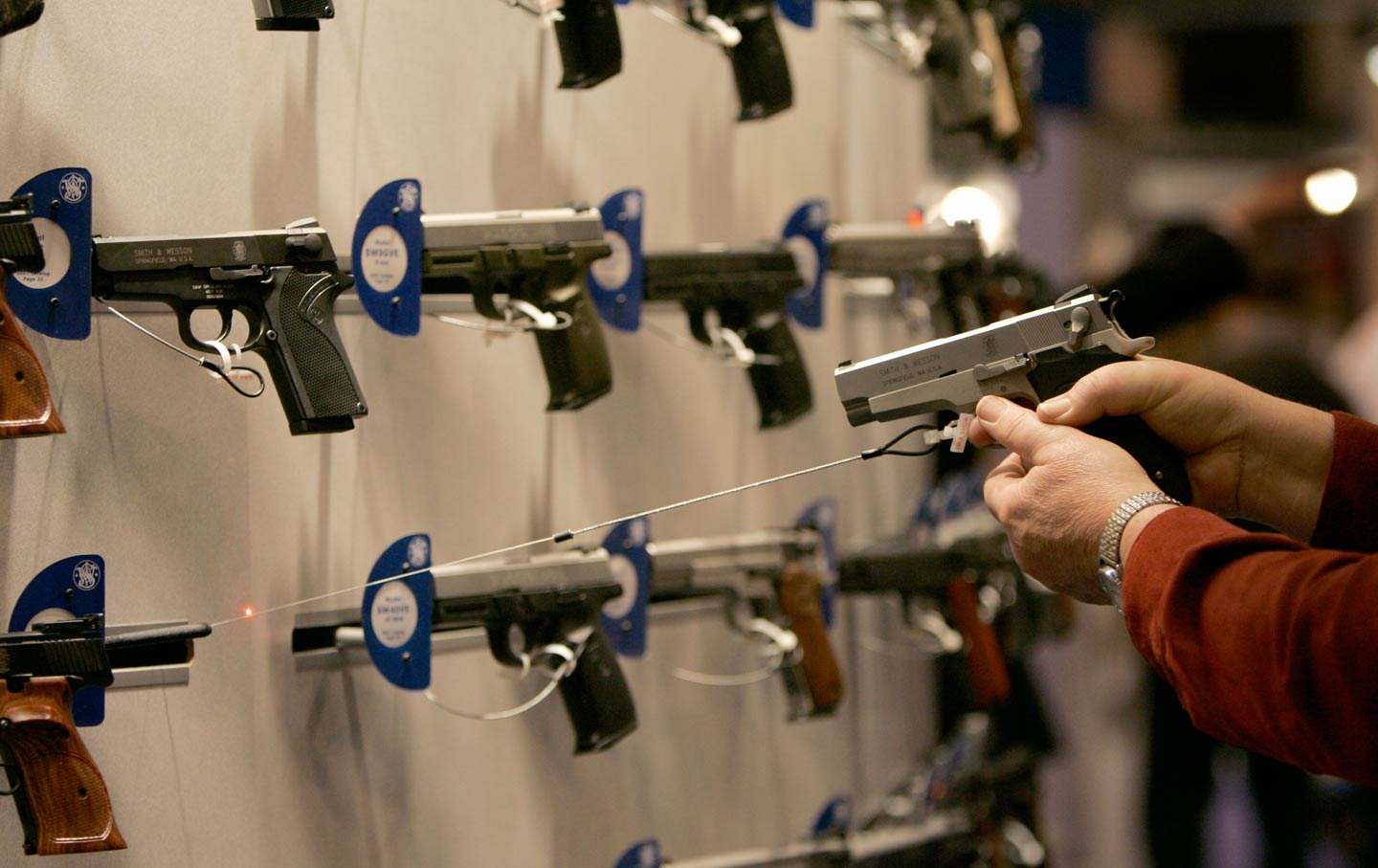
The Real Reason Americans Love Guns The Real Reason Americans Love Guns
With a weak social safety net, a gun offers a false sense of personal power and security.

The Endless Hypocrisy of Bari Weiss The Endless Hypocrisy of Bari Weiss
She claims to be a free speech champion. But as her actions at CBS News keep showing, she seems to think free speech should run only in a rightward direction.
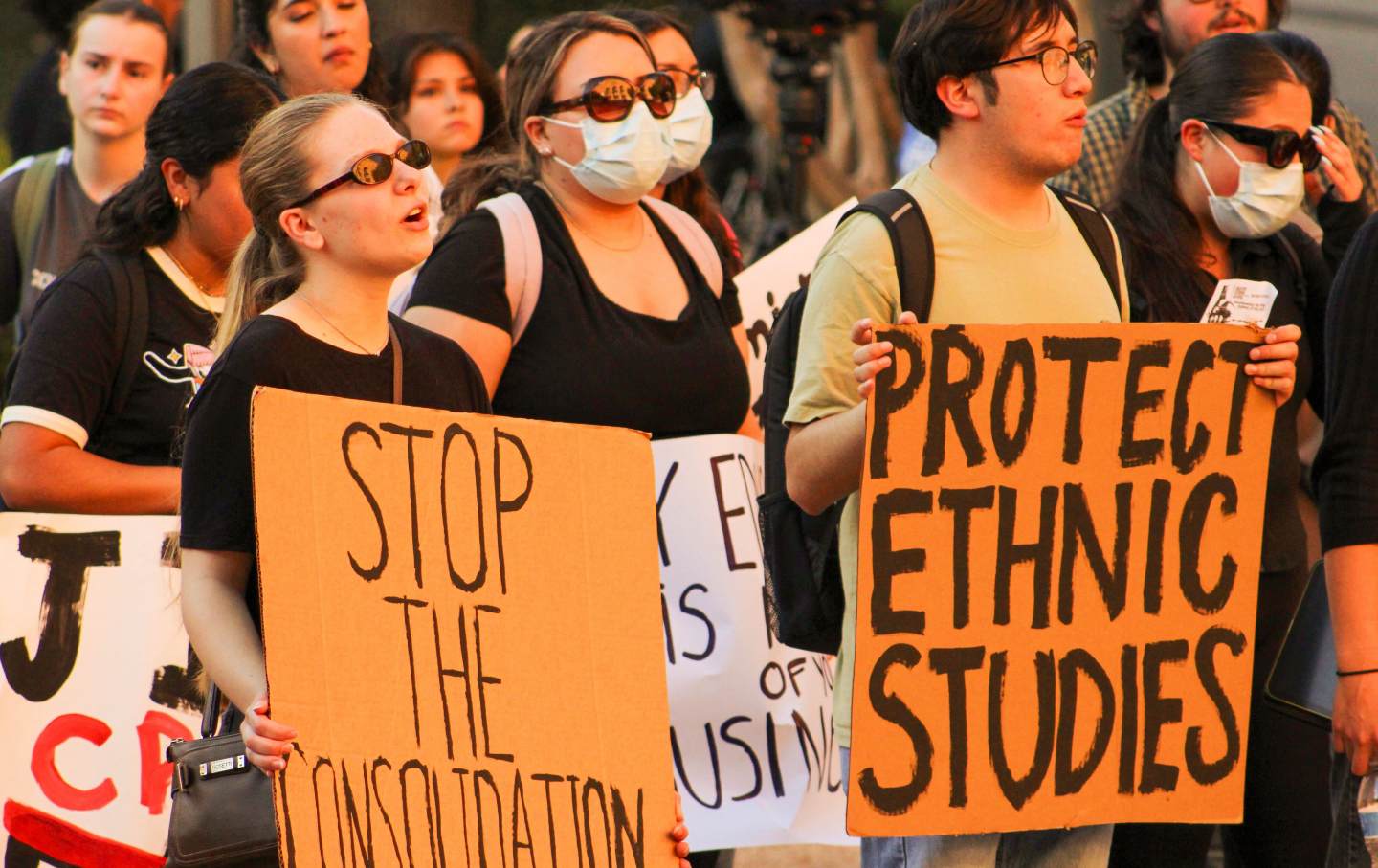
What Will Be Left After the University of Texas Destroys Itself? What Will Be Left After the University of Texas Destroys Itself?
UT-Austin has collapsed its race, ethnic, and gender studies into a single program while a new policy asks faculty to avoid “controversial” topics. But the attacks won’t end there...
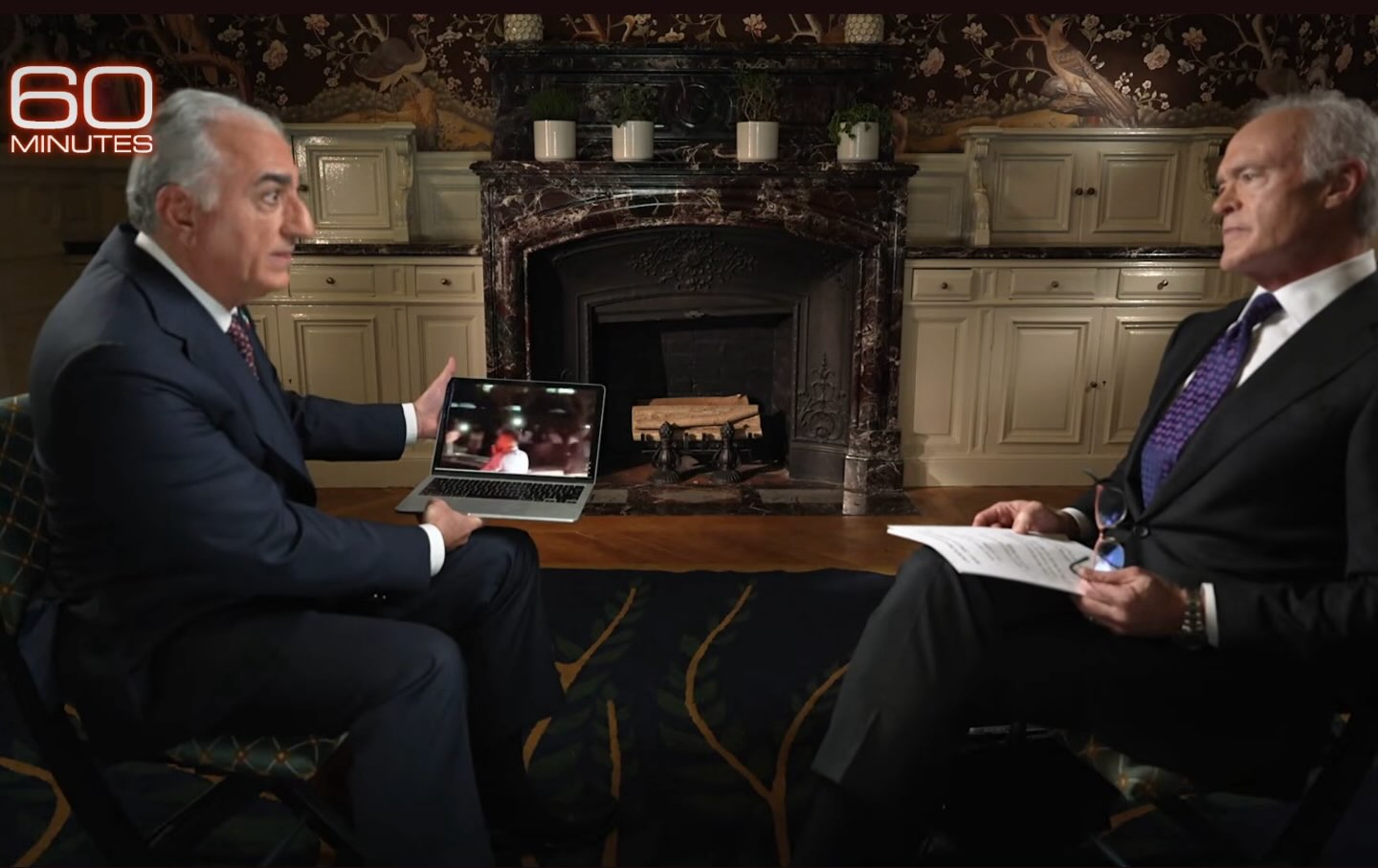
The Corporate Media Is Head Over Heels for the Iran War The Corporate Media Is Head Over Heels for the Iran War
Donald Trump’s attack may be surreal, unjustified, and illegal. But that’s not stopping the press from turning the propaganda dial way up.
The Disturbing History of ICE’s “Death Cards” The Disturbing History of ICE’s “Death Cards”
The Vietnam-era practice is yet another example of ICE agents thrilling to the brutality they have been encouraged to cultivate.
The American Universities Programming Israel’s Killer Drones The American Universities Programming Israel’s Killer Drones
Industry partnerships in higher education are pushing STEM graduates into the business of weapons manufacturing and genocide profiteering.

