The Archbishop of New York Should Know Charlie Kirk Was No Saint
Cardinal Dolan’s recent remarks on Fox News were playing to the Catholic Church’s most reactionary elements.
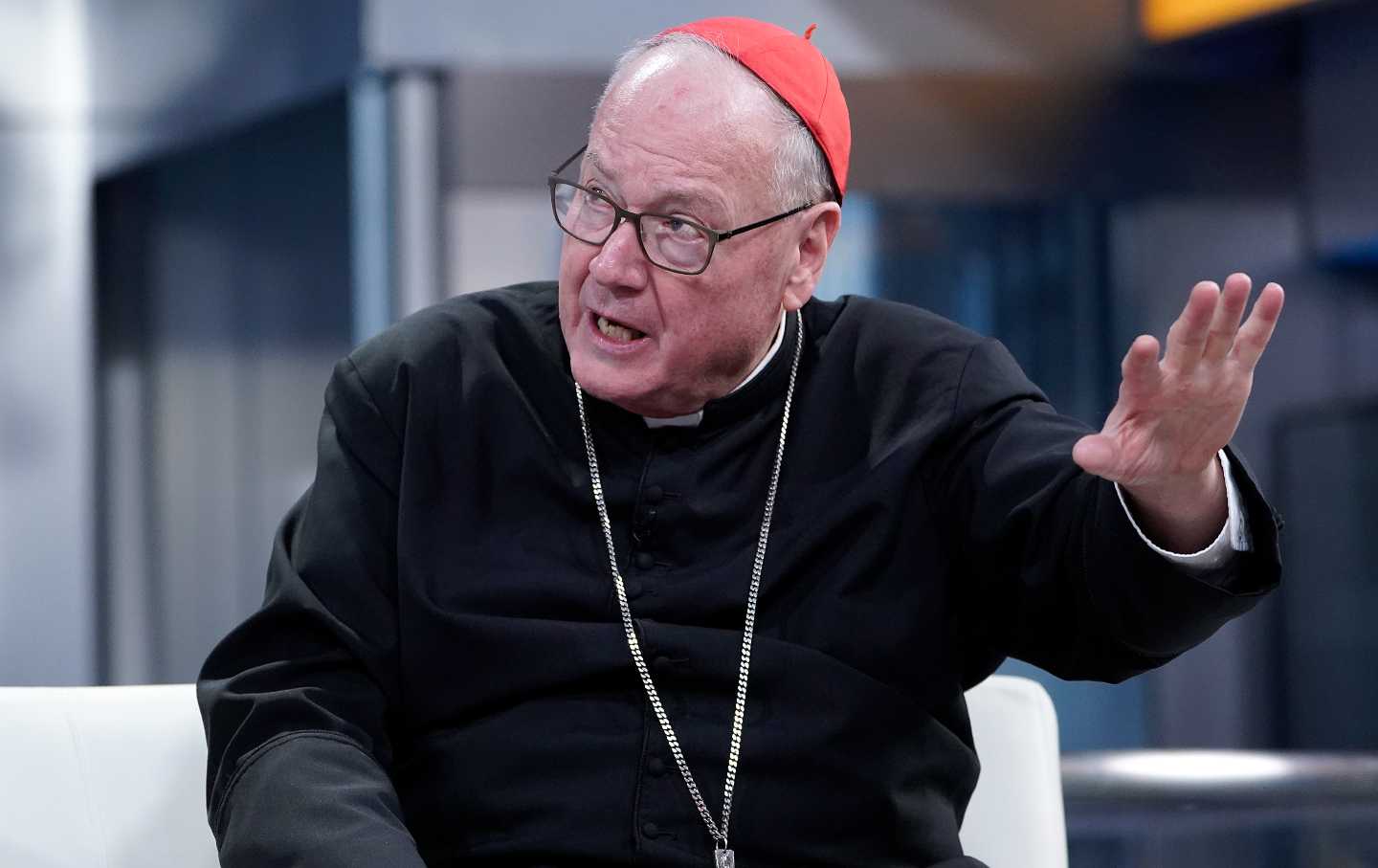
Cardinal Timothy Dolan holds forth on Fox and Friends.
(John Lamparski / Getty)It’s a modest stroll from the residence of New York Cardinal Timothy Dolan, near St. Patrick’s Cathedral, to the studio of Fox & Friends in midtown Manhattan. For Dolan, the distance seems to have grown shorter over time. In his most recent appearance on the popular right-wing morning talk show, he drew attention for calling Charlie Kirk, the slain founder of Turning Point USA, “a modern-day St. Paul.”
The remark is worth noting for a few reasons. One is that it’s absurd on its face. Dolan is the leader of the 2.8 million Catholics in the country’s second-largest archdiocese, a prelate once thought likely to be the first US-born pope. For the uninitiated, St. Paul is a towering figure of Christianity as we know it, a first-century Pharisee who famously converted on the road to Damascus and preached throughout Asia Minor and Europe. Dolan is certainly acquainted with Paul’s epistles, the writings addressed to the communities he ministered to; readings from them are a standard part of the Catholic liturgy. Again, he’s a cardinal—he surely knows the qualities of sainthood. Does he really believe Kirk embodied them? Many Christians and Catholics, while condemning Kirk’s murder, have also felt obligated to note his record of racist, homophobic, transphobic, and anti-immigrant rhetoric and relentless pro-gun advocacy. These include prominent Black church leaders, as well as religious orders like the Catholic Sisters of Charity of New York, who also criticized Dolan directly: Kirk’s “prejudicial words do not reflect the qualities of a saint,” they said in a statement. “To compare Mr. Kirk to St. Paul risks confusing the true witness of the Gospel and giving undue sanction to words and actions that hurt the very people Jesus calls us to love.”
Dolan should know all these things. The charitable explanation is that he chose his words carelessly. He is famously garrulous, and a widely viewed morning talk show is just his kind of stage. He has fallen prey to his own verbal irrepressibility before—even on Fox, where he once blurted that “Donald Trump takes his Christian faith seriously.” But there’s another possible explanation (which ties into the second reason his bizarre paean is so noteworthy): Dolan knew exactly what he was saying and was happy to convey it on behalf of the church’s most reactionary elements. St. Paul was one of the first Christian martyrs, beheaded at the order of Emperor Nero. The MAGA movement has seized on Kirk’s killing to claim him as a martyr to its cause. Vice President (and Catholic convert) JD Vance called Kirk “a martyr for the Christian faith” at Kirk’s memorial gathering in Arizona. Now, in directly linking Kirk to one of the most important figures in the history of Christianity, Dolan provides authoritative Catholic cover to an ethnonationalist agenda with distinctly authoritarian aims.
It’s fair to wonder why a Catholic cardinal who has spoken out (though too quietly for some) about the Trump administration’s inhumane immigration policies would throw in with this lot, and why so many other Catholics—public figures and ordinary folks in the pews alike—seem to be doing the same. But there is, sadly, ample historical precedent. Prior to World War II and even afterward, Catholic authorities often opposed democratic forms of government while emphasizing affinities with authoritarian ones. A mélange of ideas that included “fierce anti-communism, an underlying drumbeat of anti-Semitism, and skepticism about democratic politics existed across the Catholic world in the 1930s,” historian John T. McGreevy notes in Catholicism: A Global History from the French Revolution to Pope Francis.
The institutional church and many of its local leaders supported fascist dictators in Spain (Franco) and Italy (Mussolini), and while Catholics were generally more wary about Hitler, they didn’t reject him outright at first. Vatican Secretary of State Eugenio Pacelli (the future Pope Pius XII) commended Hitler for “speaking against the bolshevists,” McGreevy writes; when the church signed the diplomatic pact with the Nazis in 1933 known as the Reichskonkordat, Pacelli commented that “Catholics dodged a Kulturkampf [culture struggle] much worse than in Bismarck’s times.” McGreevy also documents “enthusiasm for Mussolini” among prominent US Catholics, including a South Dakota bishop who compared il Duce to George Washington. Famous figures like controversial “radio priest” Charles Coughlin—who counted Charles Lindbergh as a powerful ally—cultivated similar sentiments, broadcasting to an audience of millions a poisonous mix of anti-Semitic commentary, isolationism, and support for the policies of Nazi Germany and Fascist Italy. The communist witch hunts undertaken by the Catholic Republican Senator Joseph McCarthy in the 1950s were an extension of these impulses.
The liberal political order forged in the postwar years, as well as the reforms of Vatican II (including support for religious liberty and an injunction not to “use coercion to force anyone to embrace the Christian faith against his own will”), showed that Catholicism and democracy could in fact coexist, and even thrive together. Searing memories of the destruction wrought by nationalist energies kept governments alert to incipient authoritarian movements. But with the steady decline of democratic institutions in this century, and the rise of populist movements in Italy, Hungary, the United States, and elsewhere, that order has frayed. In American Catholicism, this was accompanied by vocal criticism of the late Pope Francis by archconservative Catholics—who found him insufficiently committed to church doctrine—with rhetoric echoing right-wing culture-war language on various issues, especially with respect to LGBTQ people.
And yet, a more or less mainstream figure like Dolan would seem a strange bedfellow for the MAGA faithful, even granted the exigencies of politics. Such an arrangement may be traced in part to the informal pact American bishops made with evangelical and fundamentalist Christianity in the campaign against abortion beginning in the Reagan era, which was couched in the rhetoric of confrontation and struggle.
Even today, post-Dobbs, opposition to abortion should be the preeminent priority for Catholic voters, according to the US Conference of Catholic Bishops. In this environment, a new version of Catholic fundamentalism has gradually found purchase—exhibiting some similarities with previous, fringier movements of the 20th century, as detailed by Mark Massa in his essential new book, Catholic Fundamentalism in America. The difference is that those movements generally sought to set themselves apart from Catholicism first—dissenters within the church itself in a quixotic fight against modernity and engagement with secular society. An exception among these was the mid-century Jesuit priest Fr. Leonard Feeney of the St. Benedict Center in Cambridge, Massachusetts, whom Massa credits with crafting a “paradigm” for an “anti-modern, reactive, and sectarian impulse [that] is alive and well in the twenty-first century and shows no signs of disappearing.”
This impulse finds expression in today’s integralist movement, which seeks to impose Catholic doctrine on American society at large via a theocratic monarchy that would be the sole arbiter of the common good in civil society. It and other conservative Catholic pursuits are well-funded and have institutional bases at places like the Catholic University of America and Notre Dame, at whose law school Supreme Court Justice Amy Coney Barrett served on the faculty. Reactionary Catholics, including those with ties to Opus Dei, also had a hand in fashioning Project 2025, the blueprint for the authoritarian policies of the second Trump administration. The MAGA movement benefits from a large and powerful megaphone in the form of CatholicVote, which contributed more than $10 million to help elect Trump in 2024 and whose founder, Brian Burch, is now the US ambassador to the Vatican.
All of which is to say that Dolan’s comments on Kirk cannot be overlooked or seen outside the course of history. Fox is the propaganda arm of the Trump administration, and Dolan’s eager presence in its studios suggests the degree to which powerful figures within and associated with the US Catholic Church shape—and are absorbed into—the ethnonationalist program of the MAGA regime. In the aftermath of Kirk’s assassination, this unholy and wholly un-Christian alliance appears to be solidifying.
Become a Sustaining Donor This September
Between the reemergence of right-wing red-baiting and Donald Trump’s use of the chilling National Security Presidential Memorandum–7 to criminalize left political organizing, we’re seeing McCarthyism reborn before our eyes.
This assault on democracy cannot be ignored or wished away. Resisting it requires bravery in the face of threats and repression, a steadfast commitment to the truth, and the unwavering belief that we can—and will—overcome this darkness.
We must have an independent media that sets the record straight, unearths corruption and abuses of power, and advances a politics of justice and dignity for all if we’re to win this fight.
That’s why I’m writing to you today. This September, The Nation needs to add 100 monthly donors to sustain our progressive journalism. Your contribution makes the next investigative report, the next truth-speaking column, and the next pathbreaking essay all possible.
I hope you’ll support our work with a recurring donation today. If you donate $10 or more a month, we’ll send you a brand new “Hands Off the Free Press!” sticker to recognise your commitment to our cause. Please, donate today.
Onward,
Katrina vanden Heuvel
Editor and Publisher, The Nation