
The Risks of Dementia in the House, the Senate—and the White House
Biden’s occasional slips, like Trump’s off-topic rambling, are likely the result of normal aging, not Alzheimers. But dementia in high places is definitely worth worrying about.
Aging does strange things to your mind, but then so does political partisanship. In early February, the argument over Joe Biden’s age was turbocharged after a report by special counsel Robert Hur characterized him as an “elderly man with a poor memory.” This provoked the centrist pundit Jonathan Chait into making the bizarre case that senility was not necessarily a disqualifying trait in a president. In a dialogue with a colleague at New York magazine, Chait said, “Well, if [Biden is] controlled by advisers, is that unacceptable? If the advisers are making good decisions? Reagan was pretty senile and controlled by advisers. Everybody’s forgotten this, but the accounts of his mental state are harrowing. Nobody cared because the results were fine.” Not content with invoking Reagan’s cognitive impairment, Chait added, “Biden seems more feeble than Reagan.”
With friends like Chait, Joe Biden hardly needs enemies. The invocation of Ronald Reagan was weirdly unnecessary and self-defeating. There’s reason to believe Reagan was suffering from the effects of dementia during the first term of his presidency. Contra Chait, the results were not “fine.” Someone who purports to be a liberal, as Chait does, should surely remember the attack on the Constitution in what came to be known as the Iran-contra scandal; the support for genocidal death squads in Central America; and the nuclear brinkmanship that brought the world hair-raisingly close to nuclear war.
Fortunately, Biden is not quite Reagan. All evidence suggests that his problems are the result of aging rather than any form of dementia. The same effects are even more pronounced in Biden’s slightly younger rival, Donald Trump, who at age 77 often slurs his words and goes off on long, rambling stream-of-consciousness digressions.
Chait’s argument should be understood as a kind of preemptive defense: If Biden were to be diagnosed as senile, the situation would still be “fine.” One wonders if he thinks the same would be true with Trump, who if controlled by his advisers (extremists like Stephen Miller and Steve Bannon) would surely be even more dangerous. The 25th Amendment, which provides for the removal of an impaired president, does offer a theoretical remedy, although Reagan’s presidency suggests that even in dire situations, this solution will be avoided.
As ridiculous as it is, Chait’s argument at least has the virtue of bringing out into the open a real problem: the emergence of an American gerontocracy that has radically raised the likelihood of dementia in high places. This is true not just of the presidency but also of Congress, the federal judiciary, and the national security state.
In April 2023, the Rand Corporation, a think tank that provides analysis for—and receives funding from—the Pentagon, released a report that asked, “Could dementia in the national security workforce create a security threat?” The report argues, “People are living longer [and] working later in life. As a result, the workforce might experience a higher prevalence of dementia than in past generations.”
These claims need to be qualified slightly. Americans are not in fact living longer: Life expectancy peaked in 2014. Modern medicine has created increased longevity, but the benefits are unevenly distributed. As Vox reported in 2018, “While poor Americans are dying earlier, the rich are enjoying unprecedented longevity.” The news site called attention to research showing that “men who were among the top 1 percent of income earners lived 15 years longer than men at the bottom 1 percent. For women at the extremes of the income distribution, life expectancy differed by 10 years.”
Wealthy Americans are now a distinct caste: They live longer and, if they happen to hold political or judicial power, cling on to it as long as they can. Winners in a wildly unfair medical and economic system, they are generally reluctant to share their good fortune with those outside their charmed circle. Gerontocracy and plutocracy go hand in hand.
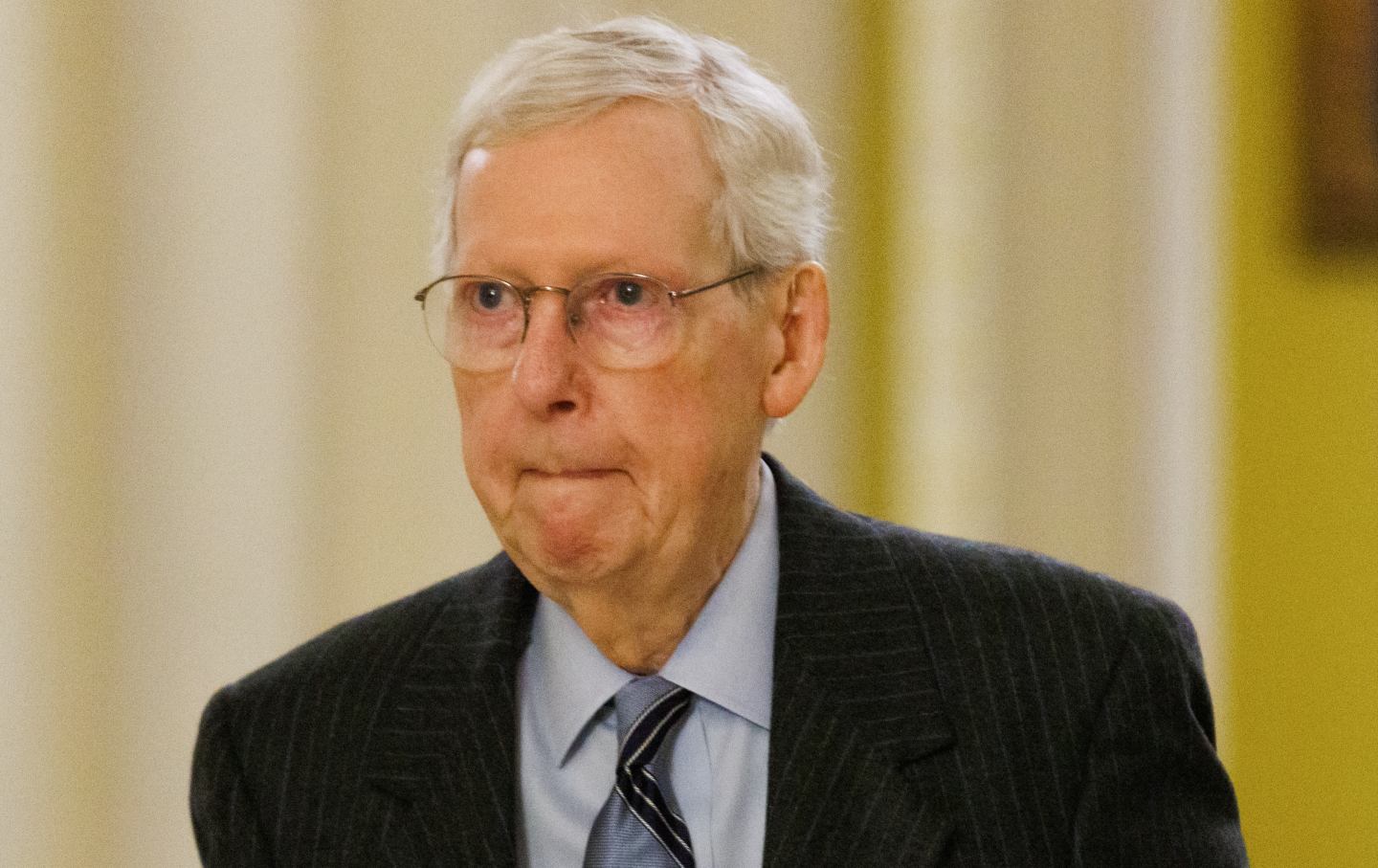
The United States is increasingly a gerontocracy, most visible in recent years in figures such as Senate minority leader Mitch McConnell, 82, and Representative Nancy Pelosi, 83, who resigned her position as House speaker in 2022 but remains a Washington powerhouse. Of the country’s 100 senators, 69 are over the age of 60.
The Rand study warns that the holders of classified secrets who suffer from dementia might compromise national security. Tactfully, no names are mentioned. Writing in The Intercept, reporter Ken Klippenstein called attention to the high-level security clearances enjoyed by McConnell and the late senator Dianne Feinstein, both of whom displayed behavior that raised concerns about their cognitive capacity. The Rand study suggests the same might be true of not just lawmakers but many in the national security establishment.
The same problem bedevils the judiciary, where federal judges enjoy lifetime tenure as well as a cozy system that provides an ample number of law clerks to do the brunt of the work. Federal judges are now an average of 69 years old. In 2023, Bloomberg Law reported on several cases of judges behaving erratically, likely because of dementia. As Harvard bioethics professor Francis Shen told the site, “It’s really problematic to have a combination of life tenure with no—and I mean zero—check-ins for cognitive ability.”
Raising the alarm about this issue can be done without ageism. Increased longevity is a blessing, and we should work to make sure it is extended to the poor. It’s wonderful that Martin Scorsese, 81, is still directing movies and that Vivian Gornick, 88, continues to share her wisdom in essays.
But in the political realm, where life-and-death decisions are made and power should be more evenly distributed, a plutocratic gerontocracy that is increasingly prone to dementia is a nightmare—as well as a genuine threat to national survival.
More from The Nation

The Real Reason Americans Love Guns The Real Reason Americans Love Guns
With a weak social safety net, a gun offers a false sense of personal power and security.

The Endless Hypocrisy of Bari Weiss The Endless Hypocrisy of Bari Weiss
She claims to be a free speech champion. But as her actions at CBS News keep showing, she seems to think free speech should run only in a rightward direction.

What Will Be Left After the University of Texas Destroys Itself? What Will Be Left After the University of Texas Destroys Itself?
UT-Austin has collapsed its race, ethnic, and gender studies into a single program while a new policy asks faculty to avoid “controversial” topics. But the attacks won’t end there...
The Corporate Media Is Head Over Heels for the Iran War The Corporate Media Is Head Over Heels for the Iran War
Donald Trump’s attack may be surreal, unjustified, and illegal. But that’s not stopping the press from turning the propaganda dial way up.

The Disturbing History of ICE’s “Death Cards” The Disturbing History of ICE’s “Death Cards”
The Vietnam-era practice is yet another example of ICE agents thrilling to the brutality they have been encouraged to cultivate.

The American Universities Programming Israel’s Killer Drones The American Universities Programming Israel’s Killer Drones
Industry partnerships in higher education are pushing STEM graduates into the business of weapons manufacturing and genocide profiteering.

