The Feminist Moment We Didn’t Know We Needed
Women are finding camaraderie in the unlikeliest of places at a time when the forces of sexism, homophobia, and transphobia are strong and emboldened.
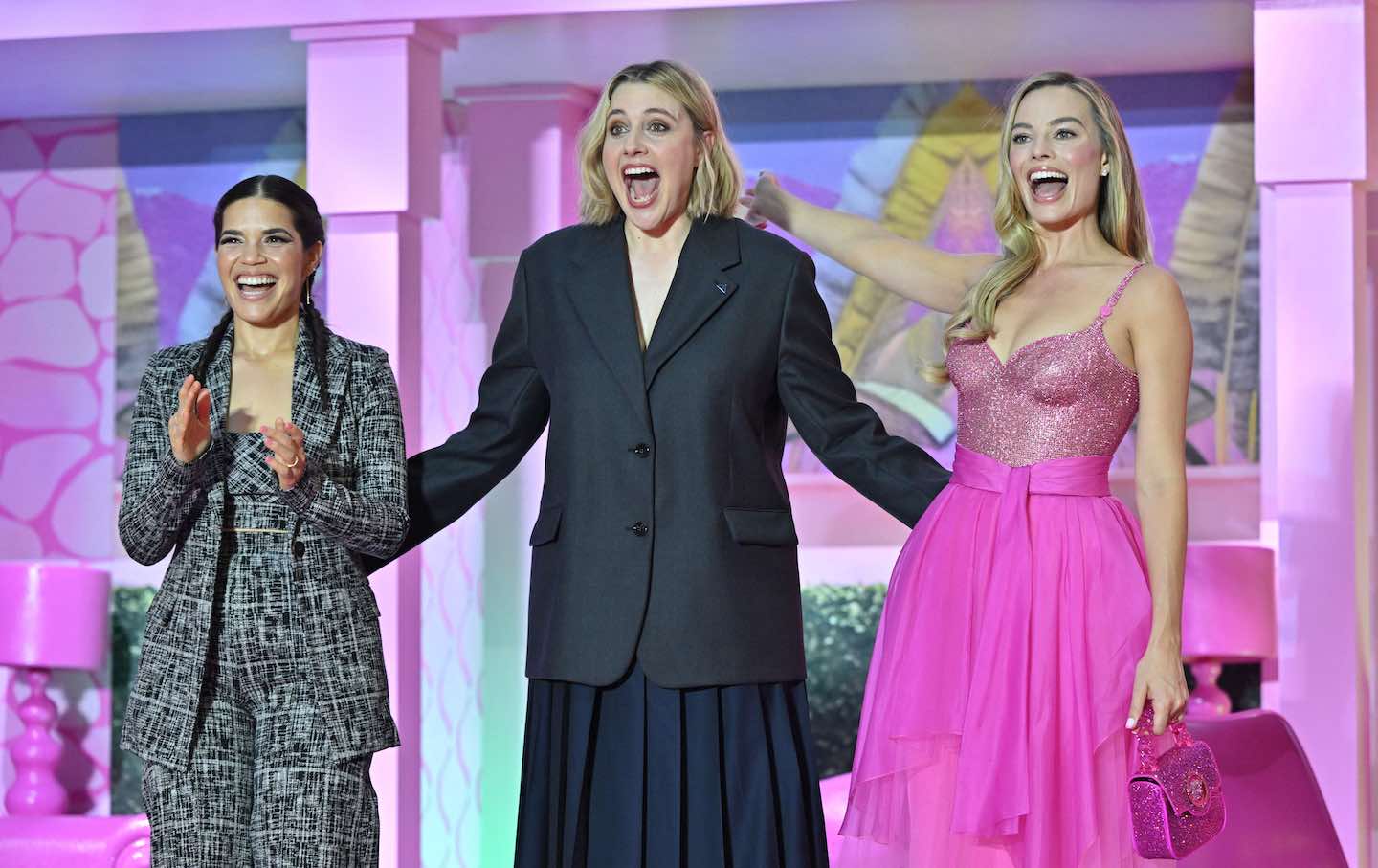
Asking “Is Barbie a feminist?” is a bit like asking “Why would a loving God allow so much suffering?” You’re not likely to get a satisfying answer, but the fact that you’re asking the question can reveal a lot about your situation. In 2023—a year after the Supreme Court overturned the national right to abortion in Dobbs, amid a virulent backlash against #MeToo, and as conservatives escalate their attacks on gay rights, gender-affirming health care, and birth control—Barbie might be the closest thing to a feminist icon that we have in mass culture right now.
Barbie, released in July, quickly became the biggest film of the year, earning $356 million worldwide at the box office in its opening weekend. The phenomenal success was due not only to the film’s aggressive marketing to women and girls but also to the script’s unambiguous, if tepid, feminist message: that girls can do anything—or, at least, that it would be nice if they could. The movie follows a Barbie doll, played by the impeccably chipper Margot Robbie, as she makes her way out of the feminist utopia of Barbie Land into the messier and more complicated real world, healing a mother-daughter relationship and becoming human herself along the way.
Quite boldly, the film presents the Barbie franchise as a synecdoche for feminism itself. The dolls, we are informed, believe that women in the real world can do anything, because Barbies, in their world, hold all the positions of influence, responsibility, and power. When the real world pales in comparison, it is because we, the humans, are not enough like the dolls.
To put it mildly, this is something of a rebrand. For decades, Barbie was an object of feminist scorn. An impossibly thin, disproportionately busty, and unblinkingly cheerful paragon of white femininity, she became a symbol of everything women were relentlessly instructed to be. And what they were supposed to be, if you were deducing from Barbie, were sexpot consumers: critically thin, rabidly materialistic, and not very bright. Barbie often seemed to be an advertisement for eating disorders, not only in her proportions but in the message pushed by her manufacturer, Mattel. Slumber Party Barbie, which came out in 1965, came with a scale stuck at 110 pounds and a weight-loss book that read, “Don’t eat!” Barbie trafficked in tropes of women as frivolous and stupid. Teen Talk Barbie, from 1992, included a voice box that said things like “Want to go shopping?” and “Math class is tough!” Studies conducted as recently as 2014 and 2021 found that playing with Barbie dolls damages young girls’ body image and limits their sense of the possibilities for their future. Barbie has been not only a symbol of misogyny but an agent of it: a product that measurably makes the world a worse place for girls.
This increasingly apparent dark side of Barbie began to hurt Mattel’s bottom line. Barbie sales plummeted by a third between 2011 and 2015, as millennial mothers, raised in the comparatively enlightened 1990s and 2000s, chose toys for their daughters that did not promulgate such a narrow vision of gender. When Mattel introduced new Barbie bodies in 2016, it had these women in mind. “The millennial mom is a small part of our consumer base,” then-Barbie brand head Evelyn Mazzocco explained to Time, “but we recognize she’s the future.” In a sense, this cold market calculation reveals some unambiguously good news for American feminism: Mattel is telling us, with capitalism’s cruel honesty, that it doesn’t think a rigidly sexist Barbie can make a profit anymore. People—women—want something different.
That’s where Greta Gerwig comes in. The director, known for her melancholic chronicles of girlhood, was tasked with solving Mattel’s marketing problem by reversing the politics of Barbie. The result has been a blowout success, the sort of dramatic turnaround in brand identity that will one day be taught in business schools. Barbie is a feminist now, and
Barbie has proved a feminist moment.
Teen girls whose feminist mothers didn’t let them play with Barbies are now gathering in suburban movie theaters, wearing gleefully parodic pink ensembles and soaking in the film’s confused but earnest message of gender equality. Grown women, who resent the messages Barbie sent to them as girls, are in on the joke too, greeting one another with “Hi, Barbie!” on the bathroom line. More still are cheering from their seats as America Ferrera, one of the film’s stars, delivers a monologue recounting the impossible standards that women are held to—standards long embodied by the Barbie dolls themselves. (For Mattel, the movie may represent more of an evolution of gender politics than of race: At one point, Ferrera’s character compares the rapid spread of patriarchy in Barbie Land to the spread of smallpox among Indigenous Americans, a line that’s played for laughs.) It is a sign of Gerwig’s talent, if also of her cynicism, that she transformed Barbie—a ubiquitous item of American girlhood that has long marked the onset of misogyny—into an opportunity to commiserate over the frustration of living under it.
In another era, women might have found such commiseration elsewhere. In the early 1970s, major cities were home to dozens of women’s activist groups, where women who were moved by the feminist cause could find solidarity, as well as mutual aid and opportunities for activism. Many groups offered consciousness-raising sessions, organizing conversations that brought women into a new awareness of gendered hierarchy. These groups have disappeared, but their tactics persist: Barbie offers its own version of consciousness raising, as the dolls’ conversations with Ferrera help restore their self-respect. “By giving voice to the cognitive dissonance required to be a woman under the patriarchy, you robbed it of its power!” one Barbie tells her.
Something similar seems to be happening among members of the audience at screenings of Barbie, and it is happening at other major events this summer as well: from Taylor Swift shows, for instance, where teenage girls trade friendship bracelets, to concerts in Tennessee, where artists like Orville Peck and Hayley Kiyoko have invited drag queens on stage in defiance of a state anti-drag law. In politics and in law, gender progress is rapidly disappearing in America, and the forces of sexism, homophobia, and transphobia are strong and emboldened. To the untrained eye, it may seem that feminism is on the back foot. But women are finding camaraderie anyway, often in unexpected places—even places like Barbie.