As Los Angeles Burns, It’s Business as Usual in Eviction Court
The relentless progression of eviction proceedings isn’t merely a grim irony amid sudden displacement mere miles away—it’s also a harbinger of the city’s future.
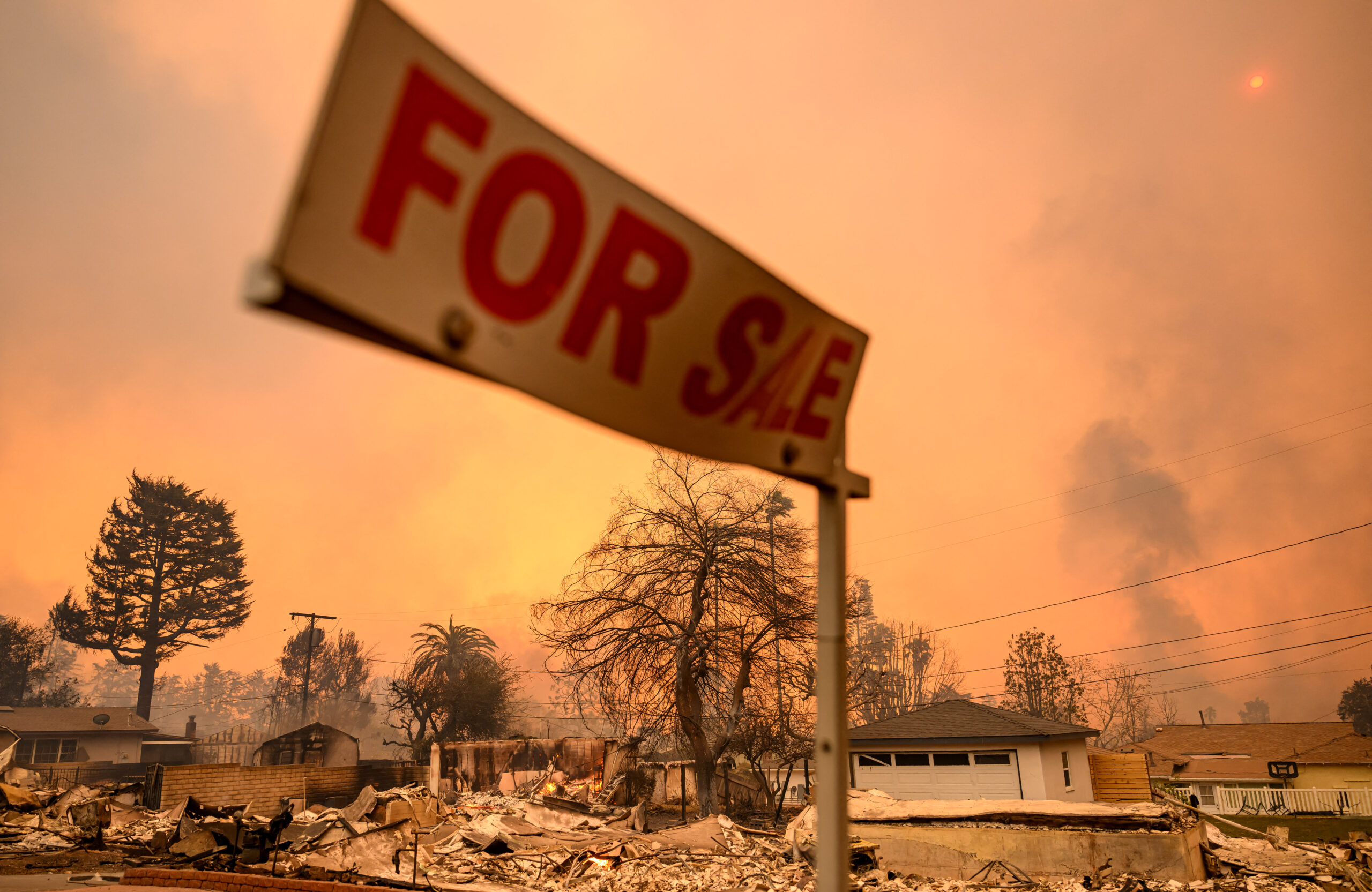
A for sale sign remains as homes smolder during the Eaton fire in the Altadena area of Los Angeles County, California on January 8, 2025.
(Josh Edelson / AFP / Getty Images)
Los Angeles, California—This past Tuesday morning, Altadena and the Pacific Palisades had been reduced to embers, the fires that consumed them were both still raging, a new blaze had spouted in Ventura County, the Santa Ana winds were picking up again—and on the sixth floor of the Stanley Mosk Courthouse in downtown Los Angeles, dozens of people were in the process of losing their homes for entirely unrelated reasons.
A historic set of conflagrations had destroyed thousands of structures and disrupted many aspects of normal life in Los Angeles County, but it had not stopped the quotidian grind of eviction proceedings. A few hearings had been postponed, but by 10 am, just a few days after the apex of the fires, which had forced 100,000 people to flee their neighborhoods, the halls of the sixth floor were full: bailiffs, lawyers in suits yammering into their phones, tenants waiting wearily for their turn before the judge. A little boy in “Lilo & Stitch” pajamas walked back and forth down the hall, hand in hand with his mom. “Welcome to hell,” Rose, an organizer from the LA Tenants’ Union (LATU), greeted me.
I walked into Courtroom 93, where a tall, slender man named Jesse Steven Aguirre explained to the judge what the home he had lived in since birth meant to him and his family. “In 1990, I would have been 6 years old,” he began, speaking so softly it was hard to hear him from the back of the room. “We recently found a picture of me, Jesse Steven Aguirre, and my mother, Miriam Monarrez Reyes, sitting on the stairs in front of the rear house at…Drive, which has been our tenant rental house since—” The judge cut him off to revert to the procedural dispute at hand: whether the family had received a motion that the other side’s lawyer had filed.
Aguirre never got to read the rest of his statement. Outside the courtroom after the hearing, he explained to me that his landlord had begun trying to evict him and his family soon after his grandmother, the original lessee, passed away last March. Glassell Park, a hilly neighborhood in Northeast LA, had been rough when the family first moved in back in 1984. Now it had wine bars and brunch spots, and the family knew their landlord could get more than three times what they were paying in the current market—as long as he got them out first. Aguirre showed me an envelope containing a check for $9,018: the full amount that the family owes in rent. The owner, he told me, had refused to accept payment for months now in order to claim delinquency, a common practice for landlords seeking to be rid of tenants. “He didn’t want our money anymore,” Aguirre’s mother Miriam said. “No explanation, no reason.”
Like most tenants in eviction court, the family lacks an attorney. These are civil proceedings, so tenants have no right to one. Instead, Aguirre was going pro se, armed with only a large binder full of case documents that he’d compiled with the help of the Eviction Defense Network. Lawyers from the organization were perched on a bench near the elevators, conferring with tenants about their cases and trying to prepare them to represent themselves in court. “The suffering is happening every day…but now, it’s affecting a different sector of our society,” one of the lawyers told me. After the fires, she thought, even Angelenos who had never before feared losing their home might “understand what’s going on in the city, and how hard it is to find a place, and how unaffordable and unsustainable it is to stay in Los Angeles.”
The devastation of the Palisades and Eaton fires is hard to fathom: some 10,000 houses gone overnight. The displacement of the people in eviction court might look mundane by comparison. It happens by degrees: with a notice, a missed court appearance, a bunch of paperwork you can’t make sense of, your belongings in a heap on the curb. None of it is particularly dramatic. If you weren’t on the sixth floor of Stanley Mosk, you probably wouldn’t even know it was happening. And yet it happens constantly, year-round, when nobody is paying attention: In Los Angeles, 4,500 to 5,000 formal evictions occur per month, or over 150 every single day. Meanwhile, data from the American Housing Survey shows that for every official dislodgement in LA, there are nearly six “forced moves,” a category that includes both the people uprooted by these fires and the many more tenants who are forced out of their homes with no due process whatsoever.
The relentless, mechanical progression of eviction proceedings isn’t merely a grim irony amid so much sudden and terrifying displacement mere miles away—it’s also a harbinger of LA’s future following this disaster. The wreckage engendered by the wildfires is sure to turbocharge the standard cycle of dispossession: countless residences have been taken off the map, and for many property owners, this sudden spike in demand has presented an enticing opportunity. “A lot of tenants were affected. My supervisor, she lost everything,” Heidi, a LATU organizer, told me. “Now she’s trying to secure [new] housing. But the thing is, the price went up.”
As LA’s new district attorney, Nathan Hochman, holds press conferences to announce charges against looters, hotels and landlords are jacking up their rates. A friend, moving out of her apartment in Culver City this past weekend, asked her landlord if the fires had impinged upon her ability to show the place to prospective tenants. “No! It’s actually been great for us!” the woman replied, beaming.
Fire may be an insurer’s nightmare, but it is a developer’s dream. Though it has received less national press than the leveling of the Palisades, the destruction of Altadena, a thriving, historically Black community in the foothills of the Angeles National Forest, is no less absolute. As families struggle to absorb temporary housing costs alongside ongoing mortgage commitments, developers are already swooping in, seeking to buy up land: a classic case of disaster capitalism that reminded one resident of his grandmother’s displacement during Hurricane Katrina. They will be aided in their quest by Governor Newsom’s near-wholesale repeal of the California Environmental Quality Act for buildings destroyed by the fires.
Meanwhile, expensive homes require a steady input of labor—gardeners, housekeepers, maintenance workers—and the loss of the Palisades means the loss of livelihood for many working people, many of whom commuted to the neighborhood from South or East LA. The fires destroyed businesses, too, leaving their workers bereft and worried about making rent next month.
That same morning, just blocks from the courthouse, LA’s city council and county board of supervisors were in session. Angelenos spoke up and called in, urging both governing bodies to institute an eviction moratorium, establish tenant protections, and enforce laws designed to prevent price gouging during the disaster. Absent these safeguards, more people are likely to miss an initial payment, starting a process that could end with them joining the already ample ranks of LA’s homeless population: another disaster unfolding in slow motion. Unlike the fires that churn through the dry hills of Southern California each year like clockwork, none of this will have been inevitable.