Donald Trump’s Nuclear Delusions
The president wants to resume nuclear testing. Senator Edward Markey asks, “Is he a warmonger or just an idiot?’
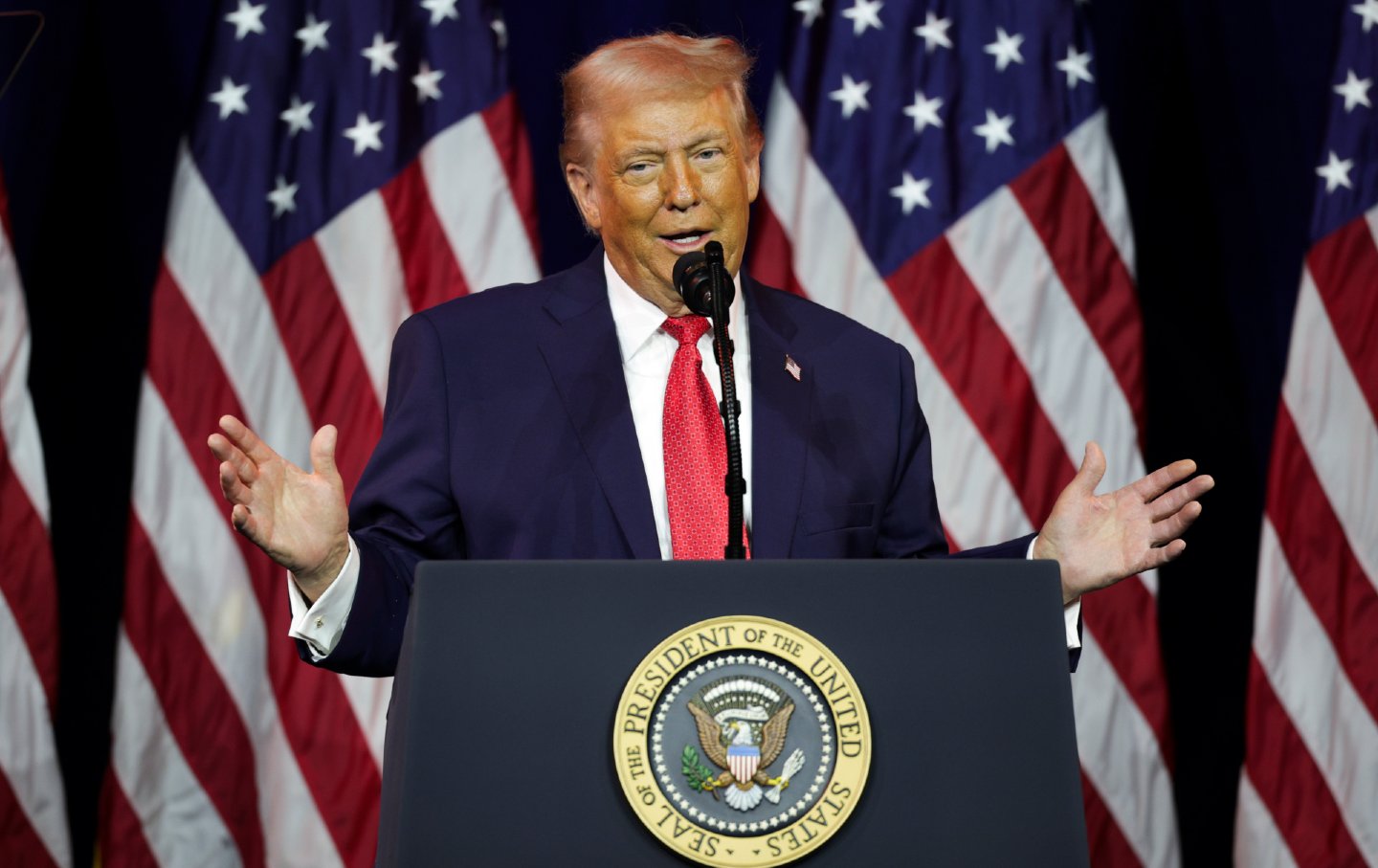
It would be a mistake of radioactive proportions to resume nuclear testing. None of the three major nuclear powers—the United States, Russia, and China—has conducted a nuclear test since 1996, when the Comprehensive Nuclear-Test-Ban Treaty was approved. The CTBT bans all nuclear tests worldwide and has been signed by 187 nations. The only country that has conducted nuclear tests this century is North Korea, which is universally regarded as a rogue state—not exactly the kind of company we should be keeping.
By resuming nuclear testing, the United States would give a major gift to its chief nuclear rivals. China, which has been expanding its nuclear test sites, would welcome the opportunity to conduct tests to develop more sophisticated weapons. Russia would too; President Vladimir Putin announced in November that his country would return to nuclear testing if Washington does.
Instead of deterring foreign nations, renewed testing would be like setting off, well, a nuclear chain reaction, with the US triggering Russia and China to ramp up their own testing, which would then likely trigger other countries to do so as well.
But while Beijing and Moscow may have much to gain from testing their nuclear weapons, the United States does not. The US has already conducted over 1,000 nuclear tests, more than all other nations combined. (By comparison, China has conducted 45 tests). We spend $25 billion each year to sustain the country’s nuclear warheads, including funding the Stockpile Stewardship Program, which maintains the weapons without explosive nuclear testing and includes room-size supercomputers, the world’s most powerful X-ray machine, and a laser system the size of a sports stadium. No other nation possesses such an extensive array of tools for nonnuclear testing.
Trump’s own advisers are confident that our nuclear weapons work—just as they are confident that other countries are not testing their nuclear weapons. Trump’s nominee to run the US Strategic Command, Navy Vice Adm. Richard Correll, told Congress in October, “Neither China nor Russia has conducted a nuclear explosive test.”
In the face of such facts, Trump changed his story. He said that Russia and China are conducting secret nuclear tests and people “just don’t know about it.” According to Trump, “You don’t necessarily know where they’re testing. They test way underground where people don’t know exactly what’s happening with the test.”
What Trump seems to be referring to are very small nuclear tests that are hard to detect and are sometimes referred to as “hydronuclear” tests. If Russia and China are conducting them, it would be in violation of the CTBT. But there is no proof that this is happening. Moreover, even if it were, renewed US nuclear testing would still not be justified. Even small US tests would give Russia and China the green light to conduct many large nuclear tests that would be much more useful. A better approach for the United States would be to seek greater transparency of global test sites.
It appears that Trump’s utter confusion—not any need to resume nuclear testing—is the root cause of this entire kerfuffle. Russia recently tested two new missiles—the Poseidon and the Skyfall—that Putin has said can evade US missile defenses. Crucially, however, there were no nuclear warheads—the part that goes “boom”—on these missiles. Trump is apparently mixing up the testing of missiles and the testing of nuclear bombs.
Such errors are harmful enough, but Trump has added to the danger by upping the ante in other ways. He continues to insist that he will build his space-based Golden Dome missile-defense system, which would cost more than $3 trillion. Yet scientists say that such missile-defense systems, like Reagan’s “Star Wars” boondoggle (or the scenario depicted in Kathryn Bigelow’s recent film A House of Dynamite), will not work. Instead of Golden Dome, it should be called Golden Sieve—it will cost a lot of money, and it will not be effective. And, once again, instead of reducing tensions, Trump is increasing them: Nations will respond to US long-range-missile defenses by building more offensive missiles.
If Trump actually wants to reduce the risk of nuclear war, as he claims, he should not build the Golden Dome. Instead, he should reach for the Golden Phone. He should talk to Putin and accept his invitation to stick with the New START treaty—the last US-Russian agreement to reduce nuclear weapons—which is set to expire in February 2026. Putin has proposed a one-year extension; the United States has yet to respond.
Is Trump a warmonger or just an idiot? Is he hell-bent on starting a new nuclear arms race, or is he simply confused about the difference between a nuclear bomb test and a missile test? As horrific as it sounds, Trump may be on the verge of undermining US and global security—just so he doesn’t have to admit that he was wrong.