
Amazon’s Prime Sweatshop Is Nothing to Celebrate
While chairman Jeff Bezos enjoys his honeymoon, Amazon workers are in line for record injuries and hospitalizations over the four-day summer sale.
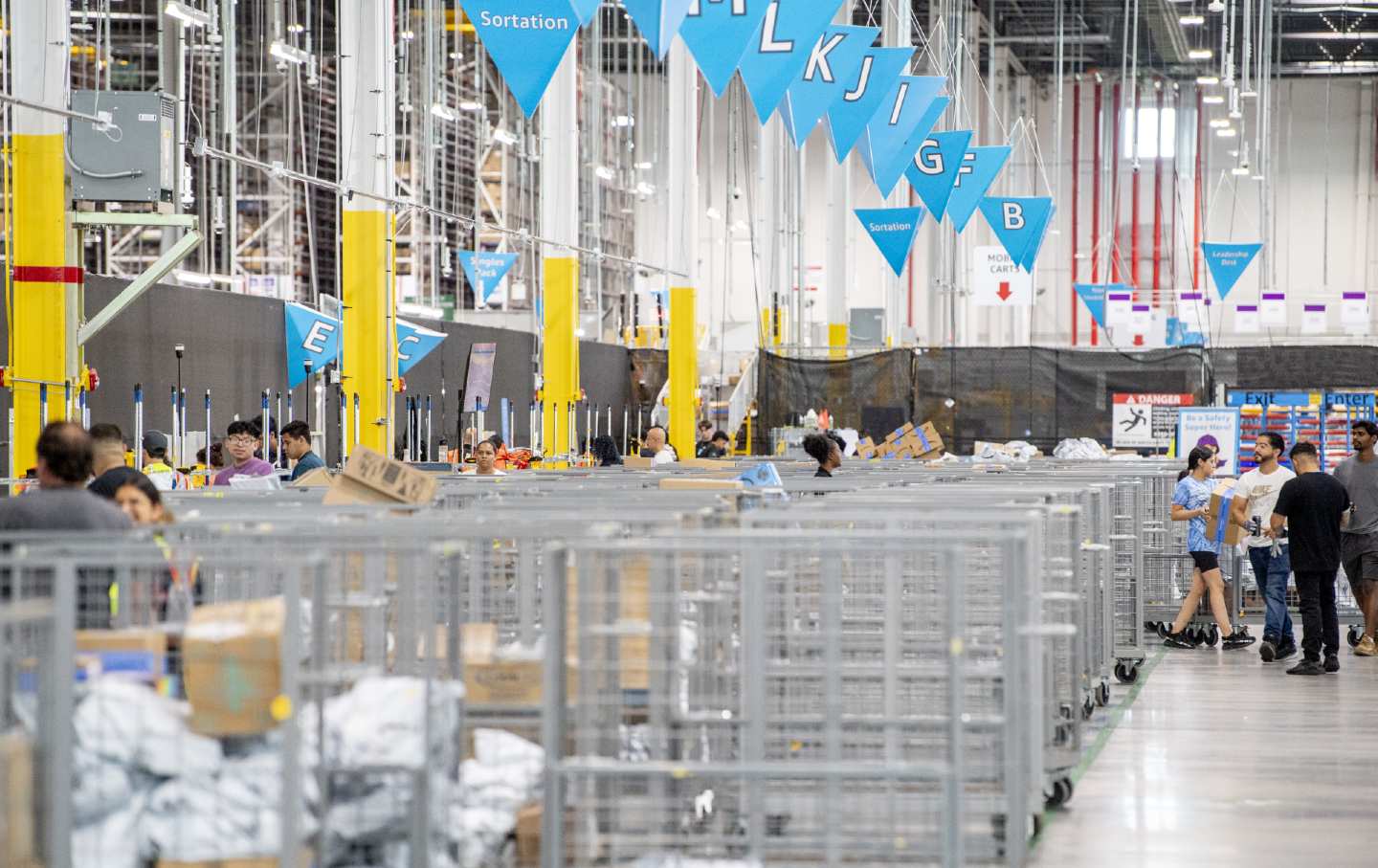
Amazon’s July Prime Days are here—that annual super-hyped, sale-on-steroids that delivers scads of exciting deals to customers and soaring revenues to the corporate executives.
Prime Days offer a bit less euphoria to the 1.5 million workers inside Amazon’s US warehouses, air cargo stations, and delivery vehicles, who endure grueling, extra-long workdays, heat exhaustion, and an alarming spike in injuries and hospitalizations.
Prime Day is a decade-old artifice of the company, designed to attract new Prime subscribers and plump revenue at a time of year when sales typically sag.
From a business perspective, it’s been a stunning success. Today, 180 million Americans are Amazon Prime subscribers. Last year, the company recorded $14.2 billion in revenue during its two-day Prime Day sale in July, fully four times its revenue for an average two-day period.
Amazon can’t, of course, quadruple output without burdening the workers who pick, sort, package, and deliver the goods. “It’s not uncommon for there to be a parade of ambulances leaving JFK8, especially during Prime week and peak season, when safety just goes out the window,” Tristian Martinez, a six-year veteran at the company’s Staten Island warehouse and a member of Amazon Labor Union Local 1 of the Teamsters, told me. “They just push and push you.”
In the days before, during, and after Prime Day—as well as during the Thanksgiving-to-Christmas peak season—Amazon institutes its notorious Mandatory Extra Time (MET) schedule. For warehouse workers that means an hour or more tacked on to their shifts every day—already 10 hours long for most—plus an extra day of work every week. For delivery drivers, there’s overtime and package load increases. The hellacious schedule wrecks family and leisure time for workers during the sale, but it also leaves a more lasting mark on many.
Serious injuries at Amazon warehouses skyrocketed during last year’s Prime Day event, shooting up 35 percent week over week, according to the Strategic Organizing Center, a union group that drew its data from the federal Occupational Safety and Health Administration. That comes on top of an injury rate that is already 66 percent higher than non-Amazon warehouses, according to the SOC. Bad as those figures are for Amazon workers, it’s likely a vast undercount: In 2022, federal workplace safety investigators fined Amazon for systematically misclassifying and even outright failing to record injuries and illnesses.
This year, Prime Day promises to be even more grueling. The company has doubled the length to four days, July 8 through 11. Workers are not looking forward to this.
Two weeks ago during a New York City heat wave, Michael Lebron measured a temperature of 95 degrees Fahrenheit at his night-shift workstation in JFK8. He recorded a TikTok video: “This is ridiculous. I haven’t received no water yet. They just told me to go to work.”
Lebron didn’t make it through his shift. Reporting chest pains mid-shift, he was sent to Amcare, the company’s on-site health clinic. “They gave me Tylenol and said to go back to work,” he told me. “That’s how Amazon does it. They really don’t care about our health.” Lebron demanded an ambulance and was transported to a nearby hospital where—thankfully—his chest pains were diagnosed as pulled muscles, not a heart attack.
Amazon provides fans at workstations, but “when it’s hot, it’s really just blowing hot air at you,” Antonie Sparrow, another union member at JFK8, told me. Heat exhaustion and heatstroke are common. “I see a lot of influx of people in and out of Amcare.”
Adrian Easterling passed out recently in JFK8’s stow department. “I ended up getting heatstroke even though I was properly hydrating,” he told me. “I told another worker, ‘I don’t feel good,’ and the next thing I remember I was in Amcare.” An ambulance transported him to the hospital, where he got fluids and cooling treatment.
Many of the Staten Island workers have long commutes—as much as two or three hours each way. “During MET, literally you go home, shut your eyes, then go and do it all again,” Sparrow said.
The problem is systemic throughout Amazon’s 1,000-plus warehouses, air cargo centers, and delivery stations.
“During Prime, they load the planes more” because of the higher package volumes, said Allen (not his real name), an Amazon ramp worker in Fort Worth, Texas. “They always say we don’t want you to rush, but the managers will be out there telling everyone to hurry up and squeeze all of the packages into the [plane’s] belly,” he told me, adding that managers get a bonus when all the planes go out on time.
“Amazon likes to say it’s all about safety, but we all know it comes second to productivity,” Rebecca (not her real name either), a Sacramento warehouse worker, told me.
Amazon delivery drivers are also subjected to brutal working conditions. The drivers technically are employed by a host of contractors—“delivery service partners” (DSPs)—but Amazon dictates and monitors the drivers’ work rates and package loads. Drivers are hard-pressed to get any break during their 10-hour delivery shifts, and many resort to peeing in bottles in their vans.
Popular
“swipe left below to view more authors”Swipe →Drivers on chat channels like Reddit note that it gets worse during Prime week, when package loads go up and there’s a spike in muscle injuries, extreme fatigue, and traffic accidents. Management at most DSPs are unsupportive. A Colorado delivery driver told me about a coworker who fainted while delivering in 95-degree heat. “The DSP responded by cutting his hours. When he expressed frustration at this treatment in the company group chat, management immediately deleted all the messages and removed him from the chat,” the driver told me.
In a few places, Amazon workers are organizing, fighting back, and winning some improvements. At the KSBD air cargo hub in San Bernardino, California, workers staged direct actions and won heat breaks, cold water, and cooling stations. At the KCVG air cargo center in Kentucky, workers refused to work on the ramp until the company provided vans with functioning air conditioning. (Shamefully, Amazon then fired the union activist who led the action.) In Garner, North Carolina, where RDU1 warehouse workers have been agitating for heat safety after a series of worker hospitalizations earlier this year, Amazon has begun installing more fans and overhauling the building’s ventilation system. “This is a big win—this was a result of our advocacy,” said Ras Amon, an RDU1 worker and member of the independent union Carolina Amazonians United for Solidarity and Empowerment.
But overall, the pace of organizing at Amazon doesn’t come close to matching the urgency on the shop floor. Last December the Teamsters union led minority strikes at eight Amazon warehouses, but has since maintained a low national organizing profile. Over the past months, quite a few workers around the country have expressed bewilderment to me about why there hasn’t been more aggressive campaigning from the Teamsters.
There certainly is a big union difference to highlight. Teamsters at UPS also are battling for heat safety, but thanks to their union contract, management must provide water and ice to drivers and two fans in every van. UPS Teamsters have the right to take extra breaks if they are experiencing heat stress.
An informal national network of Amazon workers, which I have been supporting through my work at the Center for Work and Democracy, is encouraging workers to go to Amazonworkers.org to contribute their stories of unsafe heat. ALU Local 1 members have developed a Safety Bill of Rights and are circulating it nationally for Amazon workers and supporters to sign, as they continue to battle for union recognition at JFK8—three years after winning their federal representation election.
As for dealing with this week’s Prime sweatshop, JFK8’s Easterling urges fellow Amazon workers enduring extreme heat and overwork to organize their coworkers and “to not be scared. To fight back. This may be normal, but it’s not OK.”
Become a Sustaining Donor This September
Between the reemergence of right-wing red-baiting and Donald Trump’s use of the chilling National Security Presidential Memorandum–7 to criminalize left political organizing, we’re seeing McCarthyism reborn before our eyes.
This assault on democracy cannot be ignored or wished away. Resisting it requires bravery in the face of threats and repression, a steadfast commitment to the truth, and the unwavering belief that we can—and will—overcome this darkness.
We must have an independent media that sets the record straight, unearths corruption and abuses of power, and advances a politics of justice and dignity for all if we’re to win this fight.
That’s why I’m writing to you today. This September, The Nation needs to add 100 monthly donors to sustain our progressive journalism. Your contribution makes the next investigative report, the next truth-speaking column, and the next pathbreaking essay all possible.
I hope you’ll support our work with a recurring donation today. If you donate $10 or more a month, we’ll send you a brand new “Hands Off the Free Press!” sticker to recognise your commitment to our cause. Please, donate today.
Onward,
Katrina vanden Heuvel
Editor and Publisher, The Nation
More from The Nation
What’s the Matter With Effective Altruism? What’s the Matter With Effective Altruism?
President Trump has decried the techbro creed for indulging in AI doomerism, but its excesses are far worse than that.
As Morale Sags, More Military Service Members Are Having a Crisis of Conscience As Morale Sags, More Military Service Members Are Having a Crisis of Conscience
According to multiple GI rights organizations, service members are inquiring in unprecedented numbers about seeking conscientious objector status.
What Remains of Riis? What Remains of Riis?
A new members’ club has revived Riis Park’s long-vacant bathhouse, reopening old questions about whom the People’s Beach is really for.

When Texas Sex Ed Falls Short, Gen Z Women Turn to Social Media When Texas Sex Ed Falls Short, Gen Z Women Turn to Social Media
A 2025 study found that 70 percent of adolescents sought reproductive health information through social media platforms.

Justice for Macklemore Justice for Macklemore
The rapper has been dumped from Ed Sheeran’s tour for saying “free Palestine.” That’s a disgrace.
We Are Living Under Roy Cohnian Logic We Are Living Under Roy Cohnian Logic
The political fixer created a career for himself as a self-promoting, ubiquitous hustler. Like Trump, he got away with it by having the right friends.

