Healthcare Workers Must Continue Alex Pretti’s Fight
Pretti was one of us. We have to carry on his struggle.
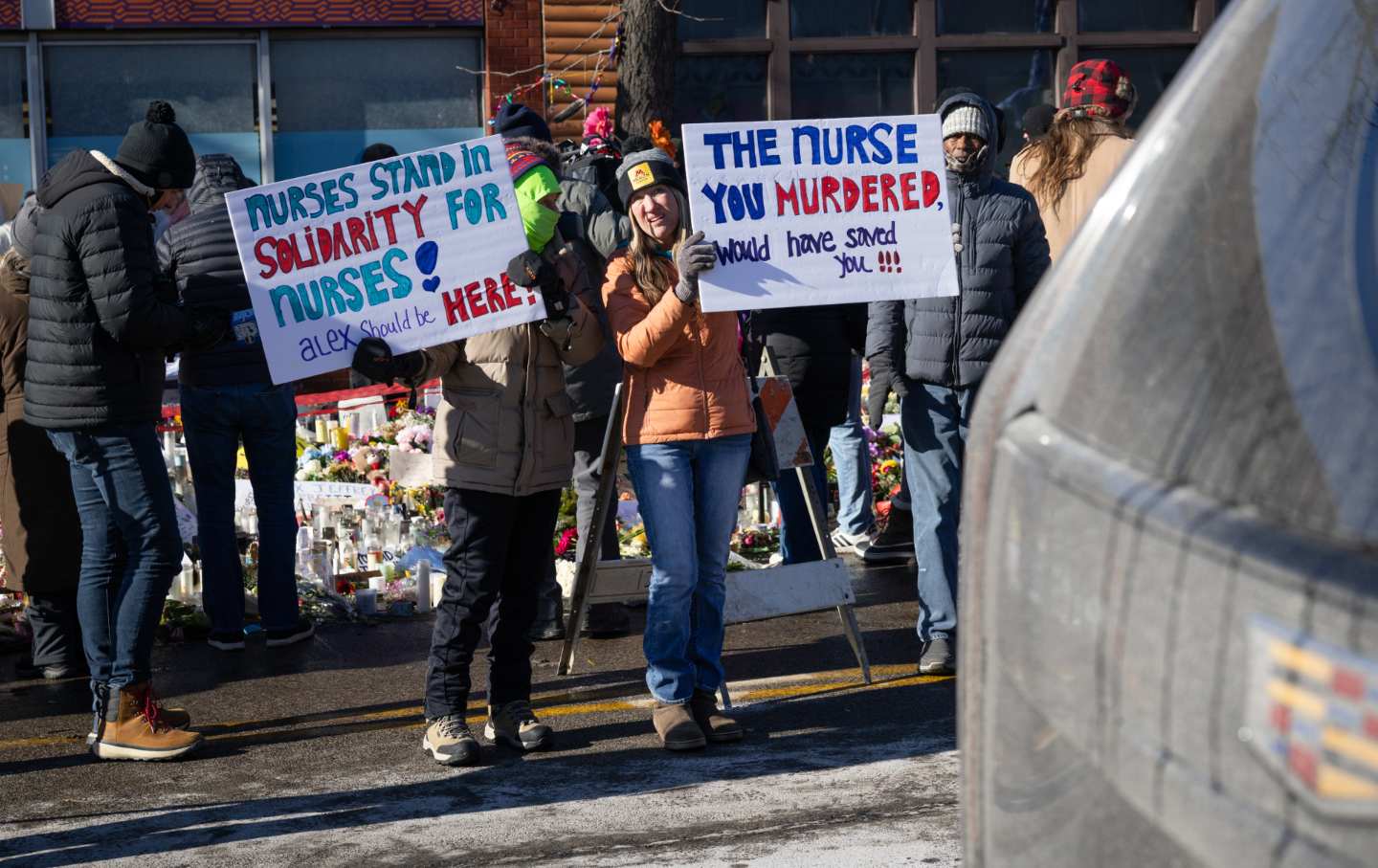
Protesters at a memorial to Alex Pretti on January 27, 2026, in Minneapolis.
(Scott Olson / Getty Images)In 1964, a military coup overthrew the democratically elected government of Brazil and plunged the country into more than 20 years of dictatorship. One might ask why an epidemiologist like me would be interested in Latin American history at this moment. What drew me to that era was the key role that clinicians and public health workers played in the resistance against the dictatorship; their simultaneous push for a national healthcare program; and the ways in which this sector organized, even as more conservative physicians sided with the putschists, happy to see their more progressive colleagues jailed and persecuted.
I’m not making one-to-one comparisons between our current predicament and what happened in Brazil years ago. But the insights of that time ring true generations later. Brazil’s medical rebels thought healthcare was a human right. They wanted it to benefit the public good, not private greed. And they saw themselves as equal to workers rather than as their social betters. That history also reminds us that authoritarianism, which Americans since the Red Scares of the 20th century have been told comes from the left, finds an easy alliance with the rich and privileged.
Which brings us to Minneapolis and the United States in 2026. The killing of ICU nurse Alex Pretti last weekend sent shock waves across this country, but it fell especially hard on people who work in health. The National Nurses United union spoke out directly on an assault on one of their own, but the grief was shared by everyone who knows the clinicians at our local VA hospitals or works on infectious disease research. For all of us, the murder of Alex Pretti has cut close to home.
There are plenty of clinicians and public health professionals who, like Pretti, have been appalled by what is happening in this country and to our communities. But there are still others who, whether because of their class or their ideology, either see themselves above the fray or have allied themselves with the current administration. Then there are the reactionary centrists in the field, more concerned with academic hippie-punching and attacking the supposed excesses of the progressive movement in public health than they are with fighting fascism.
The political economy of healthcare and public health in America is deeply tied up with the oligarchy of wealth. The authoritarian violence happening now is occurring in conjunction with a totalizing project from the far right and its corporate allies that, among other things, seeks to destroy public health and healthcare in the US and leave the carcass of what is left to the private sector to devour.
Despite what the “can’t we all just get along” caucus tells us, merely pleading for an end to polarization won’t turn the tide here. We have to organize directly against the entrenched interests that have brought this country to the brink. This means, as Adrienne Maree has said, “Do we all share the same worldview?” isn’t the question we need to be posing now; we rather need to ask,“Is your heart beating and do you plan to live? Then come this way and we will figure out the rest on the other side.”
The fight for health for all, for clinical care as a public good, and for public health as a necessity is tied up with the struggle against authoritarianism in 2026. At this point, the threat is existential, and the coalition we need to build can include everyone who is not part of this administration’s techno-death cult. And this coalition is growing every day.
For all the sorrow and horror over what is happening in Minneapolis, the people there are an example to the rest of us. They are organizing to defend their city, but more importantly to care for each other. They are the antithesis of the rapacious violence that President Trump has brought down on them—an example of another kind of social organization built on solidarity and community rather than extraction and exploitation, the grift that this president personifies.
What is happening in Minneapolis is partly spontaneous, but also deeply rooted in the expertise of activists there. Organizing is a practice, a way of life; it can be taught. Two weeks ago, I was at a gathering in Orlando, Florida, which was organized by the Emergency Campaign to Support Higher Education. The meeting was a training on the basics of community organizing with over 300 people, mostly students, in attendance from all around the country. For two days, we went through the basics of understanding and using power and public narrative, identifying issues that inspire, building a mass movement, mapping power, and developing campaigns. These kinds of trainings can be done all over the US—there are groups in every state that have the experience and expertise to take you through these fundamentals. Find them. Organize local trainings. Get skilled up. Learn the tools. Put them to use.
This leads us back to Brazil. Like the Brazilian doctors, who joined the labor movement and helped topple their dictatorship, we can build power by organizing and linking together with others, so that the chance to divide and conquer us, by stoking class and professional divisions, simply fails. This isn’t about just showing up to rallies and marches, signing petitions and sending letters—it’s creating powerful movements locally that can hold politicians and other decision-makers to account, to shape the future ourselves on an ongoing basis. Look to Brazil. Look to Alex Pretti. History shows us it can be done.