Alabama Won’t Say Alireza Doroudi’s Name. We Must.
The Iranian PhD student is one of several abducted by ICE in the past month—a pattern we cannot become numb to.
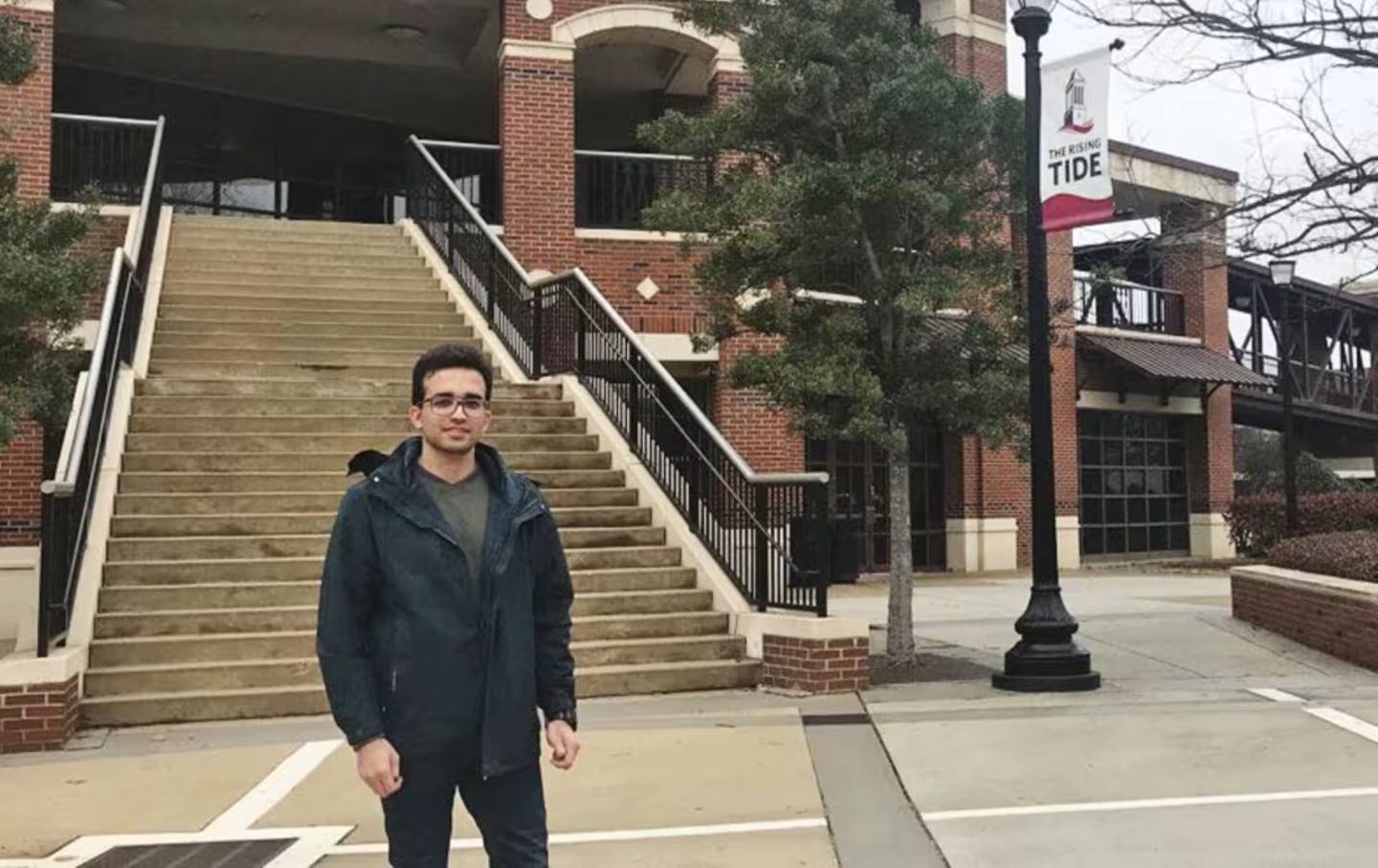
Alireza Doroudi on the University of Alabama’s campus.
(Facebook)Earlier this week, University of Alabama PhD student and Iranian citizen Alireza Doroudi was abducted from his home at 5 am and disappeared by the US Government. As of March 28, Doroudi was moved by ICE to a jail in Jena, Louisiana. Initially, it was unclear where he had been taken; three days later, he has still not been charged with a crime.
Doroudi’s attorney, David Rozas, told the AP: “In the words of his fiancé, he is a nerd. All he does is study and is literally trying to fulfill his dream, the American dream, of becoming a researcher and professor of mechanical engineering.” Rozas also said that Doroudi had “not been arrested for any crime, nor has he participated in any anti-government protests.”
So far, there is no evidence that Doroudi wrote or said anything about Israel’s genocidal war on the people of Gaza—the Trump administration’s unconstitutional, altogether illegal pretense for going after international student visas over the past month. Doroudi’s arrest is yet more evidence that their entire “antisemitic administration against antisemitism” battle plan is something they can take or leave as a pretense for kidnapping international students and shredding due process. So far, all the Department of Homeland Security has said about the arrest is that he “posed significant national security concerns,” without giving details.
Was it a random abduction because Doroudi is an Iranian citizen and any pretense to provoke Iran into war is part of this administration’s agenda? Is Netanyahu, in his clamoring for attacks on Iran, unilaterally rewriting, or at minimum inspiring, how we now do policing in this country? Were the years of “pacification” training US police chiefs and officers received in Israel just seeding the ground for this moment? Did DHS assume that if it singled out someone at the University of Alabama, neither the community nor the school’s administration would be up in arms? Is there an irony in a school so dependent on Black football players for its notoriety and largesse not intervening in what might be a purely racist targeting? I’m just asking questions.
It’s hard not to focus on the “American dream” part of Doroudi’s lawyer’s plea. Instead of streets paved with gold, he ends up in indefinite detention. This is exactly what would have happened to Marco Rubio’s grandfather when he fled Fulgencio Batista’s right-wing, authoritarian dictatorship in Cuba in the 1950s. I guess when his gramps told horror stories of Batista’s secret prisons where people were tortured, baby Marco was taking notes. Grandpa Rubio remained in the United States illegally before going back to Cuba to help Castro, then returned to the US on a “vacation” only to be detained as an undocumented immigrant. He was set to be deported, but instead he stayed for years, ultimately applying for a “retroactive refugee” status. While this much-parroted story has never quite sounded true, we do know that Marco’s grandpa did not end up in an El Salvadoran labor camp.
As for Marco, he was 4 years old before his own parents became naturalized citizens. If Musk/Trump gets away with ending birthright citizenship and then Little Marco accidentally sideswipes a Tesla, he might find himself up close and personal with one of the aforementioned El Salvadoran concentration camps. Here’s hoping he doesn’t have any tattoos in support of autism awareness or he could be in extra trouble.
Little Marco’s sole talent is a willingness to be bluntly cruel to the weak while bowing and scraping for the strong. Little Marco, for all his grasping ambition, is a very dull blade and that serves him well. Shamelessness is Washington, DC’s new superpower.
As for Alireza Doroudi, Tommy Tuberville—failed Auburn football coach and semi-sentient senator from Alabama—is the only member of Alabama’s statehouse to comment on Doroudi’s abduction, with something so casually idiotic that I won’t quote it directly. Tuberville says he proudly knows nothing about the case but is convinced that Doroudi must be guilty of something.
As we’ve long known, Tuberville was a better football coach than he is a human being, and that ain’t great. The Florida-based Alabama senator can get away with the blithe dehumanizing of Doroudi Doroudi because, unlike the other disappeared, Doroudi has next to no grassroots base of people agitating for his release. He wasn’t part of any movements. No state politicians are saying his name. The students at the University of Alabama are not in the streets by the thousands, as we have seen in the cases of Columbia University’s Mahmoud Khalil or Tufts University Fulbright Scholar Rumeysa Ozaturk. According to one report, many are shocked and angry that these abductions taking place at elite northern colleges have come to roost in their backyard. As Bryanna Taylor, a UA student, said, “It could be anyone in our classes who we may not see anymore because they’re going to get taken away.”
To prevent that—to stop Rubio from making good on his threat to do this to the “hundreds” of student visas he claims to have revoked—we need to say the names of the disappeared, and say them loudly. This is especially the case with Doroudi, who clearly needs every bit of amplification and attention he can get. Or we can look away—and become further numbed by what is getting normalized in our names.
Become a Sustaining Donor This September
Between the reemergence of right-wing red-baiting and Donald Trump’s use of the chilling National Security Presidential Memorandum–7 to criminalize left political organizing, we’re seeing McCarthyism reborn before our eyes.
This assault on democracy cannot be ignored or wished away. Resisting it requires bravery in the face of threats and repression, a steadfast commitment to the truth, and the unwavering belief that we can—and will—overcome this darkness.
We must have an independent media that sets the record straight, unearths corruption and abuses of power, and advances a politics of justice and dignity for all if we’re to win this fight.
That’s why I’m writing to you today. This September, The Nation needs to add 100 monthly donors to sustain our progressive journalism. Your contribution makes the next investigative report, the next truth-speaking column, and the next pathbreaking essay all possible.
I hope you’ll support our work with a recurring donation today. If you donate $10 or more a month, we’ll send you a brand new “Hands Off the Free Press!” sticker to recognise your commitment to our cause. Please, donate today.
Onward,
Katrina vanden Heuvel
Editor and Publisher, The Nation